Department of Biological Sciences, The Center for Biomedical Studies, The University of Texas at Brownsville, 80 Fort Brown, Brownsville, TX 78520, USA.
Neurosci Res. 2011 Aug;70(4):361-9. doi: 10.1016/j.neures.2011.05.011. Epub 2011 May 20.
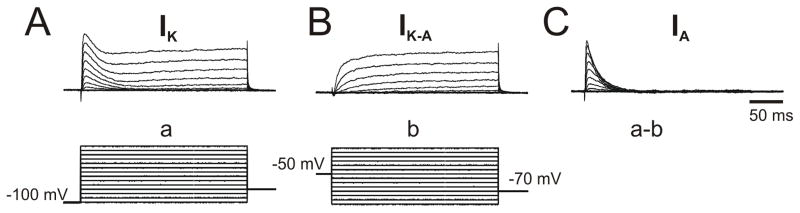
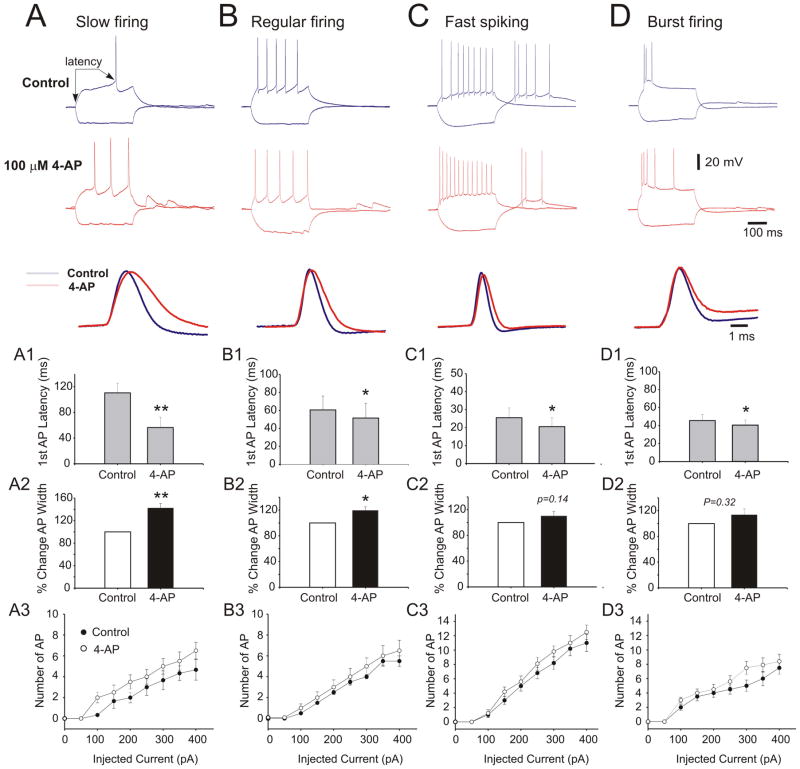
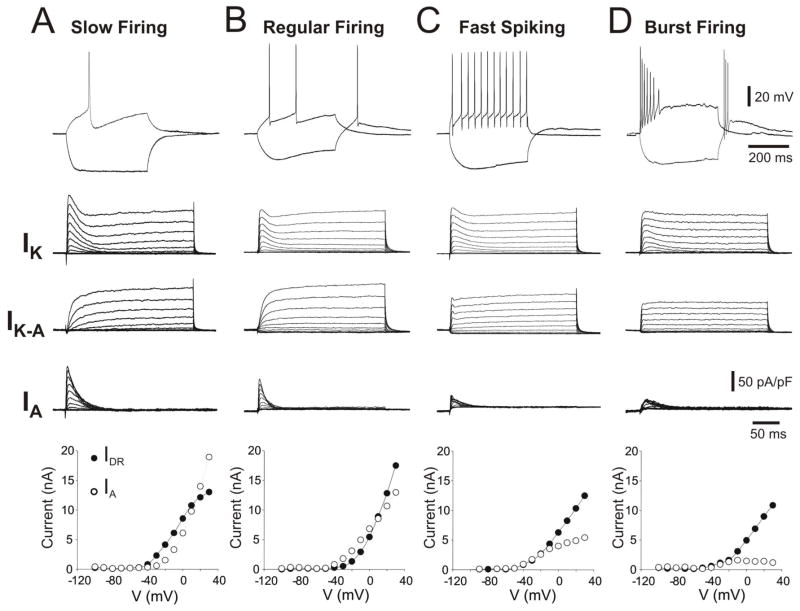
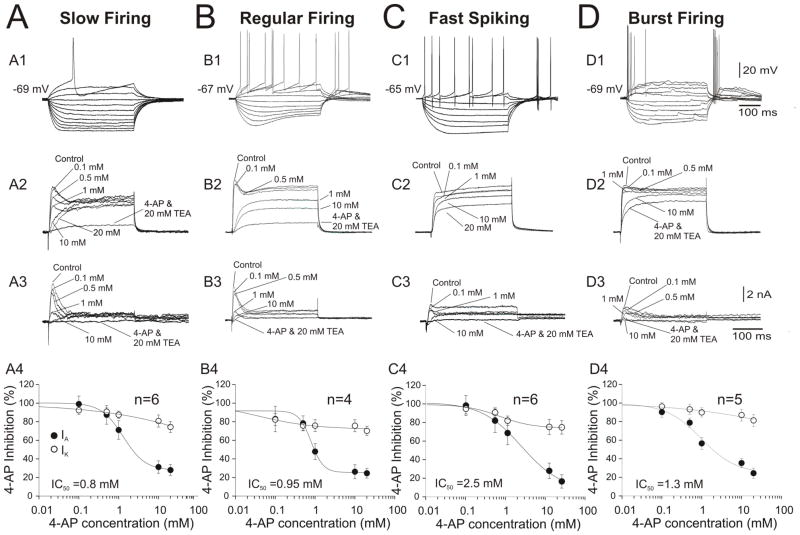
The medial septum/diagonal band complex (MSDB) controls hippocampal excitability, rhythms and plastic processes. Medial septal neuronal populations display heterogeneous firing patterns. In addition, some of these populations degenerate during age-related disorders (e.g. cholinergic neurons). Thus, it is particularly important to examine the intrinsic properties of theses neurons in order to create new agents that effectively modulate hippocampal excitability and enhance memory processes. Here, we have examined the properties of voltage-gated, K(+) currents in electrophysiologically-identified neurons. These neurons were taken from young rat brain slices containing the MS/DB complex. Whole-cell, patch recordings of outward currents were obtained from slow firing, fast-spiking, regular-firing and burst-firing neurons. Slow firing neurons showed depolarization-activated K(+) current peaks and densities larger than in other neuronal subtypes. Slow firing total current exhibited an inactivating A-type current component that activates at subthreshold depolarization and was reliably blocked by high concentrations of 4-AP. In addition, slow firing neurons expressed a low-threshold delayed rectifier K(+) current component with slow inactivation and intermediate sensitivity to tetraethylammonium. Fast-spiking neurons exhibited the smaller I(K) and I(A) current densities. Burst and regular firing neurons displayed an intermediate firing phenotype with I(K) and I(A) current densities that were larger than the ones observed in fast-spiking neurons but smaller than the ones observed in slow-firing neurons. In addition, the prevalence of each current differed among electrophysiological groups with slow firing and regular firing neurons expressing mostly I(A) and fast spiking and bursting neurons exhibiting mostly delayer rectifier K(+) currents with only minimal contributions of the I(A). The pharmacological or genetic modulations of these currents constitute an important target for the treatment of age-related disorders.
中隔/斜角带复合体(MSDB)控制海马兴奋性、节律和可塑性过程。中隔神经元群体表现出异质的放电模式。此外,一些这些群体在与年龄相关的疾病中退化(例如胆碱能神经元)。因此,特别重要的是检查这些神经元的内在特性,以便创造新的有效调节海马兴奋性和增强记忆过程的药物。在这里,我们检查了电生理鉴定的神经元中电压门控、K(+)电流的特性。这些神经元取自含有 MS/DB 复合体的年轻大鼠脑片。从慢放电、快放电、规则放电和爆发放电神经元中获得外向电流的全细胞、膜片钳记录。慢放电神经元表现出比其他神经元亚型更大的去极化激活 K(+)电流峰值和密度。慢放电总电流表现出激活阈下去极化的失活 A 型电流成分,并且可被高浓度 4-AP 可靠阻断。此外,慢放电神经元表达具有慢失活和中等对四乙铵敏感性的低阈值延迟整流 K(+)电流成分。快放电神经元表现出较小的 I(K)和 I(A)电流密度。爆发和规则放电神经元表现出中间放电表型,其 I(K)和 I(A)电流密度大于快放电神经元,但小于慢放电神经元。此外,在电生理组中,每种电流的流行程度不同,慢放电和规则放电神经元主要表达 I(A),而快放电和爆发放电神经元主要表达延迟整流 K(+)电流,只有最小的 I(A)贡献。这些电流的药理学或遗传调节是治疗与年龄相关疾病的重要目标。