Department of Psychiatry and Behavioral Sciences, Northwestern University Feinberg School of Medicine, Chicago, IL, USA.
Neuroscience. 2011 Aug 25;189:215-22. doi: 10.1016/j.neuroscience.2011.05.017. Epub 2011 May 26.
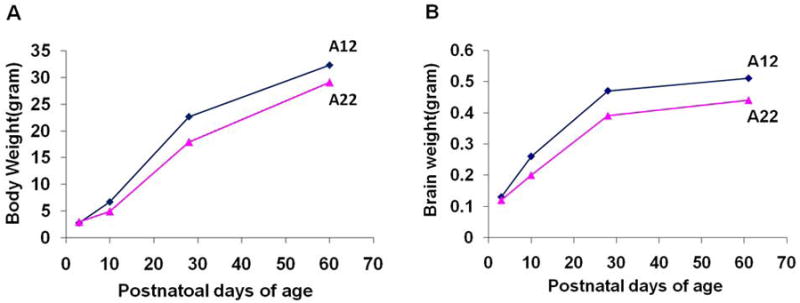
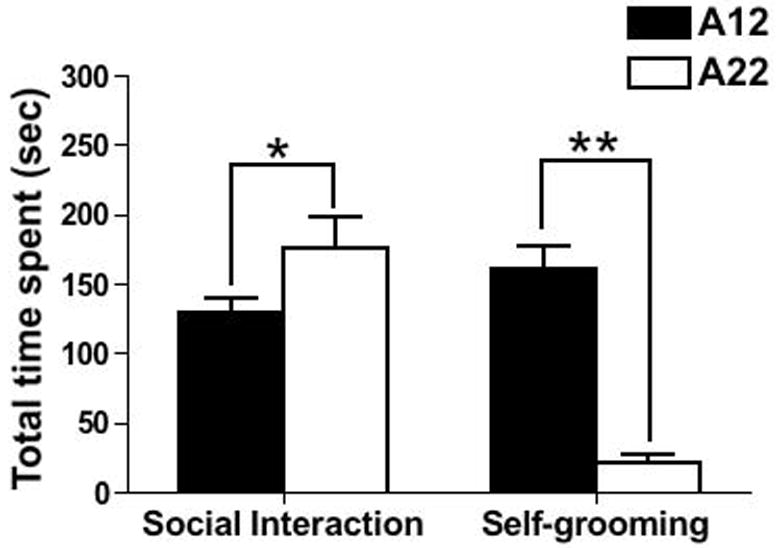
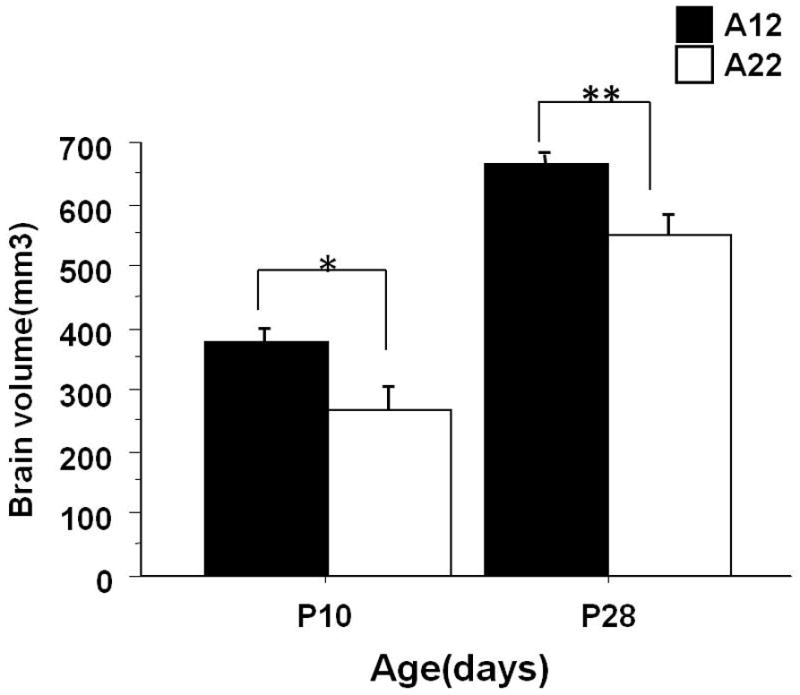
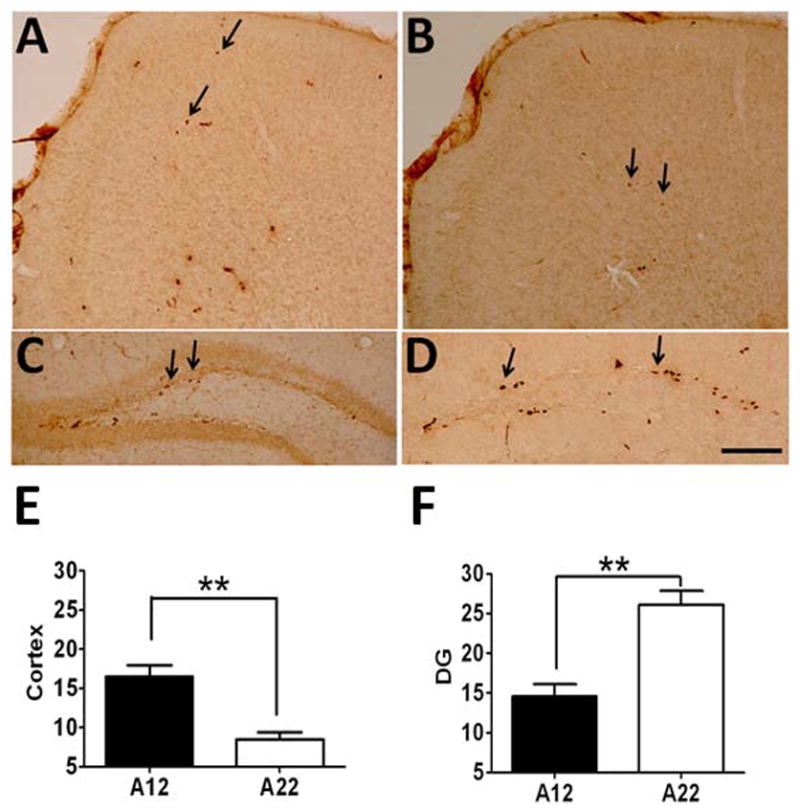
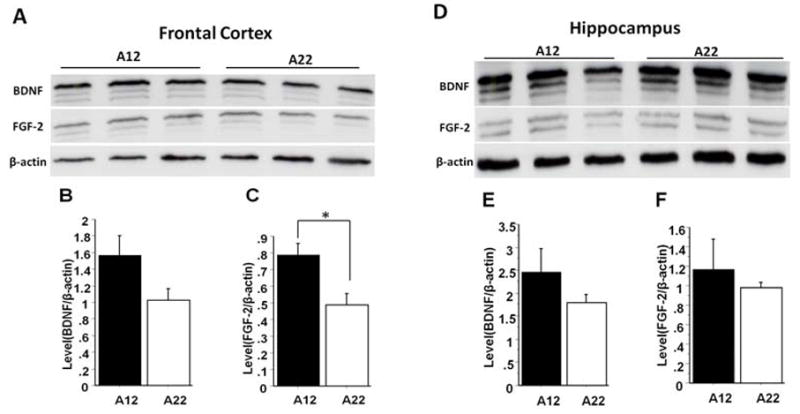
The pathogenesis of neurodevelopmental disorders such as autism is believed to be influenced by interactions between genetic and environmental factors, and appropriate animal models are needed to assess the influence of such factors on relevant neurodevelopmental phenotypes. A set of inbred mouse strains (Atchley strains) including A12 (E+L0) and A22 (E-L0) were generated by age-specific restricted index selection from a baseline random-bred ICR mouse population obtained from Harlan Sprague-Dawley [Atchley et al. (1997) Genetics 146(2):629-640; Indianapolis, IN, USA). As compared with the A22 strain, A12 mice had significantly increased early (P0-P10) body weight gain with minimal changes in late (P28-P56) body weight gain. We found that these strains also differed in brain weight, brain volume, cell proliferation, and FGF-2 levels in certain brain regions. Specifically, brain weight and volume were significantly greater in A12 mice than that in A22 mice at P10 and P28. Quantitative analysis of bromodeoxyuridine (BrdU) labeling of proliferating cells showed that the number of BrdU-positive cells in the A12 strain were significantly greater in the frontal cortex and lesser in the dentate gyrus than that in the A22 strain at P28. Western blot revealed that fibroblast growth factors-2 (FGF-2), but not brain-derived neurotrophic factor (BDNF), expression was significantly increased in the frontal cortex of A12 strain at P28. Also, A12 mice exhibited decreased intra-strain social interaction and increased repetitive stereotyped behaviors at P28. Our study suggests that A12 mice may partially mimic the anatomic and behavioral traits of patients with neurodevelopmental disorders such as autism spectrum disorders, and therefore may yield insights into the developmental mechanisms involved in their pathogenesis.
神经发育障碍(如自闭症)的发病机制被认为受到遗传和环境因素相互作用的影响,因此需要合适的动物模型来评估这些因素对相关神经发育表型的影响。一组近交系小鼠(Atchley 品系)包括 A12(E+L0)和 A22(E-L0),是通过对来自哈兰斯普雷格道利(Harlan Sprague-Dawley)的基础随机杂交 ICR 小鼠群体进行特定年龄的限制指数选择而产生的[Atchley 等人,(1997)遗传学 146(2):629-640;印第安纳州印第安纳波利斯]。与 A22 品系相比,A12 小鼠在早期(P0-P10)体重增加明显,而晚期(P28-P56)体重增加变化较小。我们发现这些品系在脑重、脑体积、细胞增殖和特定脑区的 FGF-2 水平上也存在差异。具体而言,在 P10 和 P28 时,A12 小鼠的脑重和脑体积明显大于 A22 小鼠。增殖细胞的溴脱氧尿苷(BrdU)标记的定量分析显示,在 P28 时,A12 品系的额皮质中 BrdU 阳性细胞数量明显多于 A22 品系,而齿状回中 BrdU 阳性细胞数量则明显少于 A22 品系。Western blot 显示,在 P28 时,A12 品系的额皮质中纤维母细胞生长因子-2(FGF-2),而不是脑源性神经营养因子(BDNF),表达明显增加。此外,A12 小鼠在 P28 时表现出内源性社交互动减少和重复性刻板行为增加。我们的研究表明,A12 小鼠可能部分模拟了自闭症谱系障碍等神经发育障碍患者的解剖和行为特征,因此可能深入了解其发病机制中的发育机制。