• 文献检索
  • 文档翻译
  • 深度研究
  • 学术资讯
  • Suppr Zotero 插件Zotero 插件
  • 邀请有礼
  • 套餐&价格
  • 历史记录
应用&插件
Suppr Zotero 插件Zotero 插件浏览器插件Mac 客户端Windows 客户端微信小程序
定价
高级版会员购买积分包购买API积分包
服务
文献检索文档翻译深度研究API 文档MCP 服务
关于我们
关于 Suppr公司介绍联系我们用户协议隐私条款
关注我们

Suppr 超能文献

核心技术专利:CN118964589B侵权必究
粤ICP备2023148730 号-1Suppr @ 2026

文献检索

告别复杂PubMed语法,用中文像聊天一样搜索,搜遍4000万医学文献。AI智能推荐,让科研检索更轻松。

立即免费搜索

文件翻译

保留排版,准确专业,支持PDF/Word/PPT等文件格式,支持 12+语言互译。

免费翻译文档

深度研究

AI帮你快速写综述,25分钟生成高质量综述,智能提取关键信息,辅助科研写作。

立即免费体验

围产期缺氧缺血性脑损伤后的药物神经保护。

Pharmacological neuroprotection after perinatal hypoxic-ischemic brain injury.

机构信息

Department of Neonatology, University Medical Center, Utrecht, the Netherlands.

出版信息

Curr Neuropharmacol. 2010 Dec;8(4):324-34. doi: 10.2174/157015910793358150.

DOI:10.2174/157015910793358150
PMID:21629441
原文链接:https://pmc.ncbi.nlm.nih.gov/articles/PMC3080590/
Abstract

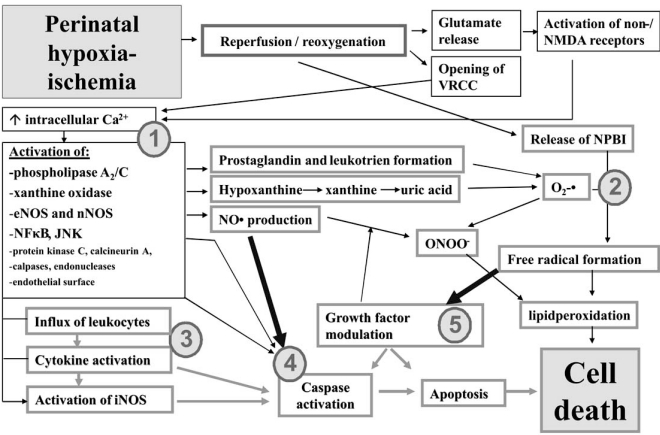
Perinatal hypoxia-ischemia (HI) is an important cause of neonatal brain injury. Recent progress in the search for neuroprotective compounds has provided us with several promising drugs to reduce perinatal HI-induced brain injury. In the early stage (first 6 hours after birth) therapies are concentrated on prevention of the production of reactive oxygen species or free radicals (xanthine-oxidase-, nitric oxide synthase-, and prostaglandin inhibition), anti-inflammatory effects (erythropoietin, melatonin, Xenon) and anti-apoptotic interventions (nuclear factor kappa B- and c-jun N-terminal kinase inhibition); in a later stage stimulation of neurotrophic properties in the neonatal brain (erythropoietin, growth factors) can be targeted to promote neuronal and oligodendrocyte regeneration. Combination of pharmacological means of treatment with moderate hypothermia, which is accepted now as a meaningful therapy, is probably the next step in clinical treatment to fight post-asphyxial brain damage. Further studies should be directed at a more rational use of therapies by determining the optimal time and dose to inhibit the different potentially destructive molecular pathways or to enhance endogenous repair while at the same time avoiding adverse effects of the drugs used.

摘要

围产期缺氧缺血(HI)是新生儿脑损伤的一个重要原因。寻找神经保护化合物的最新进展为我们提供了几种有希望的药物,以减少围产期 HI 引起的脑损伤。在早期(出生后 6 小时内),治疗集中在预防活性氧或自由基(黄嘌呤氧化酶、一氧化氮合酶和前列腺素抑制)的产生、抗炎作用(促红细胞生成素、褪黑素、氙气)和抗细胞凋亡干预(核因子 kappa B 和 c-jun N 末端激酶抑制);在后期,可以针对新生儿大脑中的神经营养特性(促红细胞生成素、生长因子)进行刺激,以促进神经元和少突胶质细胞的再生。将治疗的药理手段与目前被认为有意义的亚低温治疗相结合,可能是治疗窒息后脑损伤的下一步临床治疗。进一步的研究应该通过确定抑制不同潜在破坏性分子途径的最佳时间和剂量,或增强内源性修复,同时避免所用药物的不良反应,来指导更合理地使用治疗方法。
https://cdn.ncbi.nlm.nih.gov/pmc/blobs/bb7a/3080590/0d45fea2a53e/CN-8-324_F3.jpg
https://cdn.ncbi.nlm.nih.gov/pmc/blobs/bb7a/3080590/464bc9ecfe00/CN-8-324_F1.jpg
https://cdn.ncbi.nlm.nih.gov/pmc/blobs/bb7a/3080590/43d328f064e6/CN-8-324_F2.jpg
https://cdn.ncbi.nlm.nih.gov/pmc/blobs/bb7a/3080590/0d45fea2a53e/CN-8-324_F3.jpg
https://cdn.ncbi.nlm.nih.gov/pmc/blobs/bb7a/3080590/464bc9ecfe00/CN-8-324_F1.jpg
https://cdn.ncbi.nlm.nih.gov/pmc/blobs/bb7a/3080590/43d328f064e6/CN-8-324_F2.jpg
https://cdn.ncbi.nlm.nih.gov/pmc/blobs/bb7a/3080590/0d45fea2a53e/CN-8-324_F3.jpg

相似文献

1
Pharmacological neuroprotection after perinatal hypoxic-ischemic brain injury.围产期缺氧缺血性脑损伤后的药物神经保护。
Curr Neuropharmacol. 2010 Dec;8(4):324-34. doi: 10.2174/157015910793358150.
2
Pharmacological neuroprotection after perinatal asphyxia.围产期窒息后的药理神经保护作用。
J Matern Fetal Neonatal Med. 2010 Oct;23 Suppl 3:17-9. doi: 10.3109/14767058.2010.505052.
3
Intervention strategies for neonatal hypoxic-ischemic cerebral injury.新生儿缺氧缺血性脑损伤的干预策略
Clin Ther. 2006 Sep;28(9):1353-65. doi: 10.1016/j.clinthera.2006.09.005.
4
Neuroprotective therapies after perinatal hypoxic-ischemic brain injury.围产期缺氧缺血性脑损伤后的神经保护治疗。
Brain Sci. 2013 Mar 5;3(1):191-214. doi: 10.3390/brainsci3010191.
5
Xenon Combined With Hypothermia in Perinatal Hypoxic-Ischemic Encephalopathy: A Noble Gas, a Noble Mission.氙气联合亚低温治疗围生期缺氧缺血性脑病:一种稀有气体,一项崇高使命。
Pediatr Neurol. 2018 Jul;84:5-10. doi: 10.1016/j.pediatrneurol.2018.02.009. Epub 2018 Feb 27.
6
Mitochondrial JNK phosphorylation as a novel therapeutic target to inhibit neuroinflammation and apoptosis after neonatal ischemic brain damage.线粒体 JNK 磷酸化作为一种新的治疗靶点,可抑制新生儿缺血性脑损伤后的神经炎症和细胞凋亡。
Neurobiol Dis. 2013 Jun;54:432-44. doi: 10.1016/j.nbd.2013.01.017. Epub 2013 Jan 30.
7
Mangiferin Potentiates Neuroprotection by Isoflurane in Neonatal Hypoxic Brain Injury by Reducing Oxidative Stress and Activation of Phosphatidylinositol-3-Kinase/Akt/Mammalian Target of Rapamycin (PI3K/Akt/mTOR) Signaling.芒果苷通过减少氧化应激和激活磷脂酰肌醇-3-激酶/蛋白激酶 B/哺乳动物雷帕霉素靶蛋白(PI3K/Akt/mTOR)信号通路增强异氟醚在新生大鼠缺氧性脑损伤中的神经保护作用。
Med Sci Monit. 2018 Oct 19;24:7459-7468. doi: 10.12659/MSM.908142.
8
New pharmacological approaches in infants with hypoxic-ischemic encephalopathy.新生儿缺氧缺血性脑病的新药理治疗方法。
Curr Pharm Des. 2012;18(21):3086-100.
9
Novel interventions to reduce oxidative-stress related brain injury in neonatal asphyxia.新型干预措施减少新生儿窒息相关氧化应激性脑损伤。
Free Radic Biol Med. 2019 Oct;142:113-122. doi: 10.1016/j.freeradbiomed.2019.04.028. Epub 2019 Apr 27.
10
Neuroprotective effects of inter-alpha inhibitor proteins after hypoxic-ischemic brain injury in neonatal rats.新生儿大鼠缺氧缺血性脑损伤后抗胰蛋白酶抑制剂蛋白的神经保护作用。
Exp Neurol. 2019 Jul;317:244-259. doi: 10.1016/j.expneurol.2019.03.013. Epub 2019 Mar 23.

引用本文的文献

1
Cannabidiol effectively prevents oxidative stress and stabilizes hypoxia-inducible factor-1 alpha (HIF-1α) in an animal model of global hypoxia.大麻二酚在动物整体缺氧模型中能有效防止氧化应激,并稳定缺氧诱导因子-1α(HIF-1α)。
Sci Rep. 2024 Jul 10;14(1):15952. doi: 10.1038/s41598-024-66599-5.
2
Non-Excitatory Amino Acids, Melatonin, and Free Radicals: Examining the Role in Stroke and Aging.非兴奋性氨基酸、褪黑素与自由基:探讨其在中风和衰老中的作用
Antioxidants (Basel). 2023 Oct 10;12(10):1844. doi: 10.3390/antiox12101844.
3
Therapeutic Interventions in Rat Models of Preterm Hypoxic Ischemic Injury: Effects of Hypothermia, Caffeine, and the Influence of Sex.

本文引用的文献

1
Mesenchymal stem cell treatment after neonatal hypoxic-ischemic brain injury improves behavioral outcome and induces neuronal and oligodendrocyte regeneration.骨髓间充质干细胞治疗新生鼠缺氧缺血性脑损伤可改善行为学预后,并促进神经元和少突胶质细胞再生。
Brain Behav Immun. 2010 Mar;24(3):387-93. doi: 10.1016/j.bbi.2009.10.017. Epub 2009 Oct 31.
2
Recombinant human erythropoietin in the treatment of acute ischemic stroke.重组人促红细胞生成素治疗急性缺血性脑卒中。
Stroke. 2009 Dec;40(12):e647-56. doi: 10.1161/STROKEAHA.109.564872. Epub 2009 Oct 15.
3
The glial cell response is an essential component of hypoxia-induced erythropoiesis in mice.
早产缺氧缺血性损伤大鼠模型的治疗干预:低温、咖啡因的作用及性别影响
Life (Basel). 2022 Sep 28;12(10):1514. doi: 10.3390/life12101514.
4
CeRebrUm and CardIac Protection with ALlopurinol in Neonates with Critical Congenital Heart Disease Requiring Cardiac Surgery with Cardiopulmonary Bypass (CRUCIAL): study protocol of a phase III, randomized, quadruple-blinded, placebo-controlled, Dutch multicenter trial.西拉柳胺和别嘌醇在需要体外循环心脏手术的危重新生儿中的心脏保护作用(CRUCIAL):一项 III 期、随机、四盲、安慰剂对照、荷兰多中心试验的研究方案。
Trials. 2022 Feb 23;23(1):174. doi: 10.1186/s13063-022-06098-y.
5
Cytokine and chemokine responses to injury and treatment in a nonhuman primate model of hypoxic-ischemic encephalopathy treated with hypothermia and erythropoietin.细胞因子和趋化因子对接受低温和促红细胞生成素治疗的缺氧缺血性脑病非人灵长类动物模型的损伤和治疗的反应。
J Cereb Blood Flow Metab. 2021 Aug;41(8):2054-2066. doi: 10.1177/0271678X21991439. Epub 2021 Feb 7.
6
Characterization and Imaging of Lipid-Shelled Microbubbles for Ultrasound-Triggered Release of Xenon.脂质壳微泡的特性和成像用于超声触发氙气释放。
Neurotherapeutics. 2019 Jul;16(3):878-890. doi: 10.1007/s13311-019-00733-4.
7
Neuroprotective Drugs in Infants With Severe Congenital Heart Disease: A Systematic Review.重症先天性心脏病患儿的神经保护药物:一项系统综述
Front Neurol. 2018 Jul 3;9:521. doi: 10.3389/fneur.2018.00521. eCollection 2018.
8
Brain Metabolism Alterations Induced by Pregnancy Swimming Decreases Neurological Impairments Following Neonatal Hypoxia-Ischemia in Very Immature Rats.孕期游泳诱导的脑代谢改变可减轻极不成熟大鼠新生儿缺氧缺血后的神经损伤。
Front Neurol. 2018 Jun 25;9:480. doi: 10.3389/fneur.2018.00480. eCollection 2018.
9
Nitric Oxide Synthase Inhibition as a Neuroprotective Strategy Following Hypoxic-Ischemic Encephalopathy: Evidence From Animal Studies.一氧化氮合酶抑制作为缺氧缺血性脑病后的神经保护策略:来自动物研究的证据
Front Neurol. 2018 Apr 19;9:258. doi: 10.3389/fneur.2018.00258. eCollection 2018.
10
Tert-butylhydroquinone post-treatment attenuates neonatal hypoxic-ischemic brain damage in rats.叔丁基对苯二酚处理可减轻大鼠新生缺氧缺血性脑损伤。
Neurochem Int. 2018 Jun;116:1-12. doi: 10.1016/j.neuint.2018.03.004. Epub 2018 Mar 9.
神经胶质细胞反应是小鼠缺氧诱导红细胞生成的重要组成部分。
J Clin Invest. 2009 Nov;119(11):3373-83. doi: 10.1172/JCI39378. Epub 2009 Oct 5.
4
Moderate hypothermia to treat perinatal asphyxial encephalopathy.采用中度低温治疗围产期窒息性脑病。
N Engl J Med. 2009 Oct 1;361(14):1349-58. doi: 10.1056/NEJMoa0900854.
5
The role and regulation of hypoxia-inducible factor-1alpha expression in brain development and neonatal hypoxic-ischemic brain injury.缺氧诱导因子-1α表达在脑发育及新生儿缺氧缺血性脑损伤中的作用与调控
Brain Res Rev. 2009 Dec 11;62(1):99-108. doi: 10.1016/j.brainresrev.2009.09.006. Epub 2009 Sep 25.
6
Inhibition of the JNK/AP-1 pathway reduces neuronal death and improves behavioral outcome after neonatal hypoxic-ischemic brain injury.抑制 JNK/AP-1 通路可减少新生鼠缺氧缺血性脑损伤后的神经元死亡并改善行为学结果。
Brain Behav Immun. 2010 Jul;24(5):812-21. doi: 10.1016/j.bbi.2009.09.008. Epub 2009 Sep 17.
7
Erythropoietin attenuates hyperoxia-induced oxidative stress in the developing rat brain.促红细胞生成素可减轻发育期大鼠脑内氧中毒引起的氧化应激。
Brain Behav Immun. 2010 Jul;24(5):792-9. doi: 10.1016/j.bbi.2009.08.010. Epub 2009 Sep 1.
8
Erythropoietin sustains cognitive function and brain volume after neonatal stroke.促红细胞生成素可维持新生儿中风后的认知功能和脑容量。
Dev Neurosci. 2009;31(5):403-11. doi: 10.1159/000232558. Epub 2009 Aug 11.
9
Erythropoietin improved neurologic outcomes in newborns with hypoxic-ischemic encephalopathy.促红细胞生成素改善了新生儿缺氧缺血性脑病的神经学预后。
Pediatrics. 2009 Aug;124(2):e218-26. doi: 10.1542/peds.2008-3553. Epub 2009 Jul 27.
10
Alternate pathways preserve tumor necrosis factor-alpha production after nuclear factor-kappaB inhibition in neonatal cerebral hypoxia-ischemia.在新生鼠脑缺氧缺血中,核因子-κB受抑制后,替代途径可维持肿瘤坏死因子-α的产生。
Stroke. 2009 Oct;40(10):3362-8. doi: 10.1161/STROKEAHA.109.560250. Epub 2009 Jul 23.