Department of Orthopaedic Surgery, Amalia Fleming General Hospital, Athens, Greece.
Clin Orthop Surg. 2011 Jun;3(2):152-6. doi: 10.4055/cios.2011.3.2.152. Epub 2011 May 12.
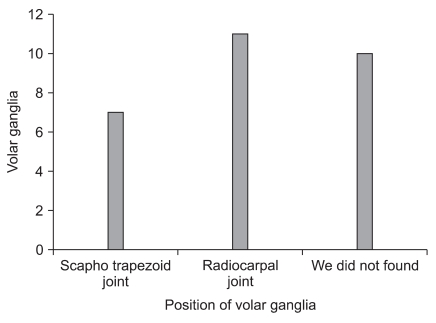
Some surgeons consider the abscission of a part of the articular bursa around the point of the input of ganglion's nape (average 1-2 cm diameter) to be very important with excellent results. However, a literature search revealed disagreement as to whether it is essential to repair a bursa defect. This study examined the effectiveness of this method without repairing the articular defect. An attempt was made to identify the anatomical origin of wrist ganglia during the surgical procedure.
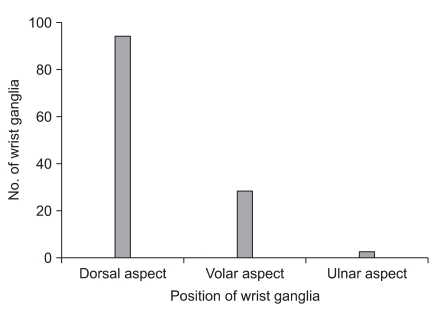
This study evaluated 124 wrist ganglia that had been treated surgically during 2004-2009 using this technique and without repairing the bursa defect (1-2 cm in diameter). The variables studied were age, gender, time from the occurrence till abscission of the ganglia, former surgical interventions, preoperative and postoperative pain, insertion of the ganglion's nape and complications. Sixty-six patients with a mean follow-up of 42 months and minimum 12 months were examined.
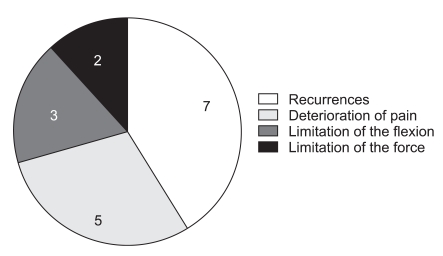
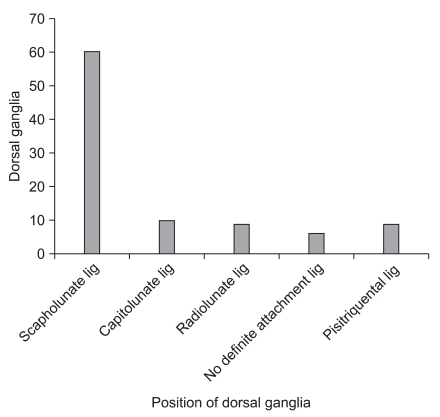
At the time of the follow-up, 80.3% had no pain whereas 92.2% showed a remarkable improvement. Seven cases of recurrence (10.6%) were found 2 to 85 months after surgery, of which most appeared during the first year (71.4%). It is important to mention that the majority of the dorsal ganglia (42.8%) originated from the capitate-lunate joint. None of the patients presented with scapholunate or other instability.
This surgical method is a simple and safe with excellent long-term results and a lower recurrence rate compared to other surgical approaches. Overall, repair of the articular bursa is unnecessary.
一些外科医生认为切除关节囊中靠近腱鞘囊肿颈部的部分(平均直径 1-2 厘米)非常重要,效果很好。然而,文献检索结果显示,是否有必要修复滑液囊缺损存在分歧。本研究旨在研究不修复关节缺损的情况下,该方法的有效性。在手术过程中尝试确定腕部腱鞘囊肿的解剖学起源。
本研究评估了 2004 年至 2009 年期间使用该技术治疗的 124 例腕部腱鞘囊肿,且未修复滑液囊缺损(直径 1-2 厘米)。研究的变量包括年龄、性别、从发病到切除腱鞘囊肿的时间、既往手术干预、术前和术后疼痛、腱鞘囊肿颈部插入情况和并发症。对 66 例患者进行了随访,平均随访时间为 42 个月,最短随访时间为 12 个月。
在随访时,80.3%的患者无疼痛,92.2%的患者疼痛明显改善。术后 2 至 85 个月发现 7 例(10.6%)复发,其中大多数在第一年(71.4%)出现。需要指出的是,大多数背侧腱鞘囊肿(42.8%)起源于头状骨-月骨关节。无 1 例患者出现舟月或其他不稳定。
与其他手术方法相比,该手术方法简单、安全,长期效果好,复发率低。总的来说,关节滑液囊修复不是必需的。