AIDS Virus Research Unit, National Institute for Communicable Diseases, Johannesburg, South Africa.
AIDS. 2011 Jul 31;25(12):1461-9. doi: 10.1097/QAD.0b013e3283492180.
To describe the prevalence of HIV-1 drug resistance mutations at the time of treatment initiation in a large cohort of HIV-infected children previously exposed to single-dose nevirapine (sdNVP) for prevention of transmission.
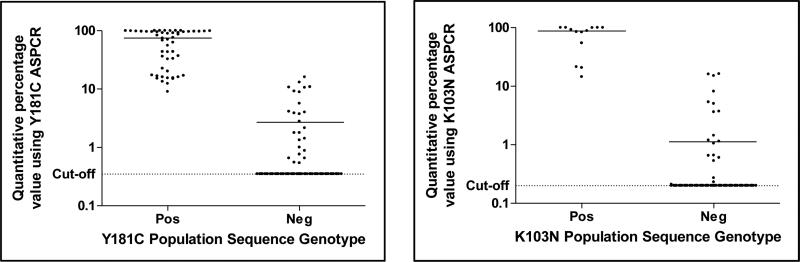
Drug resistance mutations were measured pretreatment in 255 infants and young children under 2 years of age in South Africa exposed to sdNVP and initiating ritonavir-boosted lopinavir-based therapy. Those who achieved viral suppression were randomized to either continue the primary regimen or to switch to a nevirapine-based regimen. Pretreatment samples were tested using population sequencing and real time allele-specific PCR (AS-PCR) to detect Y181C and K103N minority variants. Those with confirmed viremia more than 1000 copies/ml by 52 weeks postrandomization in the switch group were defined as having viral failure.
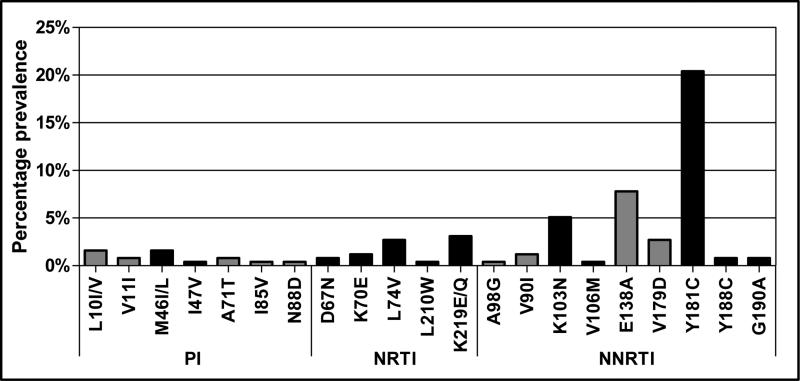
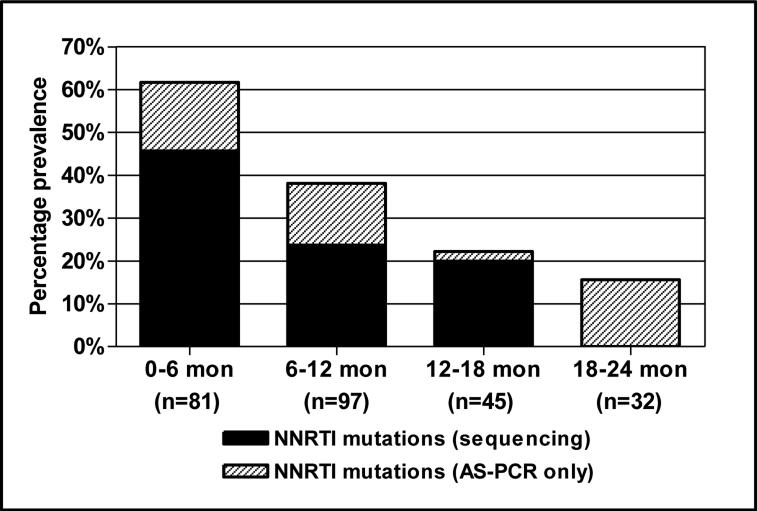
Nonnucleoside reverse transcriptase inhibitor (NNRTI) mutations, predominantly Y181C, were detected by either method in 62% of infants less than 6 months of age, in 39% of children 6-12 months of age, 22% 12-18 months, and 16% 18-24 months (P = <0.0001). NNRTI mutations detected by genotyping, but not K103N or Y181C mutations detected only by AS-PCR, were associated with viral failure in the switch group.
The prevalence of mutations known to compromise primary NNRTI-based therapy is high in sdNVP-exposed children, supporting current guidelines recommending use of protease inhibitor-based regimens for young children. Standard genotyping is adequate to identify children who could benefit from switching to NNRTI-based therapy.
描述在先前接受单剂量奈韦拉平(sdNVP)预防母婴传播的大量 HIV 感染儿童中,在开始治疗时 HIV-1 耐药突变的流行情况。
在南非,255 名年龄在 2 岁以下、曾接触过 sdNVP 并开始接受利托那韦增强洛匹那韦为基础的治疗的婴儿和幼儿,在治疗前测量了耐药突变。那些达到病毒抑制的患者被随机分配继续原方案或转换为基于奈韦拉平的方案。采用群体测序和实时等位基因特异性 PCR(AS-PCR)检测 Y181C 和 K103N 少数变体,检测预处理样本中是否存在耐药突变。在转换组中,随机分组后第 52 周时病毒载量超过 1000 拷贝/ml 的患者被定义为病毒失败。
通过两种方法均检测到非核苷类逆转录酶抑制剂(NNRTI)突变,主要是 Y181C,在小于 6 个月的婴儿中占 62%,6-12 个月的儿童中占 39%,12-18 个月的儿童中占 22%,18-24 个月的儿童中占 16%(P <0.0001)。通过基因分型检测到的 NNRTI 突变,但通过 AS-PCR 仅检测到的 K103N 或 Y181C 突变与转换组中的病毒失败有关。
在 sdNVP 暴露的儿童中,已知会破坏初始 NNRTI 为基础的治疗的突变的流行率很高,这支持了目前建议为幼儿使用蛋白酶抑制剂为基础的方案的指南。标准基因分型足以识别可能从 NNRTI 为基础的治疗中获益的儿童。