Mathai Ashu S, George Smitha E, Abraham John
Department of Anaesthesiolgy and Critical Care, Christian Medical College, Ludhiana, Punjab, India.
Indian J Crit Care Med. 2011 Jan;15(1):6-15. doi: 10.4103/0972-5229.78215.
The role of hand hygiene in preventing health care associated infections (HCAIs) has been clearly established. However, compliance rates remain poor among health care personnel.
a) To investigate the health care workers' hand hygiene compliance rates in the intensive care unit (ICU), b) to assess reasons for non-compliance and c) to study the efficacy of a multimodal intervention strategy at improving compliance.
A mixed medical-surgical ICU of a tertiary level hospital.
A before-after prospective, observational, intervention study.
All health care personnel who came in contact with patients in the ICU were observed for their hand hygiene compliance before and after a multimodal intervention strategy (education, posters, verbal reminders and easy availability of products). A self-report questionnaire was also circulated to assess perceptions regarding compliance. Statistical analysis was done using χ(2) test or Fisher exact test (Epi info software).
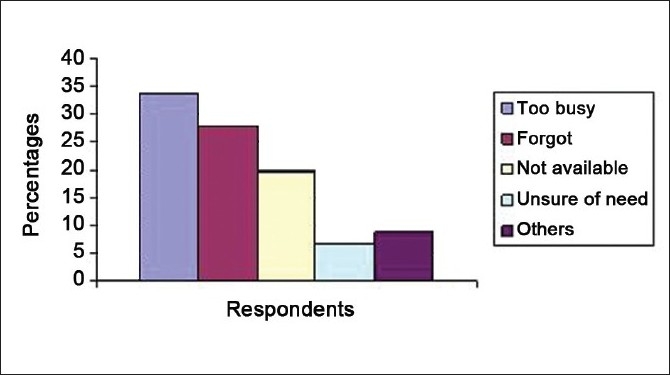
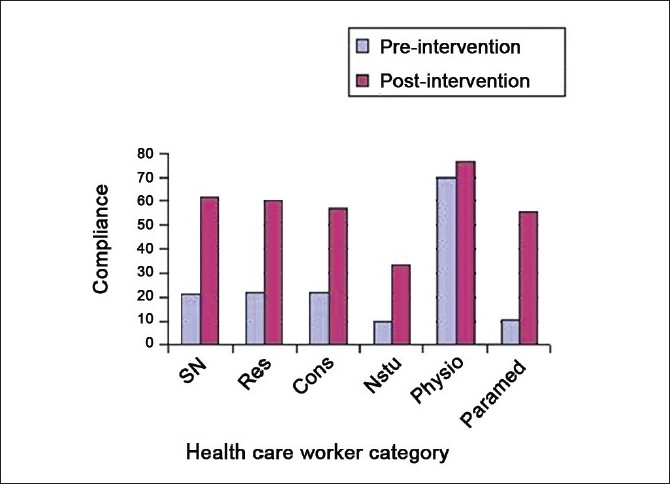
Hand hygiene compliance among medical personnel working in the ICU was 26% and the most common reason cited for non-compliance was lack of time (37%). The overall compliance improved significantly following the intervention to 57.36% (P<0.000). All health care worker groups showed significant improvements: staff nurses (21.48-61.59%, P<0.0000), nursing students (9.86-33.33%, P<0.0000), resident trainees (21.62-60.71%, P<0.0000), visiting consultants (22-57.14%, P=0.0001), physiotherapists (70-75.95%, P=0.413) and paramedical staff (10.71-55.45%, P< 0.0000).
Hand hygiene compliance among health care workers in the ICU is poor; however, intervention strategies, such as the one used, can be useful in improving the compliance rates significantly.
手部卫生在预防医疗保健相关感染(HCAIs)中的作用已得到明确证实。然而,医护人员的依从率仍然很低。
a)调查重症监护病房(ICU)医护人员的手部卫生依从率,b)评估不依从的原因,c)研究多模式干预策略在提高依从性方面的效果。
一家三级医院的内科与外科混合ICU。
一项前后瞻性、观察性干预研究。
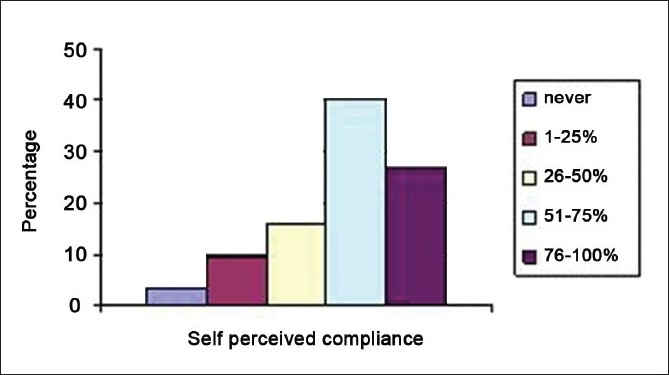
对所有在ICU接触患者的医护人员在多模式干预策略(教育、海报、口头提醒和产品易于获取)前后的手部卫生依从情况进行观察。还发放了一份自我报告问卷以评估对依从性的看法。使用χ(2)检验或Fisher精确检验(Epi info软件)进行统计分析。
在ICU工作的医务人员手部卫生依从率为26%,最常被提及的不依从原因是时间不足(37%)。干预后总体依从率显著提高至57.36%(P<0.000)。所有医护人员群体均有显著改善:注册护士(21.48 - 61.59%,P<0.0000)、护生(9.86 - 33.33%,P<0.0000)、住院实习医生(21.62 - 60.71%,P<0.0000)、客座顾问(22 - 57.14%,P = 0.0001)、物理治疗师(70 - 75.95%,P = 0.413)和辅助医务人员(10.71 - 55.45%,P<0.0000)。
ICU医护人员的手部卫生依从性较差;然而,所采用的此类干预策略可显著提高依从率。