Meinke Gretchen, Phelan Paul, Fradet-Turcotte Amélie, Archambault Jacques, Bullock Peter A
Department of Biochemistry, Tufts School of Medicine and the Sackler School of Graduate Biomedical Sciences, 136 Harrison Avenue, Boston, MA 02111, USA.
Acta Crystallogr D Biol Crystallogr. 2011 Jun;67(Pt 6):560-7. doi: 10.1107/S0907444911014302. Epub 2011 May 17.
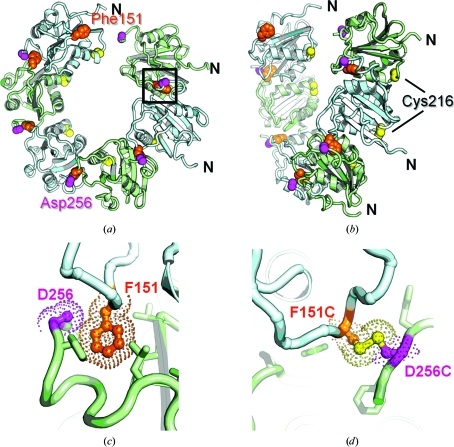
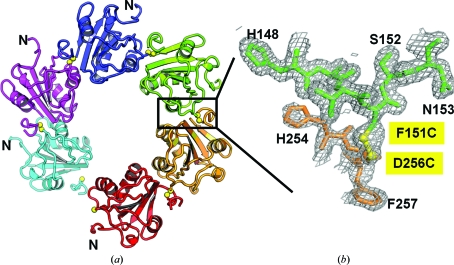
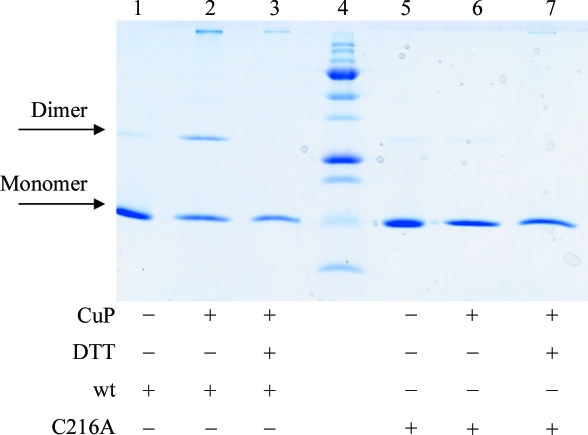
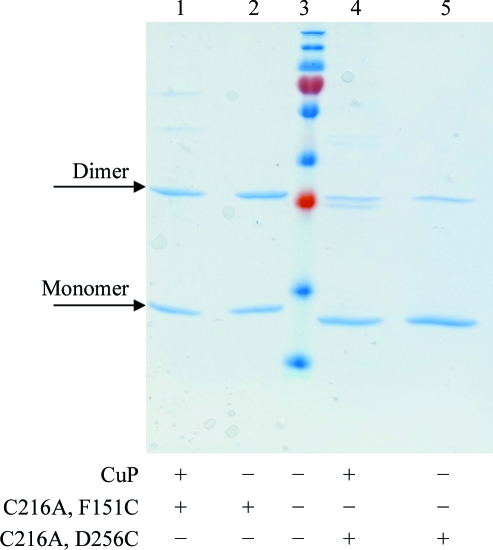
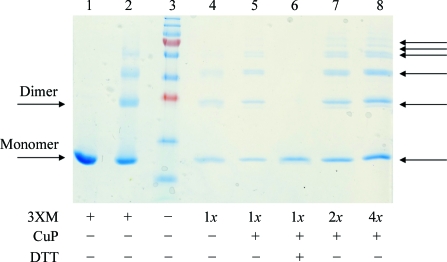
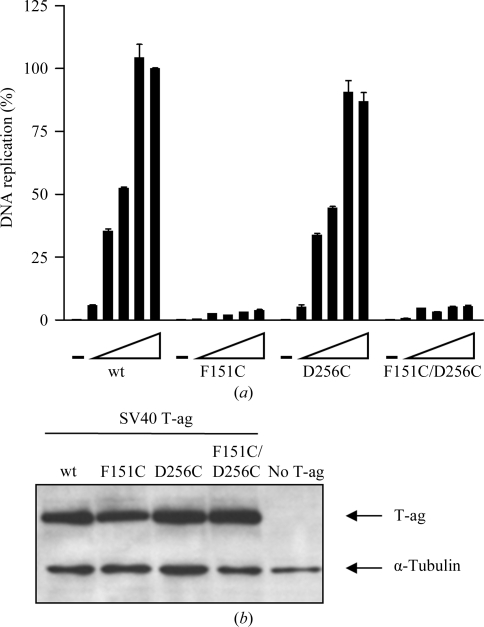
The modular multifunctional protein large T antigen (T-ag) from simian virus 40 orchestrates many of the events needed for replication of the viral double-stranded DNA genome. This protein assembles into single and double hexamers on specific DNA sequences located at the origin of replication. This complicated process begins when the origin-binding domain of large T antigen (T-ag ODB) binds the GAGGC sequences in the central region (site II) of the viral origin of replication. While many of the functions of purified T-ag OBD can be studied in isolation, it is primarily monomeric in solution and cannot assemble into hexamers. To overcome this limitation, the possibility of engineering intermolecular disulfide bonds in the origin-binding domain which could oligomerize in solution was investigated. A recent crystal structure of the wild-type T-ag OBD showed that this domain forms a left-handed spiral in the crystal with six subunits per turn. Therefore, we analyzed the protein interface of this structure and identified two residues that could potentially support an intermolecular disulfide bond if changed to cysteines. SDS-PAGE analysis established that the mutant T-ag OBD formed higher oligomeric products in a redox-dependent manner. In addition, the 1.7 Å resolution crystal structure of the engineered disulfide-linked T-ag OBD is reported, which establishes that oligomerization took place in the expected manner.
来自猴病毒40的模块化多功能蛋白大T抗原(T-ag)协调病毒双链DNA基因组复制所需的许多事件。该蛋白在位于复制起点的特定DNA序列上组装成单六聚体和双六聚体。当大T抗原的起点结合域(T-ag ODB)与病毒复制起点中心区域(位点II)的GAGGC序列结合时,这个复杂的过程就开始了。虽然纯化的T-ag OBD的许多功能可以单独研究,但它在溶液中主要是单体形式,不能组装成六聚体。为了克服这一限制,研究了在起点结合域中设计分子间二硫键的可能性,该二硫键可以在溶液中寡聚化。野生型T-ag OBD的最近晶体结构表明,该结构域在晶体中形成左手螺旋,每圈有六个亚基。因此,我们分析了该结构的蛋白质界面,并确定了两个残基,如果将其变为半胱氨酸,可能支持分子间二硫键。SDS-PAGE分析表明,突变型T-ag OBD以氧化还原依赖的方式形成了更高的寡聚产物。此外,还报道了工程化二硫键连接的T-ag OBD的1.7 Å分辨率晶体结构,这表明寡聚化是以预期的方式发生的。