IRIS Group, UMR 8194, CNRS, Hôpital Européen Georges Pompidou, Paris, France.
PLoS One. 2011;6(5):e20322. doi: 10.1371/journal.pone.0020322. Epub 2011 May 26.
The initiation of memory guided saccades is known to be controlled by the frontal eye field (FEF). Recent physiological studies showed the existence of an area close to FEF that controls also vergence initiation and execution. This study is to explore the effect of transcranial magnetic simulation (TMS) over FEF on the control of memory-guided saccade-vergence eye movements.
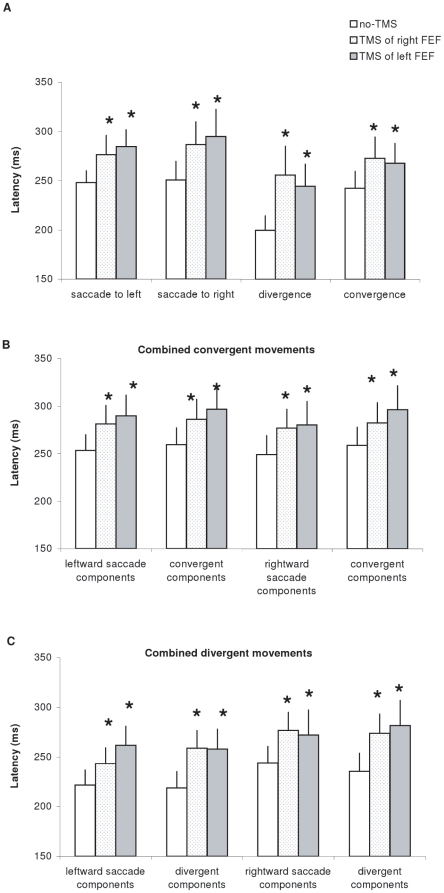
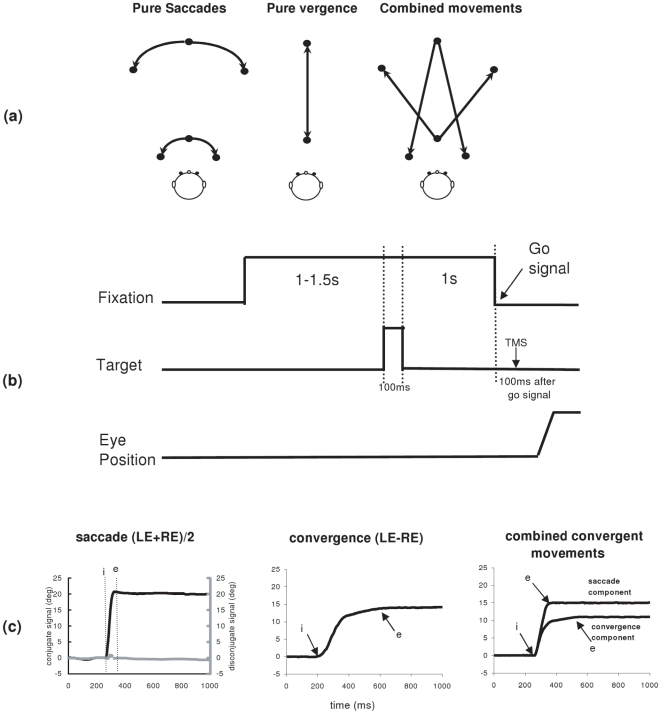
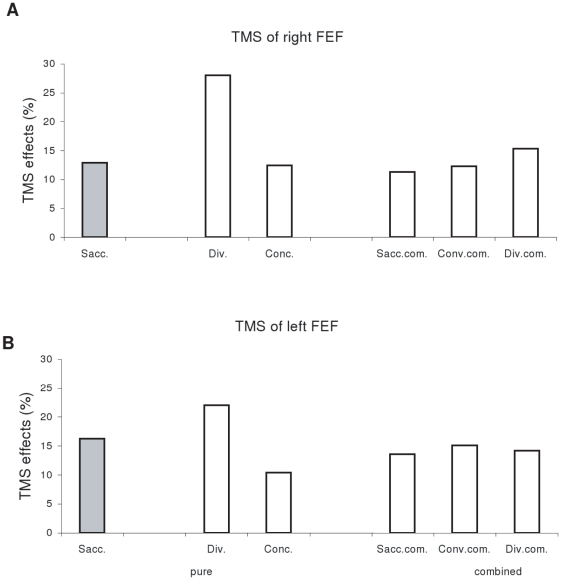
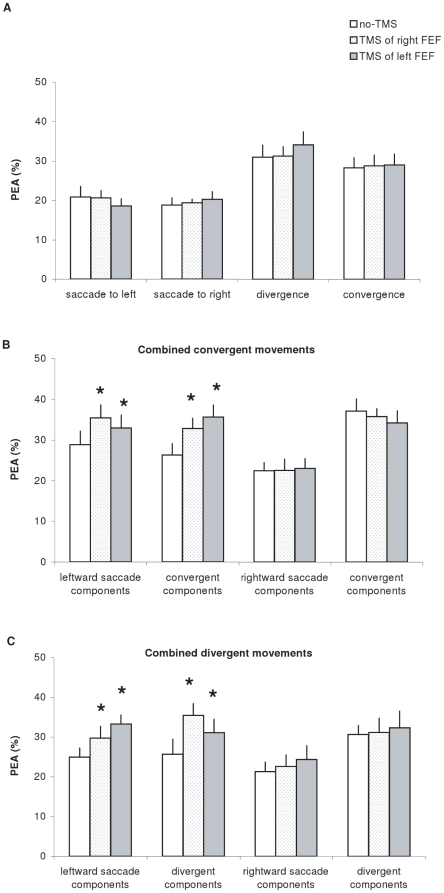
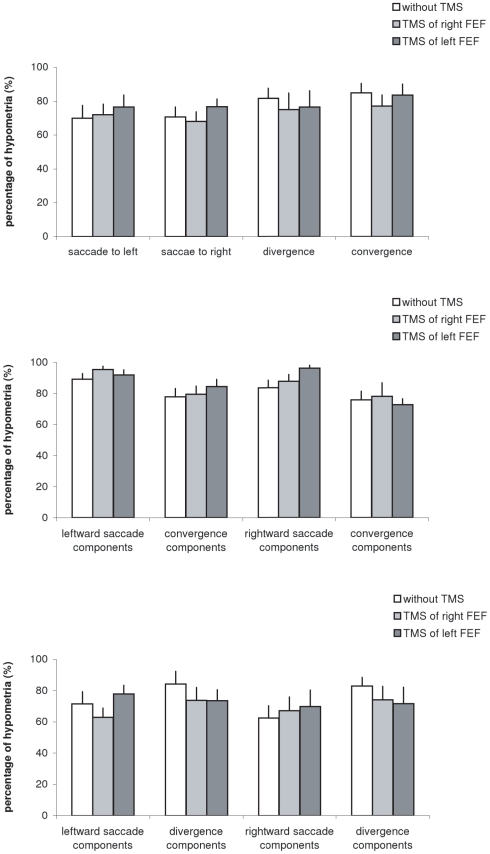
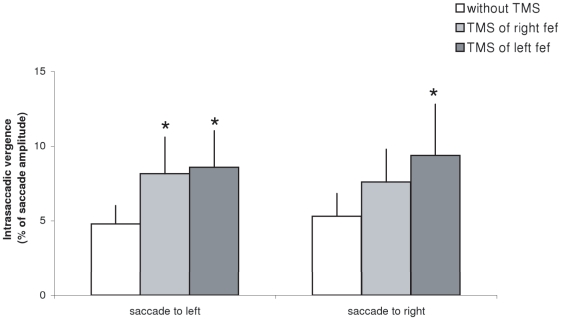
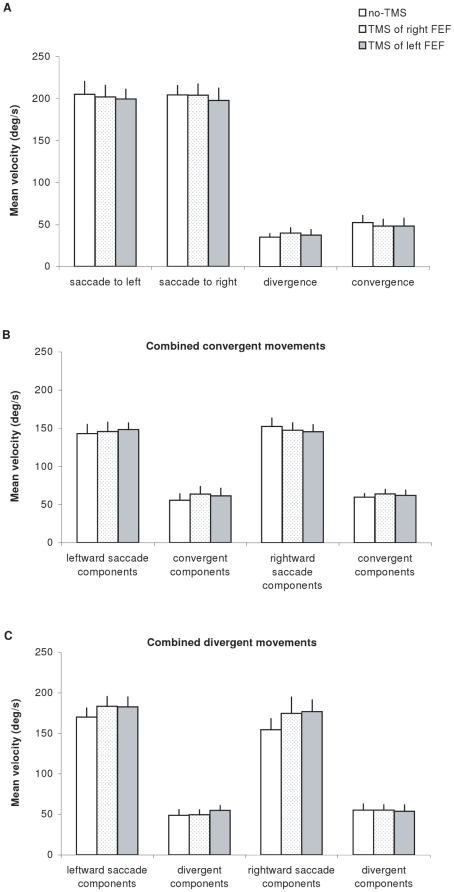
METHODOLOGY/PRINCIPAL FINDINGS: Subjects had to make an eye movement in dark towards a target flashed 1 sec earlier (memory delay); the location of the target relative to fixation point was such as to require either a vergence along the median plane, or a saccade, or a saccade with vergence; trials were interleaved. Single pulse TMS was applied on the left or right FEF; it was delivered at 100 ms after the end of memory delay, i.e. extinction of fixation LED that was the "go" signal. Twelve healthy subjects participated in the study. TMS of left or right FEF prolonged the latency of all types of eye movements; the increase varied from 21 to 56 ms and was particularly strong for the divergence movements. This indicates that FEF is involved in the initiation of all types of memory guided movement in the 3D space. TMS of the FEF also altered the accuracy but only for leftward saccades combined with either convergence or divergence; intrasaccadic vergence also increased after TMS of the FEF.
CONCLUSIONS/SIGNIFICANCE: The results suggest anisotropy in the quality of space memory and are discussed in the context of other known perceptual motor anisotropies.
众所周知,记忆引导性眼球运动的启动受额眼区(FEF)控制。最近的生理学研究表明,FEF 附近存在一个区域,它也控制着聚散的启动和执行。本研究旨在探讨经颅磁刺激(TMS)对 FEF 的影响,以控制记忆引导性扫视-聚散眼动。
方法/主要发现:被试者必须在黑暗中向 1 秒前闪烁的目标进行眼球运动(记忆延迟);目标相对于注视点的位置要求进行会聚或扫视或带有会聚的扫视;试验是交替进行的。单脉冲 TMS 施加于左侧或右侧 FEF;它在记忆延迟结束后 100 毫秒时,即固定 LED 熄灭(即“开始”信号)时被触发。12 名健康受试者参与了这项研究。左或右 FEF 的 TMS 延长了所有类型眼球运动的潜伏期;增加幅度从 21 到 56 毫秒不等,对发散运动的影响尤其强烈。这表明 FEF 参与了三维空间中所有类型记忆引导运动的启动。FEF 的 TMS 也改变了准确性,但仅适用于与会聚或发散相结合的向左扫视;扫视内聚散度也在 FEF 的 TMS 后增加。
结论/意义:结果表明空间记忆的质量存在各向异性,并在其他已知的知觉运动各向异性的背景下进行了讨论。