Department of Cardiology, Academic Medical Centre, Meibergdreef 9, 1105 AZ, Amsterdam, The Netherlands.
Int J Cardiovasc Imaging. 2012 Apr;28(4):755-62. doi: 10.1007/s10554-011-9892-4. Epub 2011 Jun 3.
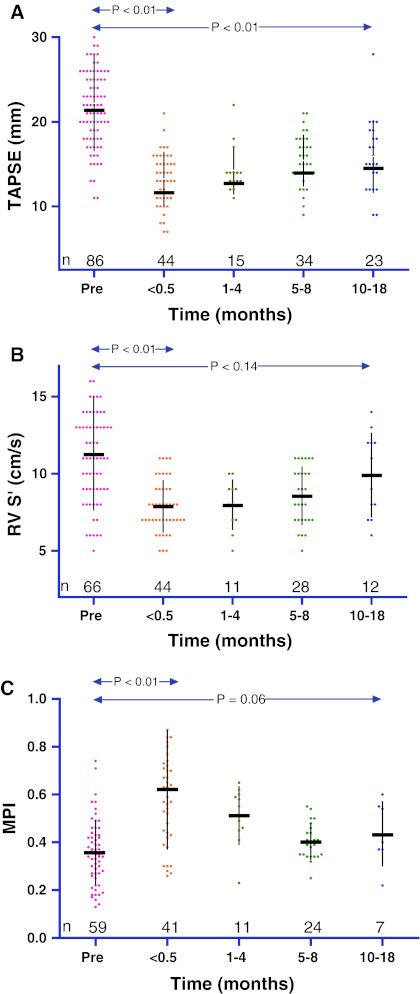
Right ventricular function (RVF) is often selectively declined after coronary artery bypass graft surgery. In adult patients with congenital heart disease (CHD) the incidence and persistence of declined RVF after cardiac surgery is unknown. The current study aimed to describe RVF after cardiac surgery in these patients. Adult CHD patients operated between January 2008 and December 2009 in the Academic Medical Centre in Amsterdam were studied. Clinical characteristics, laboratory tests, surgical data and intensive care unit outcome were obtained from medical records. RVF was measured by trans-thoracic echocardiography (TTE) and expressed by tricuspid annular plane systolic excursion (TAPSE), tissue Doppler imaging (RV S') and myocardial performance index (MPI) pre-operatively and direct, at intermediate and late follow up. Of a total of 185 operated, 86 patients (mean age 39 ± 13 years, 54% male) had echo data available. There was a significant fall in RVF after cardiac surgery. TAPSE and RV S' were significantly higher and MPI was significantly lower pre-operatively compared to direct post-operative values (TAPSE 22 ± 5 versus 13 ± 3 mm (P < 0.01), RV S' 11 ± 4 versus 8 ± 2 cm/s (P < 0.01) and MPI 0.36 ± 0.14 vs 0.62 ± 0.25; P < 0.01). There were no significant differences in left ventricular function pre-operatively compared to post-operative values. Right-sided surgery was performed in 33, left-sided surgery in 37 and both sided surgery in 16 patients. Decline in RVF was equal for those groups. Patients with severe decline in RVF, were patients who underwent tricuspid valve surgery. Decline in RVF was associated with post-operative myocardial creatine kinase level and maximal troponin T level. There was no association between decline in RVF and clinical outcome on the intensive care unit. 18 months post-operatively, most RVF parameters had recovered to pre-operative values, but TAPSE which remained still lower (P < 0.01). CHD patients have a decline in RVF directly after cardiac surgery, regardless the side of surgery. Although a gradual improvement was observed, complete recovery was not seen 18 months post-operatively.
右心室功能(RVF)在冠状动脉旁路移植手术后常常会选择性地下降。在先天性心脏病(CHD)的成年患者中,心脏手术后 RVF 的发生率和持续时间尚不清楚。本研究旨在描述这些患者心脏手术后的 RVF。研究对象为 2008 年 1 月至 2009 年 12 月在阿姆斯特丹学术医学中心接受手术的成年 CHD 患者。从病历中获得临床特征、实验室检查、手术数据和重症监护病房结果。术前和直接、中期和晚期随访时通过经胸超声心动图(TTE)测量 RVF,并通过三尖瓣环平面收缩期位移(TAPSE)、组织多普勒成像(RV S')和心肌做功指数(MPI)表示。总共 185 例接受手术的患者中,有 86 例(平均年龄 39 ± 13 岁,54%为男性)具有超声心动图数据。心脏手术后 RVF 显著下降。与直接术后值相比,TAPSE 和 RV S'明显升高,MPI 明显降低(TAPSE 22 ± 5 与 13 ± 3mm(P <0.01),RV S'11 ± 4 与 8 ± 2cm/s(P <0.01)和 MPI 0.36 ± 0.14 与 0.62 ± 0.25;P <0.01)。术前左心室功能与术后值无显著差异。33 例患者行右侧手术,37 例患者行左侧手术,16 例患者行双侧手术。各组 RVF 下降程度相同。RVF 严重下降的患者为行三尖瓣手术的患者。RVF 下降与术后肌酸激酶水平和最大肌钙蛋白 T 水平相关。RVF 下降与重症监护病房临床结局之间无相关性。术后 18 个月,大多数 RVF 参数已恢复到术前值,但 TAPSE 仍较低(P <0.01)。心脏手术后,CHD 患者的 RVF 直接下降,与手术侧无关。尽管观察到逐渐改善,但术后 18 个月并未完全恢复。