Charles LeMoyne Hospital Research Center, Greenfield Park, Québec, Canada.
BMC Health Serv Res. 2011 Jun 3;11:144. doi: 10.1186/1472-6963-11-144.
Teamwork is a key component of the health care renewal strategy emphasized in Quebec, elsewhere in Canada and in other countries to enhance the quality of oncology services. While this innovation would appear beneficial in theory, empirical evidences of its impact are limited. Current efforts in Quebec to encourage the development of local interdisciplinary teams in all hospitals offer a unique opportunity to assess the anticipated benefits. These teams working in hospital outpatient clinics are responsible for treatment, follow-up and patient support. The study objective is to assess the impact of interdisciplinarity on cancer patients and health professionals.
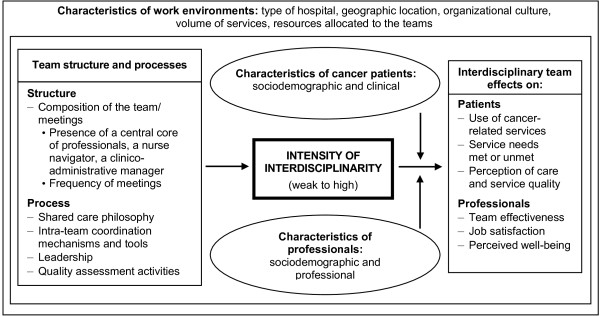
METHODS/DESIGN: This is a quasi-experimental study with three comparison groups distinguished by intensity of interdisciplinarity: strong, moderate and weak. The study will use a random sample of 12 local teams in Quebec, stratified by intensity of interdisciplinarity. The instrument to measure the intensity of the interdisciplinarity, developed in collaboration with experts, encompasses five dimensions referring to aspects of team structure and process. Self-administered questionnaires will be used to measure the impact of interdisciplinarity on patients (health care utilization, continuity of care and cancer services responsiveness) and on professionals (professional well-being, assessment of teamwork and perception of teamwork climate). Approximately 100 health professionals working on the selected teams and 2000 patients will be recruited. Statistical analyses will include descriptive statistics and comparative analysis of the impact observed according to the strata of interdisciplinarity. Fixed and random multivariate statistical models (multilevel analyses) will also be used.
This study will pinpoint to what extent interdisciplinarity is linked to quality of care and meets the complex and varied needs of cancer patients. It will ascertain to what extent interdisciplinary teamwork facilitated the work of professionals. Such findings are important given the growing prevalence of cancer and the importance of attracting and retaining health professionals to work with cancer patients.
团队合作是魁北克、加拿大其他地区和其他国家强调的医疗保健更新战略的关键组成部分,旨在提高肿瘤服务质量。虽然这一创新在理论上似乎有益,但其实践效果的证据有限。目前,魁北克正在努力鼓励所有医院发展当地的跨学科团队,这为评估预期效益提供了一个独特的机会。这些在医院门诊工作的团队负责治疗、随访和患者支持。本研究旨在评估跨学科性对癌症患者和卫生专业人员的影响。
方法/设计:这是一项准实验研究,有三个比较组,按跨学科性的强度区分:强、中、弱。该研究将使用随机抽取的 12 个魁北克当地团队的样本,按跨学科性的强度进行分层。该研究与专家合作开发了一种衡量跨学科性强度的工具,包括五个维度,涉及团队结构和流程的各个方面。将使用自我管理问卷来衡量跨学科性对患者(医疗保健利用、护理连续性和癌症服务响应)和专业人员(专业幸福感、团队合作评估和团队合作氛围感知)的影响。大约 100 名在选定团队工作的卫生专业人员和 2000 名患者将被招募。统计分析将包括描述性统计和根据跨学科性的分层观察到的影响的比较分析。还将使用固定和随机多变量统计模型(多层次分析)。
本研究将确定跨学科性在多大程度上与护理质量相关,并满足癌症患者复杂多样的需求。它将确定跨学科团队合作在多大程度上促进了专业人员的工作。鉴于癌症的发病率不断上升,以及吸引和留住卫生专业人员与癌症患者合作的重要性,这些发现非常重要。