Department of Zoology, Comenius University, Mlynská dolina B-1, SK 84215 Bratislava, Slovak Republic.
Eur J Protistol. 2011 Nov;47(4):295-313. doi: 10.1016/j.ejop.2011.04.006. Epub 2011 Jun 8.
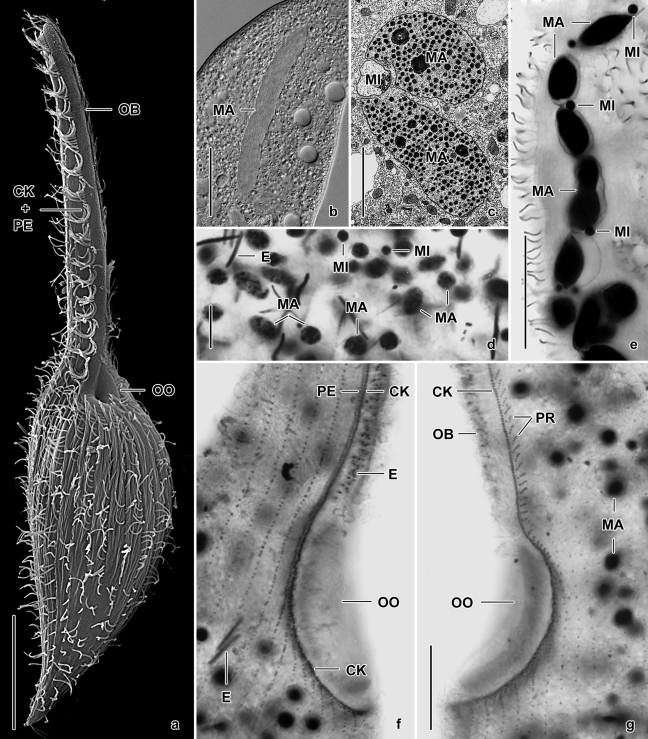
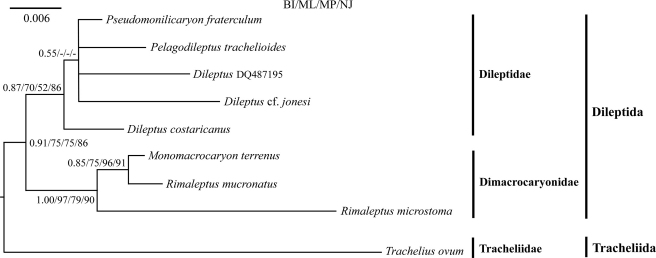
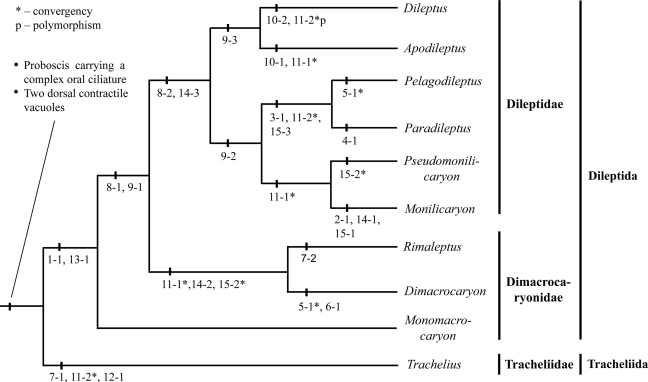
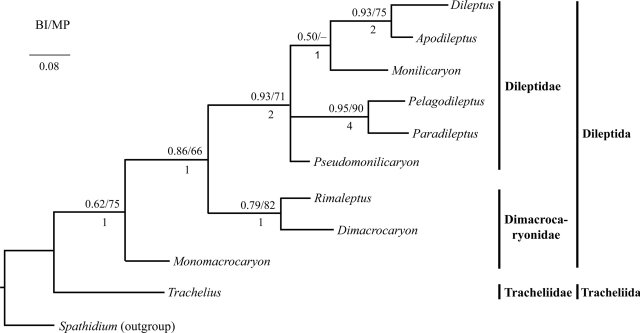
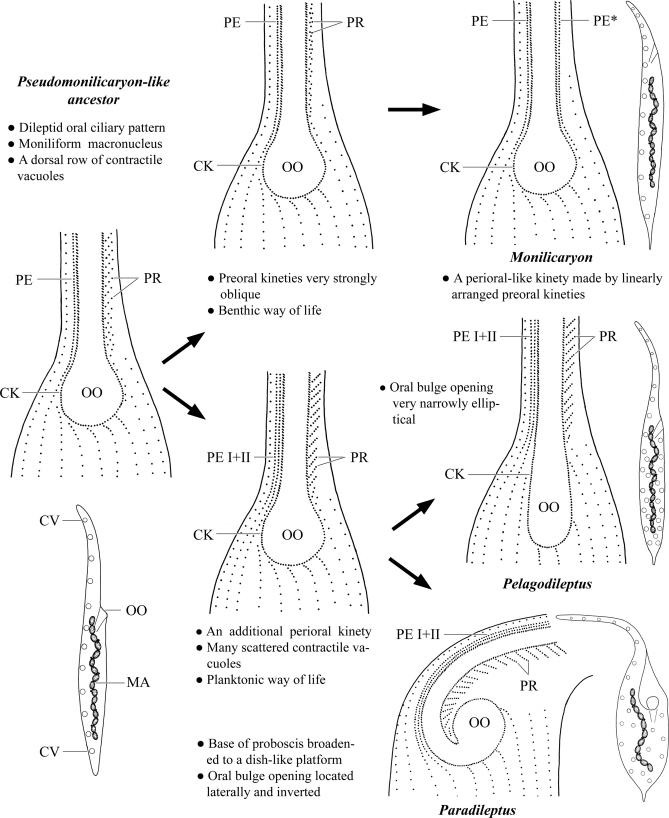
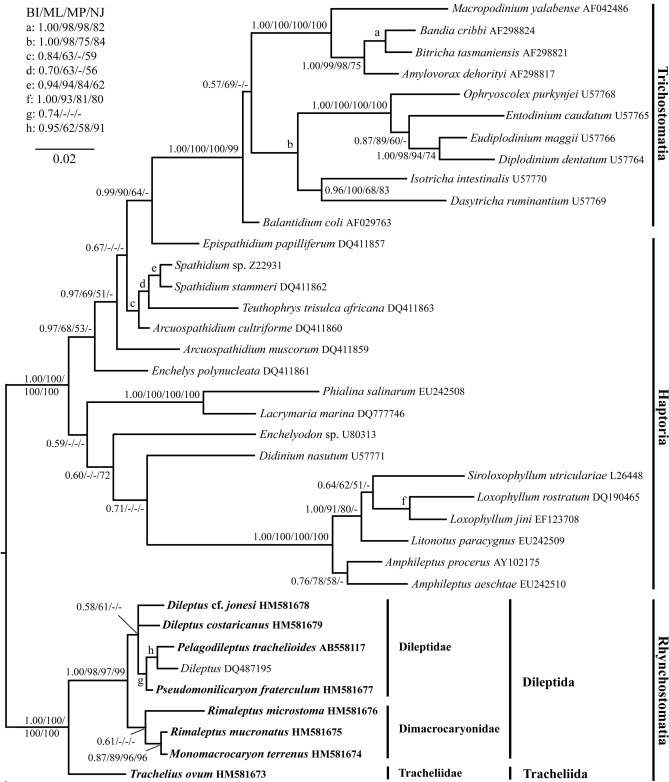
Dileptid and tracheliid ciliates have been traditionally classified within the subclass Haptoria of the class Litostomatea. However, their phylogenetic position among haptorians has been controversial and indicated that they may play a key role in understanding litostomatean evolution. In order to reconstruct the evolutionary history of dileptids and tracheliids, and to unravel their affinity to other haptorians, we have used a cladistic approach based on morphological evidence and a phylogenetic approach based on 18S rRNA gene sequences, including eight new ones. The molecular trees demonstrate that dileptids and tracheliids represent a separate subclass, Rhynchostomatia, that is sister to the subclasses Haptoria and Trichostomatia. The Rhynchostomatia are characterized by a ventrally located oral opening at the base of a proboscis that carries a complex oral ciliature. We have recognized two orders within Rhynchostomatia. The new order Tracheliida is monotypic, while the order Dileptida comprises two families: the new, typically bimacronucleate family Dimacrocaryonidae and the multimacronucleate family Dileptidae. The Haptoria evolved from the last common ancestor of the Litostomatea by polarization of the body, the oral opening locating more or less apically and the oral ciliature simplifying. The Trichostomatia originated from a microaerophylic haptorian by further simplification of the oral ciliature, possibly due to an endosymbiotic lifestyle.
双毛目和吸管目纤毛虫传统上被归类于寡膜亚纲的纤毛亚目。然而,它们在寡毛类中的系统发育位置一直存在争议,并表明它们可能在理解寡毛类的进化方面发挥关键作用。为了重建双毛目和吸管目的进化历史,并揭示它们与其他寡毛类的亲缘关系,我们使用了基于形态学证据的分支分析方法和基于 18S rRNA 基因序列的系统发育方法,其中包括 8 个新序列。分子树表明双毛目和吸管目代表一个独立的亚目,即旋唇目,它与寡毛亚目和毛口亚目互为姐妹群。旋唇目具有一个位于口前庭底部的腹侧开口,口前庭携带一个复杂的口纤毛。我们在旋唇目中识别出两个目。新目的吸管目是单型的,而双毛目的目则包括两个科:新的,通常具有二联体核的二毛科和多联体核的双毛科。寡毛类是由Litostomatea 的最后共同祖先通过身体极化演化而来的,口前庭的位置或多或少位于顶部,口纤毛简化。毛口类是由一种微需氧的寡毛类通过进一步简化口纤毛而起源的,可能是由于内共生的生活方式。