Department of Neurobiology, Yale University School of Medicine New Haven, CT, USA.
Front Neuroanat. 2011 May 23;5:30. doi: 10.3389/fnana.2011.00030. eCollection 2011.
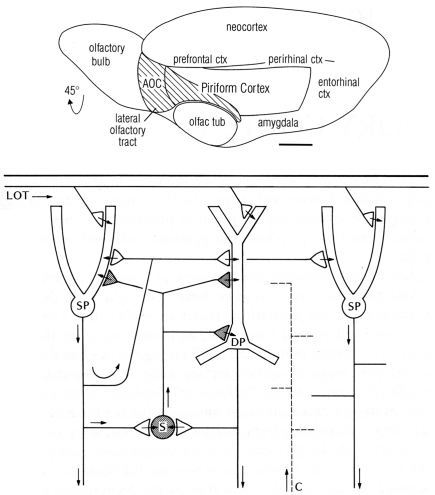
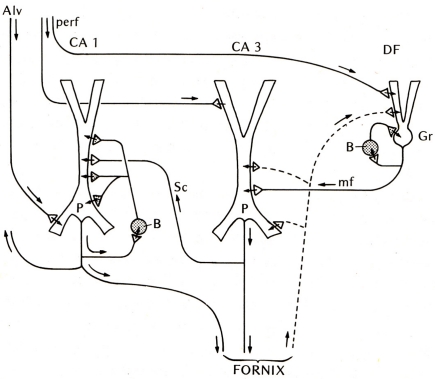
Understanding the principles of organization of the cerebral cortex requires insight into its evolutionary history. This has traditionally been the province of anatomists, but evidence regarding the microcircuit organization of different cortical areas is providing new approaches to this problem. Here we use the microcircuit concept to focus first on the principles of microcircuit organization of three-layer cortex in the olfactory cortex, hippocampus, and turtle general cortex, and compare it with six-layer neocortex. From this perspective it is possible to identify basic circuit elements for recurrent excitation and lateral inhibition that are common across all the cortical regions. Special properties of the apical dendrites of pyramidal cells are reviewed that reflect the specific adaptations that characterize the functional operations in the different regions. These principles of microcircuit function provide a new approach to understanding the expanded functional capabilities elaborated by the evolution of the neocortex.
理解大脑皮层的组织原则需要深入了解其进化历史。这一直是解剖学家的领域,但有关不同皮层区域的微电路组织的证据为解决这个问题提供了新的方法。在这里,我们使用微电路的概念,首先关注嗅觉皮层、海马体和龟类一般皮层三层皮层的微电路组织原则,并将其与六层新皮层进行比较。从这个角度来看,可以确定在所有皮层区域中普遍存在的用于递归兴奋和侧向抑制的基本电路元件。还回顾了反映不同区域功能操作特征的特定适应的锥形细胞的树突的特殊性质。这些微电路功能的原则为理解新皮层进化所产生的扩展功能提供了一种新方法。