Institut für Toxikologie und Genetik, Karlsruhe Institute of Technology, Karlsruhe, Germany.
PLoS One. 2011;6(6):e20524. doi: 10.1371/journal.pone.0020524. Epub 2011 Jun 2.
The turnover of acetylcholine receptors at the neuromuscular junction is regulated in an activity-dependent manner. Upon denervation and under various other pathological conditions, receptor half-life is decreased.
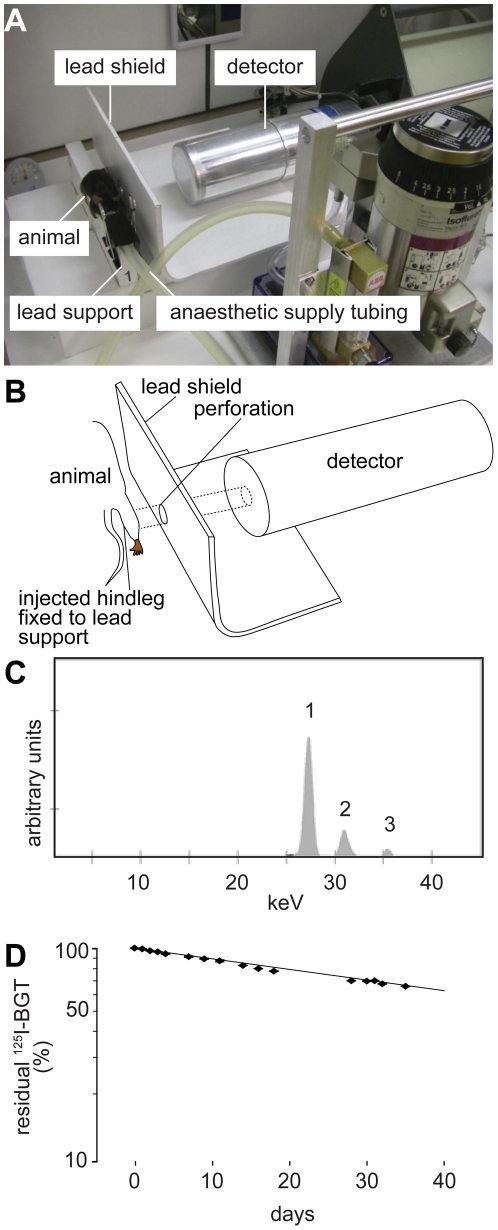
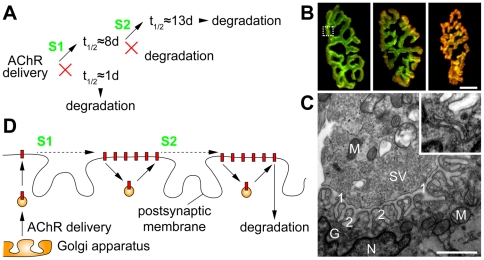
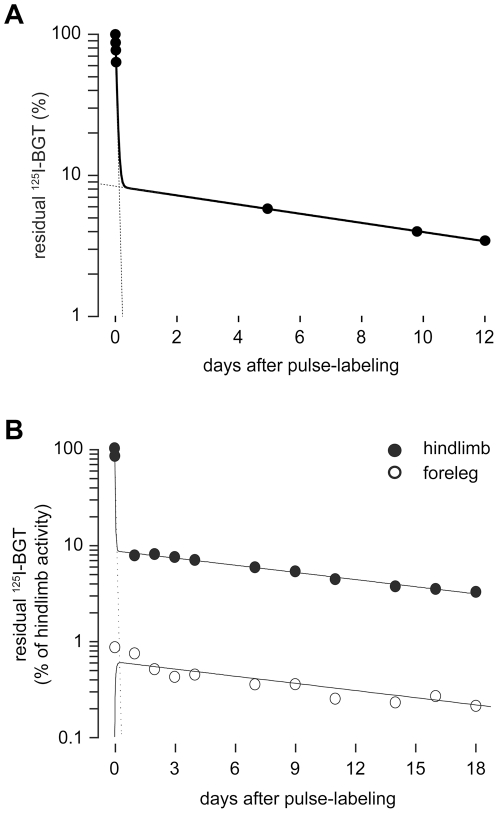
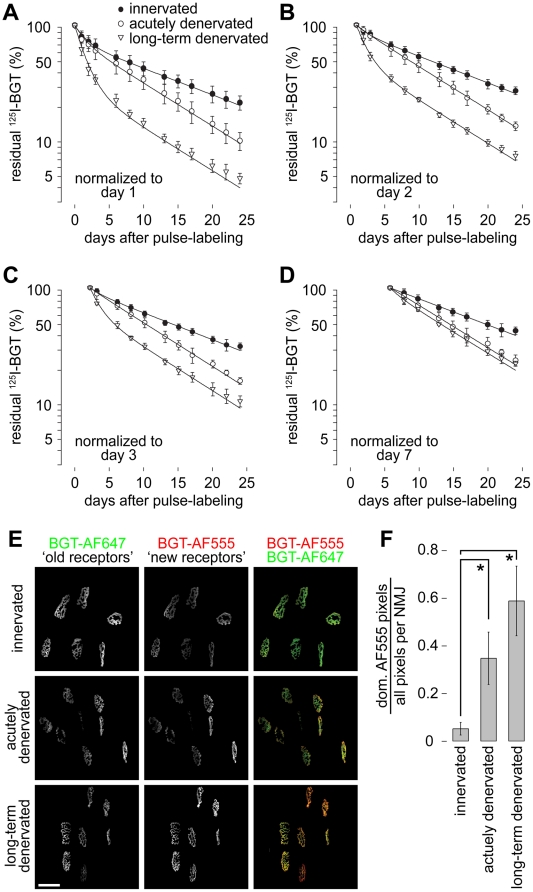
METHODOLOGY/PRINCIPAL FINDINGS: We demonstrate a novel approach to follow the kinetics of acetylcholine receptor lifetimes upon pulse labeling of mouse muscles with ¹²⁵I-α-bungarotoxin in vivo. In contrast to previous assays where residual activity was measured ex vivo, in our setup the same animals are used throughout the whole measurement period, thereby permitting a dramatic reduction of animal numbers at increased data quality. We identified three stability levels of acetylcholine receptors depending on the presence or absence of innervation: one pool of receptors with a long half-life of ∼13 days, a second with an intermediate half-life of ∼8 days, and a third with a short half-life of ∼1 day. Data were highly reproducible from animal to animal and followed simple exponential terms. The principal outcomes of these measurements were reproduced by an optical pulse-labeling assay introduced recently.
CONCLUSIONS/SIGNIFICANCE: A novel assay to determine kinetics of acetylcholine receptor turnover with small animal numbers is presented. Our data show that nerve activity acts on muscle acetylcholine receptor stability by at least two different means, one shifting receptor lifetime from short to intermediate and another, which further increases receptor stability to a long lifetime. We hypothesize on possible molecular mechanisms.
神经肌肉接头处乙酰胆碱受体的周转率受活动依赖性调节。在去神经支配和各种其他病理条件下,受体半衰期会缩短。
方法/主要发现:我们采用了一种新方法,通过在体内用 ¹²⁵I-α-银环蛇毒素脉冲标记小鼠肌肉,来研究乙酰胆碱受体寿命的动力学。与之前在体外用残余活性测量的实验不同,在我们的实验设置中,同一组动物在整个测量期间都被使用,从而在提高数据质量的同时,大大减少了动物数量。我们根据有无神经支配鉴定出了三种乙酰胆碱受体稳定性水平:半衰期约为 13 天的长半衰期受体池、半衰期约为 8 天的中等半衰期受体池和半衰期约为 1 天的短半衰期受体池。这些数据从动物到动物之间高度可重现,并且遵循简单的指数项。这些测量的主要结果被最近引入的光学脉冲标记测定法所重现。
结论/意义:提出了一种用于确定具有少量动物的乙酰胆碱受体周转率动力学的新测定法。我们的数据表明,神经活动通过至少两种不同的方式作用于肌肉乙酰胆碱受体稳定性,一种方式将受体寿命从短半衰期转变为中半衰期,另一种方式进一步增加受体稳定性,达到长半衰期。我们假设了可能的分子机制。