Department of Pharmacology, Toxicology, and Therapeutics, University of Kansas Medical Center, Kansas City, Kansas, United States of America.
PLoS One. 2011;6(5):e20307. doi: 10.1371/journal.pone.0020307. Epub 2011 May 31.
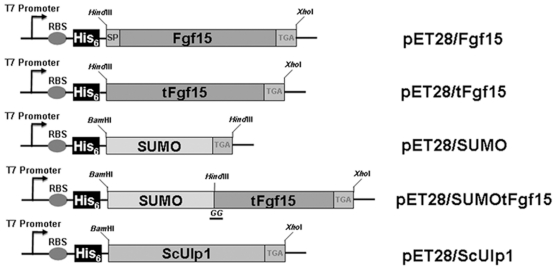
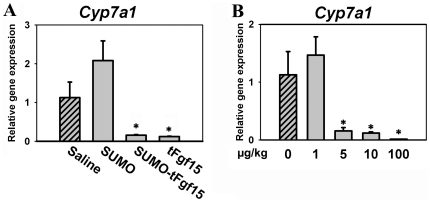
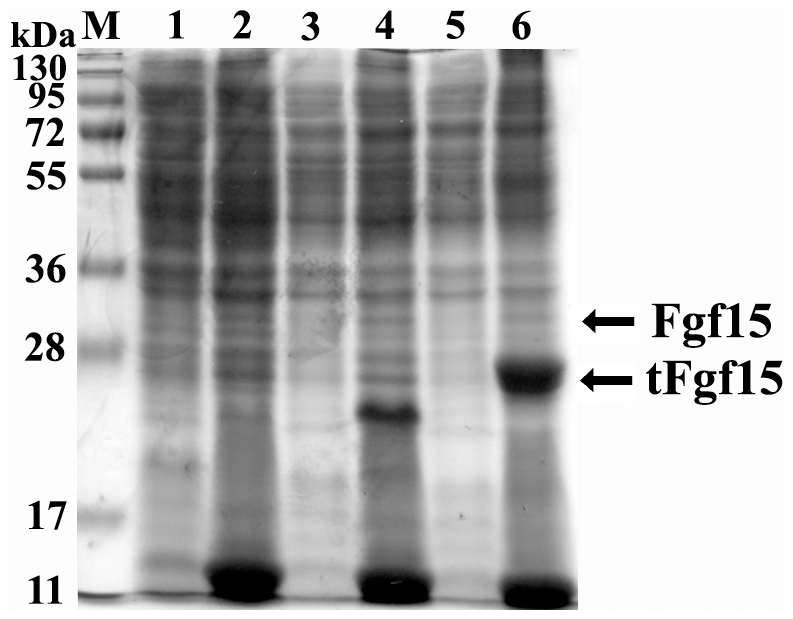
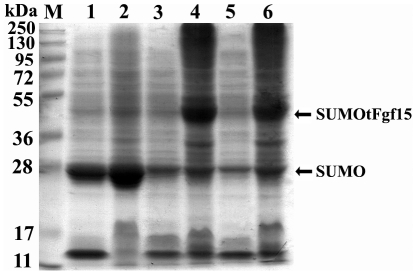
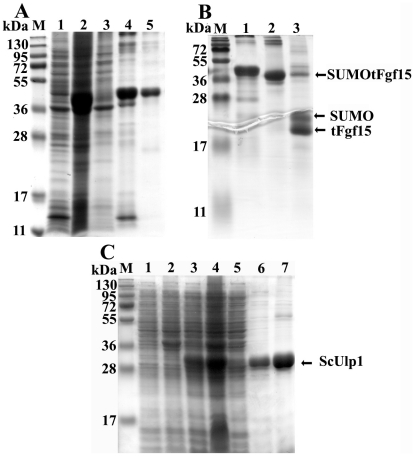
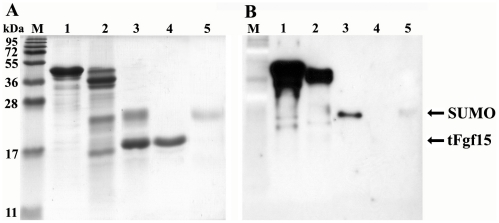
Fibroblast growth factor 15 (Fgf15) is the mouse orthologue of human FGF19. Fgf15 is highly expressed in the ileum and functions as an endocrine signal to regulate liver function, including bile acid synthesis, hepatocyte proliferation and insulin sensitivity. In order to fully understand the function of Fgf15, methods are needed to produce pure Fgf15 protein in the prokaryotic system. However, when expressed in Escherichia coli (E. coli), the recombinant Fgf15 protein was insoluble and found only in inclusion bodies. In the current study, we report a method to produce recombinant Fgf15 protein in E. coli through the use of small ubiquitin-related modifier (SUMO) fusion tag. Even though the SUMO has been shown to strongly improve protein solubility and expression levels, our studies suggest that the SUMO does not improve Fgf15 protein solubility. Instead, proper refolding of Fgf15 protein was achieved when Fgf15 was expressed as a partner protein of the fusion tag SUMO, followed by in vitro dialysis refolding. After refolding, the N-terminal SUMO tag was cleaved from the recombinant Fgf15 fusion protein by ScUlp1 (Ubiquitin-Like Protein-Specific Protease 1 from S. cerevisiae). With or without the SUMO tag, the refolded Fgf15 protein was biologically active, as revealed by its ability to reduce hepatic Cyp7a1 mRNA levels in mice. In addition, recombinant Fgf15 protein suppressed Cyp7a1 mRNA levels in a dose-dependent manner. In summary, we have developed a successful method to express functional Fgf15 protein in prokaryotic cells.
成纤维细胞生长因子 15(Fgf15)是小鼠与人源 FGF19 的同源物。Fgf15 在回肠中高度表达,作为一种内分泌信号调节肝脏功能,包括胆汁酸合成、肝细胞增殖和胰岛素敏感性。为了充分了解 Fgf15 的功能,需要在原核系统中产生纯 Fgf15 蛋白的方法。然而,当在大肠杆菌(E. coli)中表达时,重组 Fgf15 蛋白是不可溶的,仅发现于包涵体中。在本研究中,我们报告了一种通过使用小泛素相关修饰物(SUMO)融合标签在大肠杆菌中产生重组 Fgf15 蛋白的方法。尽管 SUMO 已被证明可强烈提高蛋白质的可溶性和表达水平,但我们的研究表明,SUMO 并不能提高 Fgf15 蛋白的可溶性。相反,当 Fgf15 作为融合标签 SUMO 的伴侣蛋白表达时,通过体外透析复性可实现 Fgf15 蛋白的适当重折叠。重折叠后,通过 ScUlp1(来自 S. cerevisiae 的泛素样蛋白特异性蛋白酶 1)从重组 Fgf15 融合蛋白中切割 N 端 SUMO 标签。无论是否存在 SUMO 标签,复性的 Fgf15 蛋白均具有生物活性,因为它能够降低小鼠肝脏 Cyp7a1 mRNA 水平。此外,重组 Fgf15 蛋白以剂量依赖性方式抑制 Cyp7a1 mRNA 水平。总之,我们已经成功开发了在原核细胞中表达功能性 Fgf15 蛋白的方法。