Department of Laboratory Medicine, National Taiwan University Hospital, National Taiwan University College of Medicine, Taipei, Taiwan.
Clinics (Sao Paulo). 2011;66(4):549-56. doi: 10.1590/s1807-59322011000400005.
The present study aimed to investigate the trends in changes in pulmonary function and the risk factors for pulmonary function deterioration in patients with pulmonary tuberculosis after completing treatment.
Patients usually have pulmonary function abnormalities after completing treatment for pulmonary tuberculosis. The time course for changes in pulmonary function and the risk factors for deterioration have not been well studied.
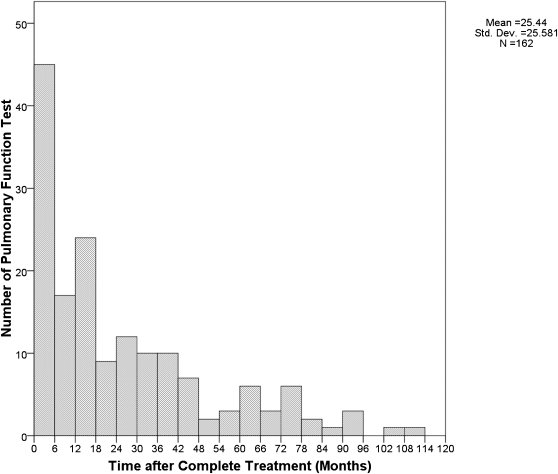
A total of 115 patients with 162 pulmonary function results were analyzed. We retrieved demographic and clinical data, radiographic scores, bacteriological data, and pulmonary function data. A generalized additive model with a locally weighted scatterplot smoothing technique was used to evaluate the trends in changes in pulmonary function. A generalized estimating equation model was used to determine the risk factors associated with deterioration of pulmonary function.
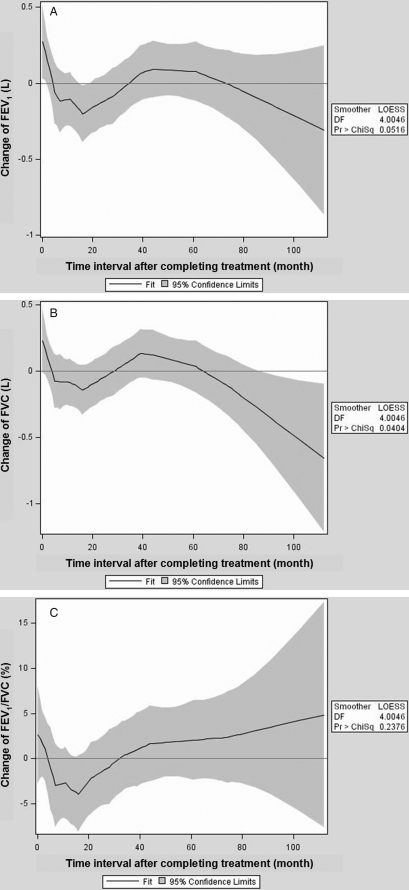
The median interval between the end of anti-tuberculosis treatment and the pulmonary function test was 16 months (range: 0 to 112 months). The nadir of pulmonary function occurred approximately 18 months after the completion of the treatment. The risk factors associated with pulmonary function deterioration included smear-positive disease, extensive pulmonary involvement prior to anti-tuberculosis treatment, prolonged anti-tuberculosis treatment, and reduced radiographic improvement after treatment.
After the completion of anti-tuberculosis TB treatment, several risk factors predicted pulmonary function deterioration. For patients with significant respiratory symptoms and multiple risk factors, the pulmonary function test should be followed up to monitor the progression of functional impairment, especially within the first 18 months after the completion of anti-tuberculosis treatment.
本研究旨在探讨肺结核患者完成治疗后肺功能变化趋势及肺功能恶化的危险因素。
肺结核患者在完成治疗后通常会出现肺功能异常。肺功能变化的时间过程以及恶化的危险因素尚未得到很好的研究。
共分析了 115 例患者的 162 项肺功能结果。我们检索了人口统计学和临床数据、影像学评分、细菌学数据和肺功能数据。使用广义加性模型和局部加权散点平滑技术评估肺功能变化的趋势。使用广义估计方程模型确定与肺功能恶化相关的危险因素。
抗结核治疗结束与肺功能测试之间的中位间隔时间为 16 个月(范围:0 至 112 个月)。肺功能的最低点出现在治疗结束后约 18 个月。与肺功能恶化相关的危险因素包括涂片阳性疾病、抗结核治疗前广泛的肺部受累、抗结核治疗时间延长以及治疗后影像学改善减少。
抗结核治疗完成后,一些危险因素预测了肺功能恶化。对于有明显呼吸道症状和多个危险因素的患者,应进行肺功能测试以监测功能损害的进展,尤其是在抗结核治疗完成后的前 18 个月内。