Health and Demographic Research Centre, CIDS, National Autonomous University, León, Nicaragua, UNAN.
BMC Public Health. 2011 Jun 9;11:455. doi: 10.1186/1471-2458-11-455.
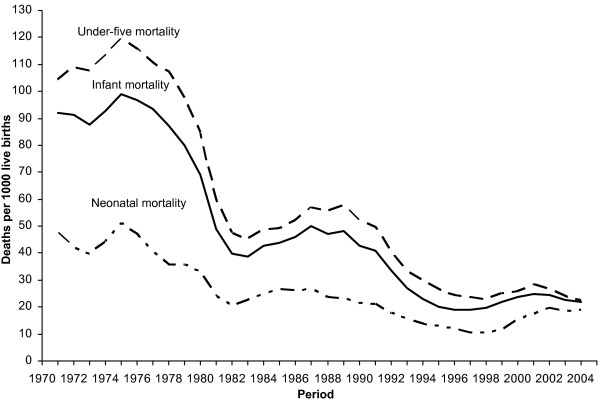
Nicaragua has made progress in the reduction of the under-five mortality since 1980s. Data for the national trends indicate that this poor Central American country is on track to reach the Millennium Development Goal-4 by 2015. Despite this progress, neonatal mortality has not showed same progress. The aim of this study is to analyse trends and social differentials in neonatal and under-five mortality in a Nicaraguan community from 1970 to 2005.
Two linked community-based reproductive surveys in 1993 and 2002 followed by a health and demographic surveillance system providing information on all births and child deaths in urban and rural areas of León municipality, Nicaragua. A total of 49 972 live births were registered.
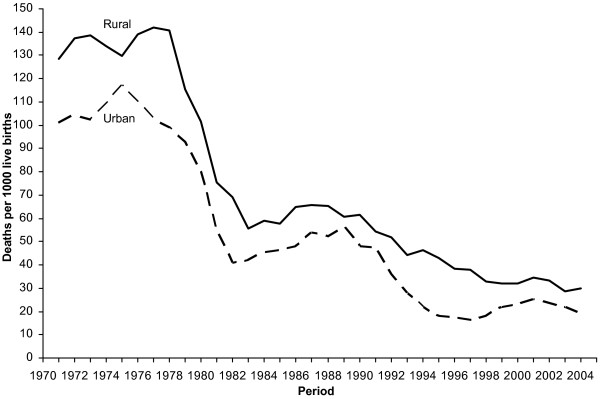
A rapid reduction in under-five mortality was observed during the late 1970s (from 103 deaths/1000 live births) and the 1980s, followed by a gradual decline to the level of 23 deaths/1000 live births in 2005. This community is on track for the Millennium Development Goal 4 for improved child survival. However, neonatal mortality increased lately in spite of a good coverage of skilled assistance at delivery. After some years in the 1990s with a very small gap in neonatal survival between children of mothers of different educational levels this divide is increasing.
After the reduction of high under-five mortality that coincided with improved equity in survival in this Nicaraguan community, the current challenge is the neonatal mortality where questions of an equitable perinatal care of good quality must be addressed.
自 20 世纪 80 年代以来,尼加拉瓜在降低五岁以下儿童死亡率方面取得了进展。全国趋势数据表明,这个贫穷的中美洲国家有望在 2015 年实现千年发展目标 4。尽管取得了这一进展,但新生儿死亡率并未显示出同样的进展。本研究旨在分析 1970 年至 2005 年期间尼加拉瓜一个社区的新生儿和五岁以下儿童死亡率的趋势和社会差异。
1993 年和 2002 年进行了两次基于社区的生殖调查,随后建立了一个健康和人口监测系统,提供了尼加拉瓜莱昂市城乡地区所有出生和儿童死亡的信息。共登记了 49972 例活产。
在 20 世纪 70 年代末(从每 1000 例活产 103 例死亡)和 80 年代,观察到五岁以下儿童死亡率的快速下降,随后逐渐下降到 2005 年的每 1000 例活产 23 例死亡。这个社区有望实现千年发展目标 4,以改善儿童生存状况。然而,尽管熟练助产人员的覆盖率很高,但最近新生儿死亡率却有所上升。在 20 世纪 90 年代的几年里,母亲受教育程度不同的儿童之间的新生儿存活率差距非常小,但现在这一差距正在扩大。
在尼加拉瓜社区降低高五岁以下儿童死亡率,同时改善生存公平性之后,目前的挑战是新生儿死亡率,必须解决高质量、公平的围产期护理问题。