Department of Neuroscience, Mount Sinai School of Medicine, New York, NY 10029, USA.
Neuroscience. 2011 Sep 15;191:148-58. doi: 10.1016/j.neuroscience.2011.05.045. Epub 2011 Jun 2.
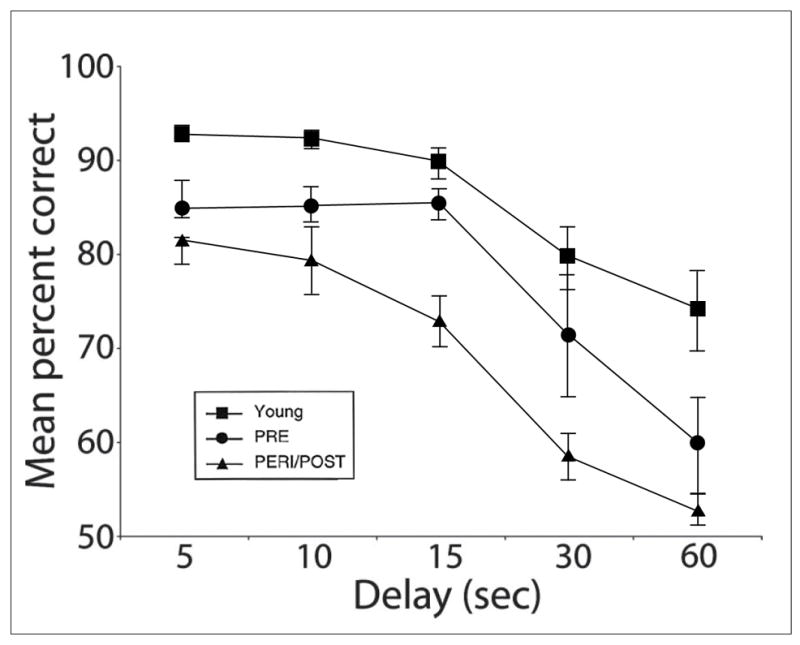
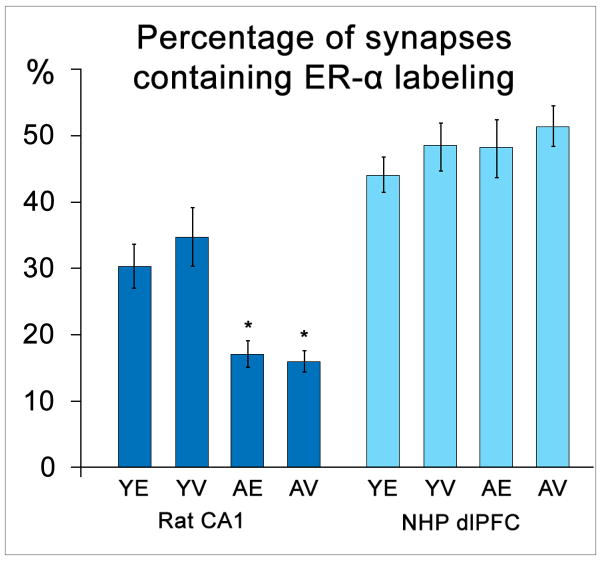
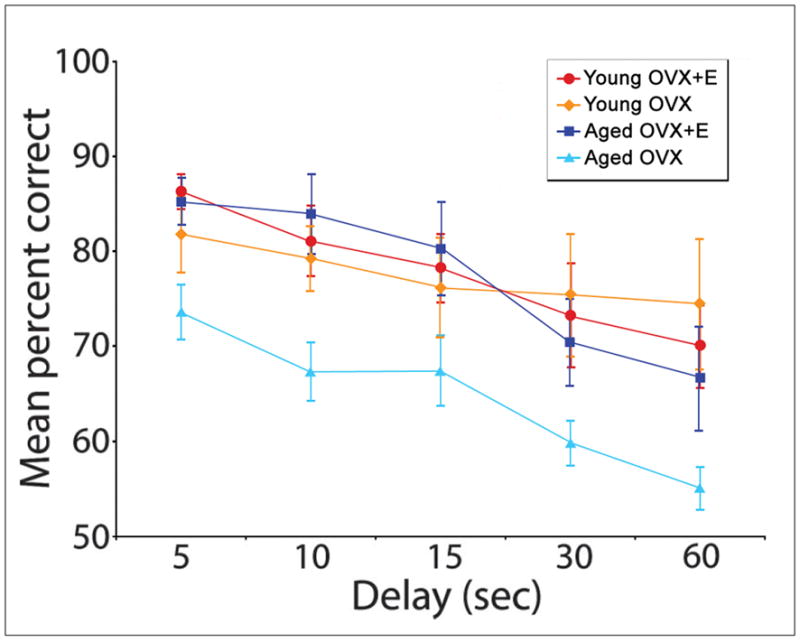
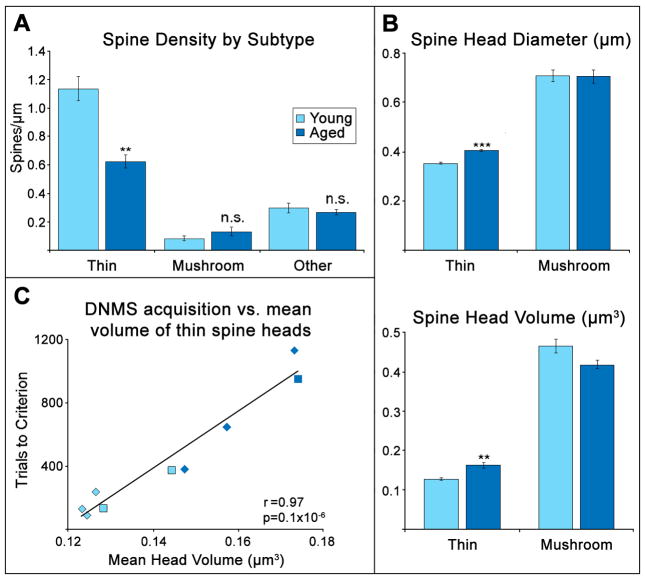
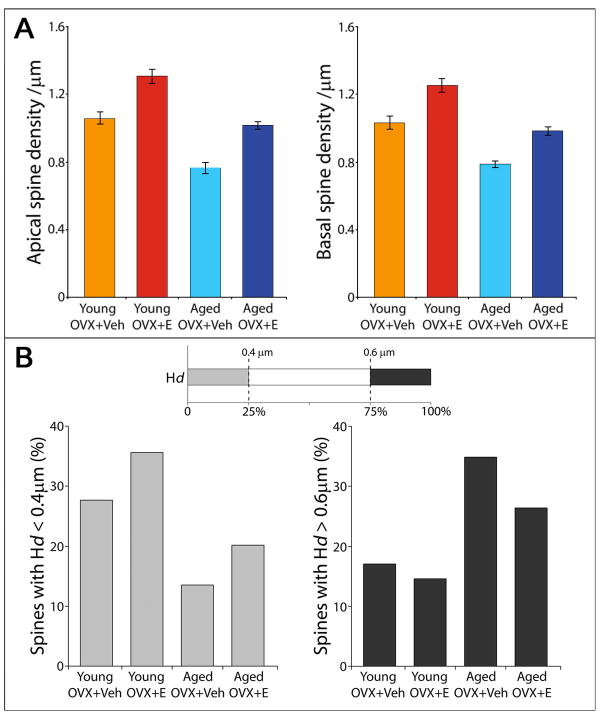
In the past few decades it has become clear that estrogen signaling plays a much larger role in modulating the cognitive centers of the brain than previously thought possible. We have developed a nonhuman primate (NHP) model to investigate the relationships between estradiol (E) and cognitive aging. Our studies of cyclical E treatment in ovariectomized (OVX) young and aged rhesus monkeys have revealed compelling cognitive and synaptic effects of E in the context of aging. Delayed response (DR), a task that is particularly dependent on integrity of dorsolateral prefrontal cortex (dlPFC) area 46 revealed the following: (1) that young OVX rhesus monkeys perform equally well whether treated with E or vehicle (V), and (2) that aged OVX animals given E perform as well as young adults with or without E, whereas OVX V-treated aged animals display significant DR impairment. We have analyzed the structure of layer III pyramidal cells in area 46 in these same monkeys. We found both age and treatment effects on these neurons that are consistent with behavioral data. Briefly, reconstructions of pyramidal neurons in area 46 from these monkeys showed that cyclical E increased the density of small, thin spines in both young and aged monkeys. However, this effect of E was against a background of age-related loss of small, thin spines, leaving aged V-treated monkeys with a particularly low density of these highly plastic spines, and vulnerable to cognitive decline. Our current interpretation is that E not only plays a critically important role in maintaining spine number, but also enables synaptic plasticity through a cyclical increase in small highly plastic spines that may be stabilized in the context of learning. Interestingly, recent studies demonstrate that chronic E is less effective at inducing spinogenesis than cyclical E. We have begun to link certain molecular attributes of excitatory synapses in area 46 to E effects and cognitive performance in these monkeys. Given the importance of synaptic estrogen receptor α (ER-α) in rat hippocampus, we focused our initial studies on synaptic ER-α in area 46. Three key findings have emerged from these studies: (1) synaptic ER-α is present in axospinous synapses in area 46; (2) it is stable across treatment and age groups (which is not the case in rat hippocampus); and (3) the abundance and distribution of synaptic ER-α is a key correlate of individual variation in cognitive performance in certain age and treatment groups. These findings have important implications for the design of hormone treatment strategies for both surgically and naturally menopausal women. This article is part of a Special Issue entitled: Neuroactive Steroids: Focus on Human Brain.
在过去的几十年中,人们已经清楚地认识到,雌激素信号在调节大脑认知中枢方面发挥着比以前认为的更为重要的作用。我们已经开发了一种非人类灵长类动物(NHP)模型,以研究雌二醇(E)与认知衰老之间的关系。我们对去卵巢(OVX)年轻和老年恒河猴进行周期性 E 治疗的研究揭示了 E 在衰老背景下对认知和突触的强烈影响。延迟反应(DR)是一项特别依赖背外侧前额叶皮层(dlPFC)区域 46 完整性的任务,结果表明:(1)年轻 OVX 恒河猴无论接受 E 还是载体(V)治疗,表现都一样好,(2)接受 E 的老年 OVX 动物的表现与年轻成年人一样好,无论是否接受 E,而接受 OVX V 治疗的老年动物则表现出明显的 DR 损伤。我们已经分析了这些猴子同一区域 46 中 III 层锥体神经元的结构。我们发现,这些神经元存在年龄和治疗的影响,与行为数据一致。简而言之,对这些猴子的锥体神经元进行重建表明,周期性 E 增加了年轻和老年猴子中小而细的棘突密度。然而,E 的这种作用是在与年龄相关的小而细的棘突丧失的背景下发生的,这使得老年 V 治疗的猴子具有特别低的这些高可塑性棘突密度,并容易发生认知能力下降。我们目前的解释是,E 不仅在维持棘突数量方面起着至关重要的作用,而且还通过周期性增加小而高度可塑性的棘突来实现突触可塑性,这些棘突可能在学习的背景下得到稳定。有趣的是,最近的研究表明,慢性 E 诱导棘突生成的效果不如周期性 E。我们已经开始将某些兴奋性突触在区域 46 中的分子属性与这些猴子的 E 效应和认知表现联系起来。鉴于突触雌激素受体 α(ER-α)在大鼠海马中的重要性,我们最初的研究集中在区域 46 中的突触 ER-α 上。这些研究有三个关键发现:(1)突触 ER-α存在于区域 46 的轴突棘突触中;(2)它在治疗和年龄组之间是稳定的(这与大鼠海马体中的情况不同);(3)突触 ER-α的丰度和分布是某些年龄和治疗组个体认知表现差异的关键相关因素。这些发现对设计手术和自然绝经妇女的激素治疗策略具有重要意义。本文是特刊的一部分,特刊标题为:神经活性甾体:聚焦人类大脑。