Biotechnology and Food Research, MTT, Jokioinen, 31600, Finland.
BMC Genet. 2011 Jun 13;12:55. doi: 10.1186/1471-2156-12-55.
Occurrence of blood and meat inclusions is an internal egg quality defect. Mass candling reveals most of the spots, but because brown eggshell hampers selection in brown chicken lines it has not been possible to eliminate the defect by selection. Estimated frequency of blood and meat inclusions in brown layers is about 18% whereas it is 0.5% in white egg layers. Several factors are known to increase the incidence of this fault: genetic background, low level of vitamin A and/or D, stress or infections, for instance. To study the genetic background of the defect, a mapping population of 1599 F2 hens from a cross of White Rock and Rhode Island Red lines was set up.
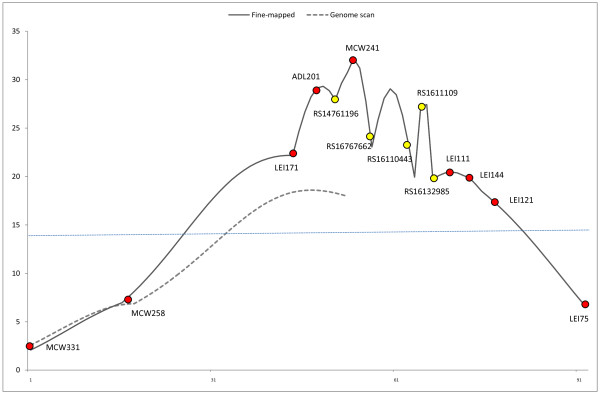
Our histopathological analyses show that blood spots consist of mainly erythrocytes and that meat spots are accumulations of necrotic material. Linkage analysis of 27 chromosomes with 162 microsatellite markers revealed one significant quantitative trait locus (QTL) affecting blood spot and meat spot frequency. We sequenced a fragment of a candidate gene within the region, ZO-2, coding for a tight junction protein. Nine polymorphisms were detected and two of them were included in fine-mapping and association analysis. Fine-mapping defined the QTL result. To further verify the QTL, association analyses were carried out in two independent commercial breeding lines with the marker MCW241 and surrounding SNPs. Association was found mainly in a 0.8 Mb-wide chromosomal area on GGAZ.
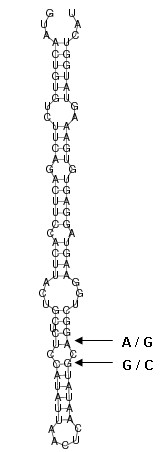
There was good agreement between the location of the QTL region on chromosome Z and the association results in the commercial breeds analyzed. Variations found in tight junction protein ZO-2 and microRNA gga-mir-1556 may predispose egg layers to blood and meat spot defects. This paper describes the first results of detailed QTL analyses of the blood and meat spots trait(s) in chickens.
血斑和肉斑的出现是一种内部蛋品质缺陷。大规模照蛋可以发现大多数斑点,但由于褐壳鸡种的褐壳妨碍了选择,因此无法通过选择消除这种缺陷。褐壳蛋鸡中血斑和肉斑的估计发生率约为 18%,而白壳蛋鸡中为 0.5%。已知有几个因素会增加这种缺陷的发生率:遗传背景、维生素 A 和/或 D 水平低、应激或感染等。为了研究该缺陷的遗传背景,我们建立了一个由白洛克和罗得岛红杂交的 1599 只 F2 母鸡组成的图谱群体。
我们的组织病理学分析表明,血斑主要由红细胞组成,肉斑是坏死物质的堆积。用 162 个微卫星标记对 27 条染色体进行连锁分析,发现一个影响血斑和肉斑频率的显著数量性状位点(QTL)。我们在该区域内的一个候选基因 ZO-2 中测序了一个片段,该基因编码一种紧密连接蛋白。检测到 9 个多态性,其中 2 个包含在精细定位和关联分析中。精细定位确定了 QTL 结果。为了进一步验证 QTL,我们在两个独立的商业育种群中用标记 MCW241 和周围的 SNPs 进行了关联分析。关联主要在 GGAZ 上一个 0.8Mb 宽的染色体区域中发现。
在染色体 Z 上 QTL 区域的位置和在分析的商业品种中的关联结果之间存在良好的一致性。在紧密连接蛋白 ZO-2 和 microRNA gga-mir-1556 中发现的变异可能使蛋鸡易患血斑和肉斑缺陷。本文描述了鸡血液和肉斑(多个)性状的详细 QTL 分析的首次结果。