Centre for Adolescent Health, Murdoch Childrens Research Institute, Royal Children's Hospital, Melbourne, Victoria, Australia.
J Affect Disord. 2011 Nov;134(1-3):151-9. doi: 10.1016/j.jad.2011.05.022. Epub 2011 Jun 13.
Adolescence is a key life period for the development of depression. Predicting the development of depression in adolescence through detecting specific early symptoms may aid in the development of timely screening and intervention programmes.
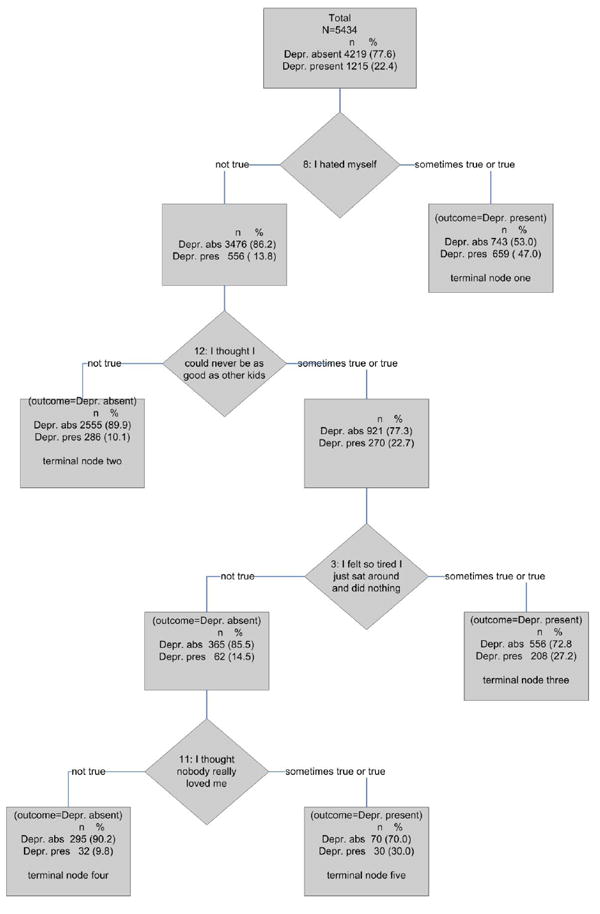
We administered the Short Mood and Feelings Questionnaire (SMFQ) to 5769 American and Australian students aged 10 to 15 years, at two time points, separated by 12 months. We attempted to predict high levels of depression symptoms at 12 months from symptoms at baseline, using statistical approaches based upon the quality, as well as the quantity, of depression symptoms present. These approaches included classification and regression trees (CART) and logistic regression.
A classification tree employing four SMFQ items, such as feelings of self-hatred and of being unloved, performed almost as well as all 13 SMFQ items at predicting subsequent depression symptomatology.
Depression was measured using a self-report instrument, rather than a criterion standard diagnostic interview.
Further validation on other populations of adolescents is required: however the results suggest that several symptoms of depression, especially feelings of self-hatred, and being unloved, are associated with increased levels of self-reported depression at 12 months post baseline. Although screening for depression can be problematic, symptoms such as the ones above should be considered for inclusion in screening tests for adolescents.
青春期是抑郁症发展的关键时期。通过检测特定的早期症状来预测青少年抑郁症的发展,可能有助于及时开展筛查和干预计划。
我们对 5769 名 10 至 15 岁的美国和澳大利亚学生进行了短期情绪和感觉问卷(SMFQ)测试,两次测试时间间隔为 12 个月。我们试图使用基于抑郁症状的质量和数量的统计方法,从基线时的症状预测 12 个月时的高水平抑郁症状。这些方法包括分类和回归树(CART)和逻辑回归。
采用四个 SMFQ 项目(如自我仇恨感和不被爱的感觉)的分类树,在预测随后的抑郁症状方面的表现几乎与 13 个 SMFQ 项目一样好。
使用自我报告工具而非标准诊断访谈来衡量抑郁。
需要在其他青少年人群中进一步验证;然而,结果表明,几种抑郁症状,尤其是自我仇恨感和不被爱的感觉,与基线后 12 个月自我报告的抑郁水平升高有关。虽然抑郁筛查可能存在问题,但上述症状应考虑纳入青少年筛查测试。