Social Development Research Group, University of Washington, Seattle, WA, USA.
Child Adolesc Psychiatry Ment Health. 2010 Feb 9;4(1):8. doi: 10.1186/1753-2000-4-8.
The use of short screening questionnaires may be a promising option for identifying children at risk for depression in a community setting. The objective of this study was to assess the validity of the Short Mood and Feelings Questionnaire (SMFQ) and one- and two-item screening instruments for depressive disorders in a school-based sample of young adolescents.
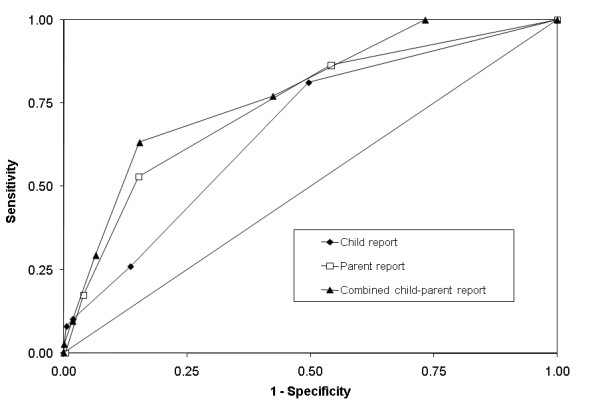
Participants were 521 sixth-grade students attending public middle schools. Child and parent versions of the SMFQ were administered to evaluate the child's depressive symptoms. The presence of any depressive disorder during the previous month was assessed using the Diagnostic Interview Schedule for Children (DISC) as the criterion standard. First, we assessed the diagnostic accuracy of child, parent, and combined scores of the full 13-item SMFQ by calculating the area under the receiver operating characteristic curve (AUC), sensitivity and specificity. The same approach was then used to evaluate the accuracy of a two-item scale consisting of only depressed mood and anhedonia items, and a single depressed mood item.
The combined child + parent SMFQ score showed the highest accuracy (AUC = 0.86). Diagnostic accuracy was lower for child (AUC = 0.73) and parent (AUC = 0.74) SMFQ versions. Corresponding versions of one- and two-item screens had lower AUC estimates, but the combined versions of the brief screens each still showed moderate accuracy. Furthermore, child and combined versions of the two-item screen demonstrated higher sensitivity (although lower specificity) than either the one-item screen or the full SMFQ.
Under conditions where parents accompany children to screening settings (e.g. primary care), use of a child + parent version of the SMFQ is recommended. However, when parents are not available, and the cost of a false positive result is minimal, then a one- or two-item screen may be useful for initial identification of at-risk youth.
在社区环境中,使用简短的筛查问卷可能是识别儿童抑郁风险的一种很有前途的选择。本研究的目的是评估短情绪和感觉问卷(SMFQ)以及用于青少年学校样本中抑郁障碍的一和两个项目筛查工具的有效性。
参与者为参加公立中学六年级的 521 名学生。对儿童和家长版 SMFQ 进行管理,以评估儿童的抑郁症状。使用儿童诊断访谈表(DISC)作为标准,评估前一个月是否存在任何抑郁障碍。首先,我们通过计算接收者操作特征曲线(AUC)、敏感性和特异性,评估了儿童、父母和完整的 13 项 SMFQ 总分的诊断准确性。然后,我们使用相同的方法评估了仅由抑郁情绪和快感缺失项目组成的两个项目量表以及一个抑郁情绪项目的准确性。
联合儿童+父母的 SMFQ 评分显示出最高的准确性(AUC = 0.86)。儿童(AUC = 0.73)和父母(AUC = 0.74)SMFQ 版本的诊断准确性较低。一个和两个项目筛查的相应版本具有较低的 AUC 估计值,但简短筛查的联合版本仍然显示出中等准确性。此外,两个项目筛查的儿童和联合版本的敏感性较高(尽管特异性较低),而不是一个项目筛查或完整的 SMFQ。
在父母陪同儿童进行筛查的情况下(例如初级保健),建议使用儿童+父母版的 SMFQ。但是,当父母无法到场且假阳性结果的成本最小化时,一或两个项目的筛查可能有助于初步识别高危青年。