• 文献检索
  • 文档翻译
  • 深度研究
  • 学术资讯
  • Suppr Zotero 插件Zotero 插件
  • 邀请有礼
  • 套餐&价格
  • 历史记录
应用&插件
Suppr Zotero 插件Zotero 插件浏览器插件Mac 客户端Windows 客户端微信小程序
定价
高级版会员购买积分包购买API积分包
服务
文献检索文档翻译深度研究API 文档MCP 服务
关于我们
关于 Suppr公司介绍联系我们用户协议隐私条款
关注我们

Suppr 超能文献

核心技术专利:CN118964589B侵权必究
粤ICP备2023148730 号-1Suppr @ 2026

文献检索

告别复杂PubMed语法,用中文像聊天一样搜索,搜遍4000万医学文献。AI智能推荐,让科研检索更轻松。

立即免费搜索

文件翻译

保留排版,准确专业,支持PDF/Word/PPT等文件格式,支持 12+语言互译。

免费翻译文档

深度研究

AI帮你快速写综述,25分钟生成高质量综述,智能提取关键信息,辅助科研写作。

立即免费体验

中美洲流浪蜘蛛 Cupiennius salei 的胚胎发育。

The embryonic development of the central American wandering spider Cupiennius salei.

机构信息

Humboldt-Universität zu Berlin Institut für Biologie/Vergleichende Zoologie Philippstraße 13, 10115 Berlin, Germany.

Universität zu Köln Institut für Genetik, Zülpicher Straße 47a, 50674 Köln, Germany.

出版信息

Front Zool. 2011 Jun 14;8(1):15. doi: 10.1186/1742-9994-8-15.

DOI:10.1186/1742-9994-8-15
PMID:21672209
原文链接:https://pmc.ncbi.nlm.nih.gov/articles/PMC3141654/
Abstract

BACKGROUND

The spider Cupiennius salei (Keyserling 1877) has become an important study organism in evolutionary and developmental biology. However, the available staging system for its embryonic development is difficult to apply to modern studies, with strong bias towards the earliest developmental stages. Furthermore, important embryonic events are poorly understood. We address these problems, providing a new description of the embryonic development of C. salei. The paper also discusses various observations that will improve our understanding of spider development.

RESULTS

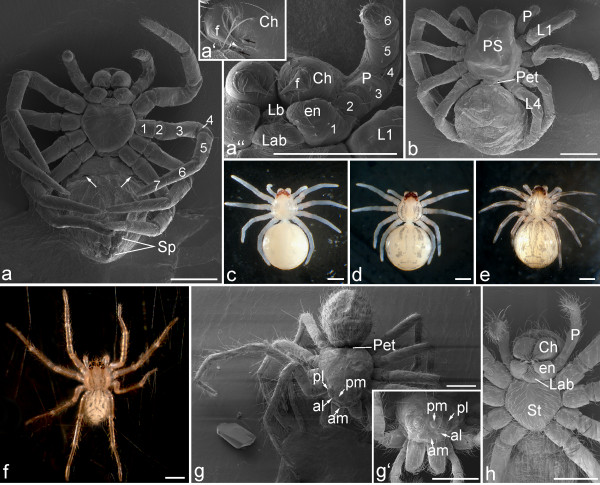
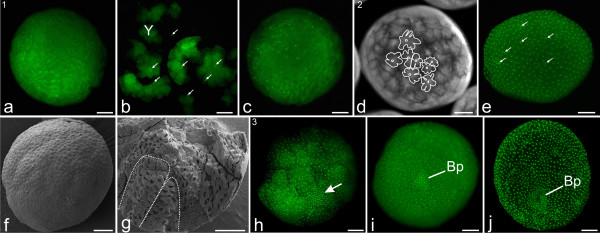
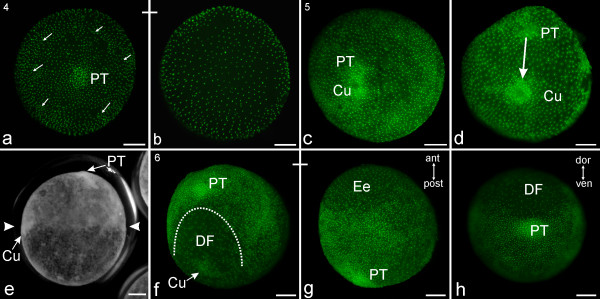
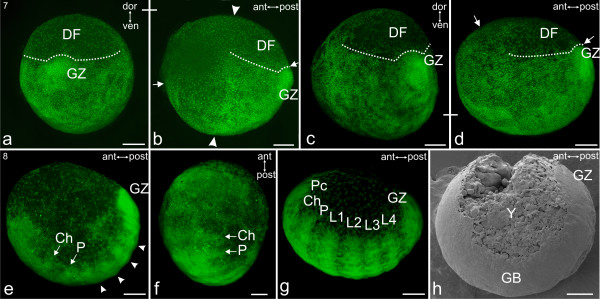
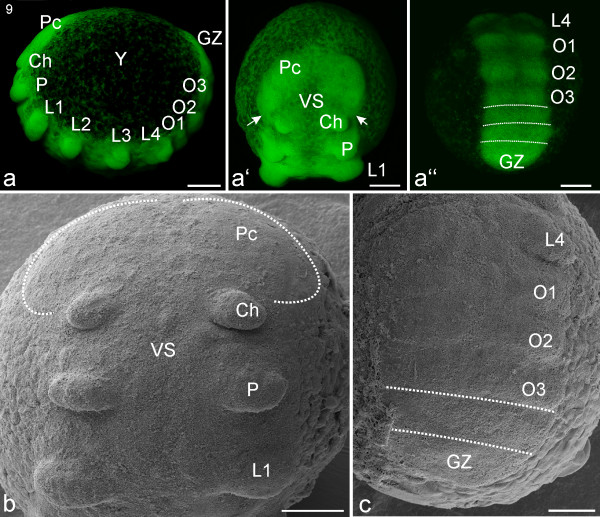
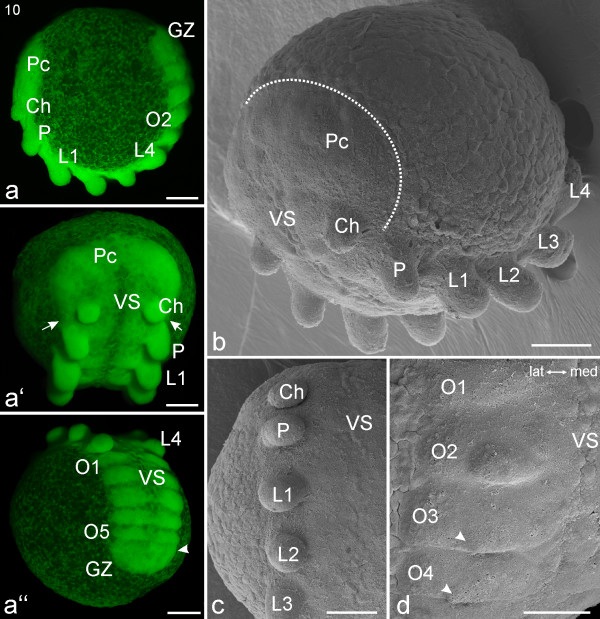
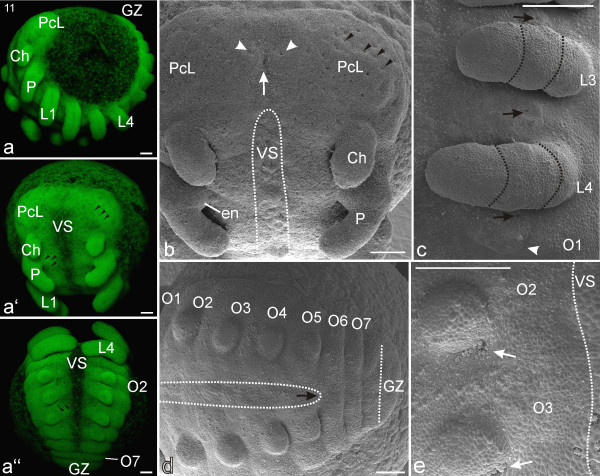
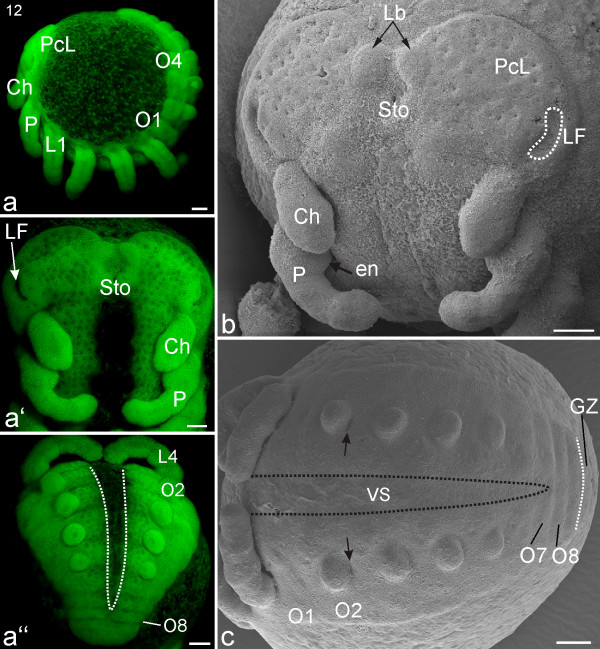
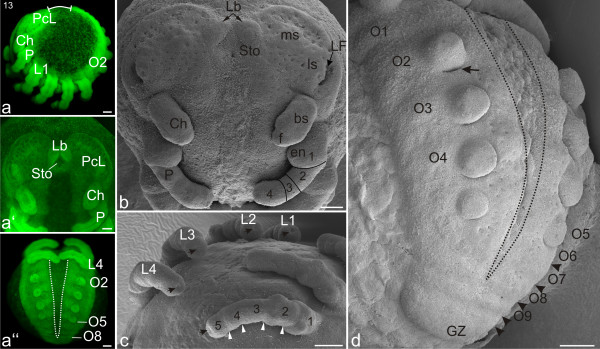
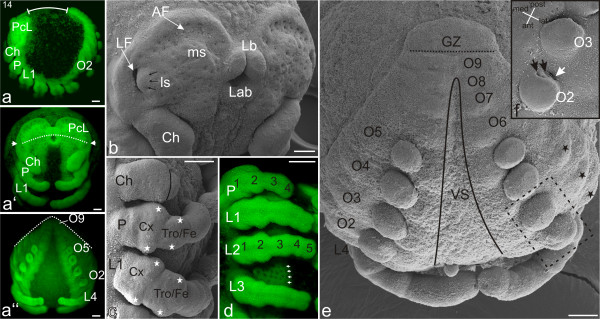
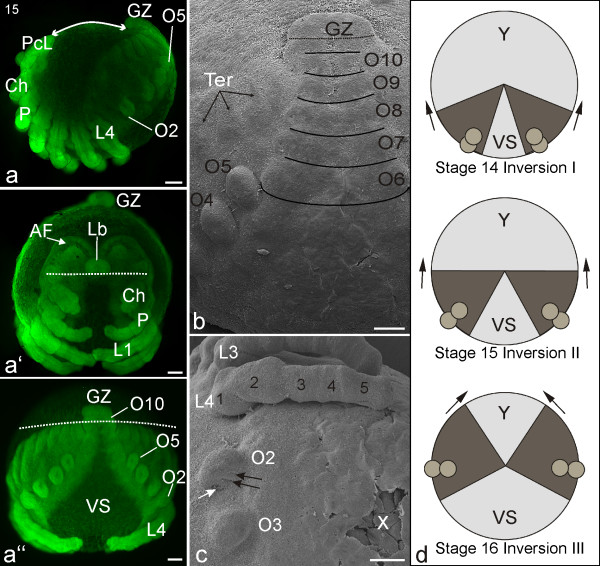
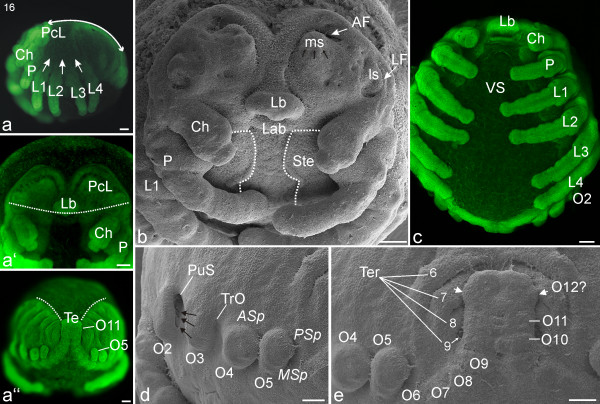
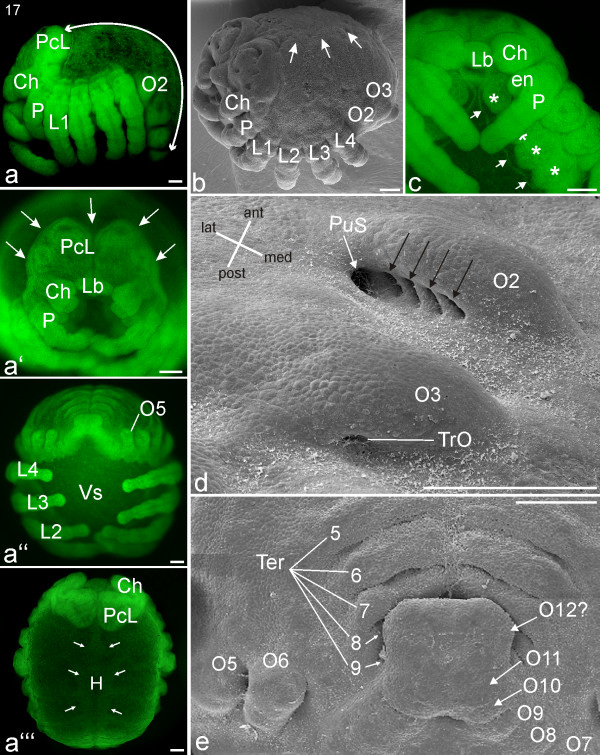
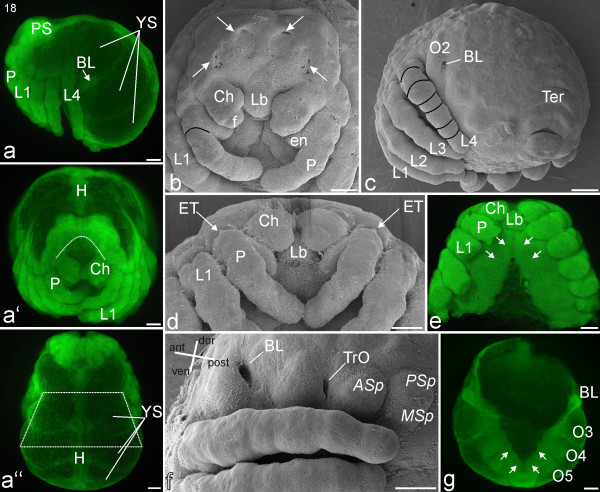
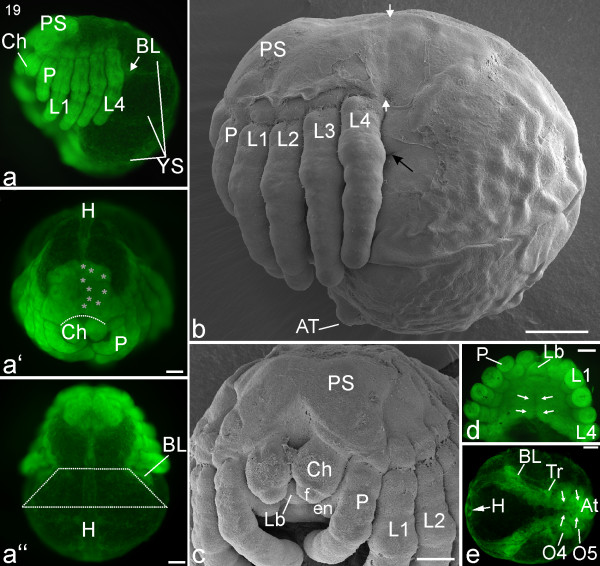
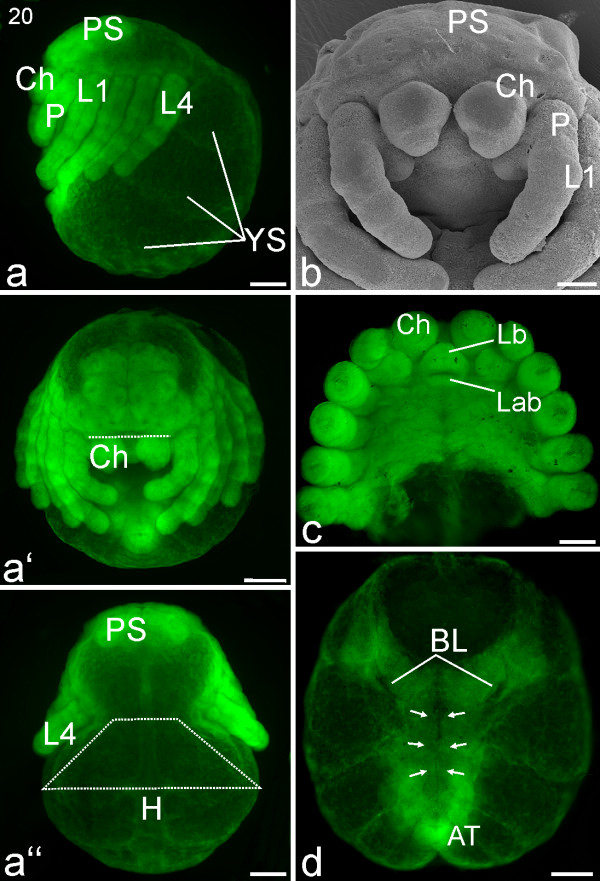
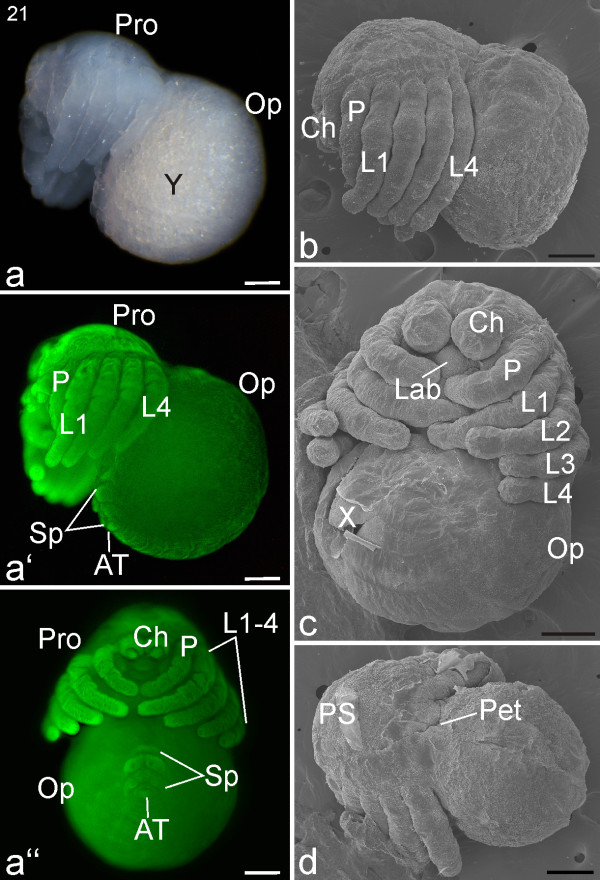
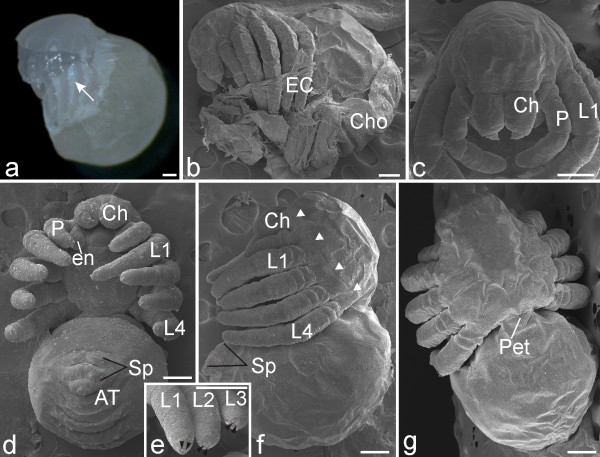
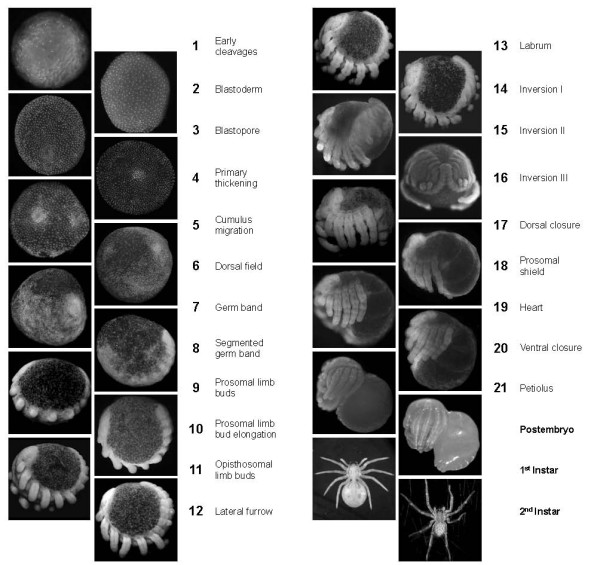
Conspicuous developmental events were used to define numbered stages 1 to 21. Stages 1 to 9 follow the existing staging system for the spider Achaearanea tepidariorum, and stages 10 to 21 provide a high-resolution description of later development. Live-embryo imaging shows cell movements during the earliest formation of embryonic tissue in C. salei. The imaging procedure also elucidates the encircling border between the cell-dense embryo hemisphere and the hemisphere with much lower cell density (a structure termed 'equator' in earlier studies). This border results from subsurface migration of primordial mesendodermal cells from their invagination site at the blastopore. Furthermore, our detailed successive sequence shows: 1) early differentiation of the precheliceral neuroectoderm; 2) the morphogenetic process of inversion and 3) initial invaginations of the opisthosomal epithelium for the respiratory system.

CONCLUSIONS

Our improved staging system of development in C. salei development should be of considerable value to future comparative studies of animal development. A dense germ disc is not evident during development in C. salei, but we show that the gastrulation process is similar to that in spider species that do have a dense germ disc. In the opisthosoma, the order of appearance of precursor epithelial invaginations provides evidence for the non-homology of the tracheal and book lung respiratory systems.

摘要

背景

蜘蛛 Cupiennius salei(Keyserling 1877)已成为进化和发育生物学的重要研究生物。然而,现有的胚胎发育分期系统难以应用于现代研究,对早期发育阶段存在强烈的偏见。此外,重要的胚胎事件理解得还不够充分。我们解决了这些问题,提供了对 C. salei 胚胎发育的新描述。本文还讨论了各种观察结果,这些结果将有助于我们更好地理解蜘蛛的发育。

结果

显著的发育事件被用来定义编号为 1 到 21 的阶段。阶段 1 到 9 遵循现有的蜘蛛 Achaearanea tepidariorum 的分期系统,阶段 10 到 21 提供了后期发育的高分辨率描述。活胚胎成像显示了 C. salei 中胚胎组织最早形成过程中的细胞运动。该成像程序还阐明了细胞密集的胚胎半球和细胞密度较低的半球之间的环绕边界(在早期研究中称为“赤道”)。该边界是由原始中胚层细胞从胚孔处的内陷位置向下方迁移形成的。此外,我们详细的连续序列显示:1)前螯神经外胚层的早期分化;2)反转的形态发生过程;3)呼吸系统的后体上皮的初始内陷。

结论

我们对 C. salei 发育的改进的发育分期系统应该对未来的动物发育比较研究具有相当大的价值。在 C. salei 的发育过程中,没有明显的密集生殖盘,但我们表明,原肠胚形成过程与具有密集生殖盘的蜘蛛物种相似。在后体部,前体上皮内陷出现的顺序为气管和书肺呼吸系统的非同源性提供了证据。
https://cdn.ncbi.nlm.nih.gov/pmc/blobs/8dc9/3141654/ba52921bd0c9/1742-9994-8-15-19.jpg
https://cdn.ncbi.nlm.nih.gov/pmc/blobs/8dc9/3141654/5a107638fc1f/1742-9994-8-15-1.jpg
https://cdn.ncbi.nlm.nih.gov/pmc/blobs/8dc9/3141654/ac3319ccfecd/1742-9994-8-15-2.jpg
https://cdn.ncbi.nlm.nih.gov/pmc/blobs/8dc9/3141654/691ebc91552f/1742-9994-8-15-3.jpg
https://cdn.ncbi.nlm.nih.gov/pmc/blobs/8dc9/3141654/efba41b57b9b/1742-9994-8-15-4.jpg
https://cdn.ncbi.nlm.nih.gov/pmc/blobs/8dc9/3141654/1aa69a172cd6/1742-9994-8-15-5.jpg
https://cdn.ncbi.nlm.nih.gov/pmc/blobs/8dc9/3141654/0153f5b1486e/1742-9994-8-15-6.jpg
https://cdn.ncbi.nlm.nih.gov/pmc/blobs/8dc9/3141654/b874c2dc895f/1742-9994-8-15-7.jpg
https://cdn.ncbi.nlm.nih.gov/pmc/blobs/8dc9/3141654/05d5fc2bbf48/1742-9994-8-15-8.jpg
https://cdn.ncbi.nlm.nih.gov/pmc/blobs/8dc9/3141654/28a99566db85/1742-9994-8-15-9.jpg
https://cdn.ncbi.nlm.nih.gov/pmc/blobs/8dc9/3141654/31ae4ce3633e/1742-9994-8-15-10.jpg
https://cdn.ncbi.nlm.nih.gov/pmc/blobs/8dc9/3141654/45eed336a2c0/1742-9994-8-15-11.jpg
https://cdn.ncbi.nlm.nih.gov/pmc/blobs/8dc9/3141654/4eeca20b05ad/1742-9994-8-15-12.jpg
https://cdn.ncbi.nlm.nih.gov/pmc/blobs/8dc9/3141654/7799336a4eed/1742-9994-8-15-13.jpg
https://cdn.ncbi.nlm.nih.gov/pmc/blobs/8dc9/3141654/f55dcf04c31b/1742-9994-8-15-14.jpg
https://cdn.ncbi.nlm.nih.gov/pmc/blobs/8dc9/3141654/00901faaae58/1742-9994-8-15-15.jpg
https://cdn.ncbi.nlm.nih.gov/pmc/blobs/8dc9/3141654/80cb9a0b64cd/1742-9994-8-15-16.jpg
https://cdn.ncbi.nlm.nih.gov/pmc/blobs/8dc9/3141654/d626baaefd18/1742-9994-8-15-17.jpg
https://cdn.ncbi.nlm.nih.gov/pmc/blobs/8dc9/3141654/1dff11745ef3/1742-9994-8-15-18.jpg
https://cdn.ncbi.nlm.nih.gov/pmc/blobs/8dc9/3141654/ba52921bd0c9/1742-9994-8-15-19.jpg
https://cdn.ncbi.nlm.nih.gov/pmc/blobs/8dc9/3141654/5a107638fc1f/1742-9994-8-15-1.jpg
https://cdn.ncbi.nlm.nih.gov/pmc/blobs/8dc9/3141654/ac3319ccfecd/1742-9994-8-15-2.jpg
https://cdn.ncbi.nlm.nih.gov/pmc/blobs/8dc9/3141654/691ebc91552f/1742-9994-8-15-3.jpg
https://cdn.ncbi.nlm.nih.gov/pmc/blobs/8dc9/3141654/efba41b57b9b/1742-9994-8-15-4.jpg
https://cdn.ncbi.nlm.nih.gov/pmc/blobs/8dc9/3141654/1aa69a172cd6/1742-9994-8-15-5.jpg
https://cdn.ncbi.nlm.nih.gov/pmc/blobs/8dc9/3141654/0153f5b1486e/1742-9994-8-15-6.jpg
https://cdn.ncbi.nlm.nih.gov/pmc/blobs/8dc9/3141654/b874c2dc895f/1742-9994-8-15-7.jpg
https://cdn.ncbi.nlm.nih.gov/pmc/blobs/8dc9/3141654/05d5fc2bbf48/1742-9994-8-15-8.jpg
https://cdn.ncbi.nlm.nih.gov/pmc/blobs/8dc9/3141654/28a99566db85/1742-9994-8-15-9.jpg
https://cdn.ncbi.nlm.nih.gov/pmc/blobs/8dc9/3141654/31ae4ce3633e/1742-9994-8-15-10.jpg
https://cdn.ncbi.nlm.nih.gov/pmc/blobs/8dc9/3141654/45eed336a2c0/1742-9994-8-15-11.jpg
https://cdn.ncbi.nlm.nih.gov/pmc/blobs/8dc9/3141654/4eeca20b05ad/1742-9994-8-15-12.jpg
https://cdn.ncbi.nlm.nih.gov/pmc/blobs/8dc9/3141654/7799336a4eed/1742-9994-8-15-13.jpg
https://cdn.ncbi.nlm.nih.gov/pmc/blobs/8dc9/3141654/f55dcf04c31b/1742-9994-8-15-14.jpg
https://cdn.ncbi.nlm.nih.gov/pmc/blobs/8dc9/3141654/00901faaae58/1742-9994-8-15-15.jpg
https://cdn.ncbi.nlm.nih.gov/pmc/blobs/8dc9/3141654/80cb9a0b64cd/1742-9994-8-15-16.jpg
https://cdn.ncbi.nlm.nih.gov/pmc/blobs/8dc9/3141654/d626baaefd18/1742-9994-8-15-17.jpg
https://cdn.ncbi.nlm.nih.gov/pmc/blobs/8dc9/3141654/1dff11745ef3/1742-9994-8-15-18.jpg
https://cdn.ncbi.nlm.nih.gov/pmc/blobs/8dc9/3141654/ba52921bd0c9/1742-9994-8-15-19.jpg

相似文献

1
The embryonic development of the central American wandering spider Cupiennius salei.中美洲流浪蜘蛛 Cupiennius salei 的胚胎发育。
Front Zool. 2011 Jun 14;8(1):15. doi: 10.1186/1742-9994-8-15.
2
Embryonic development and staging of the cobweb spider Parasteatoda tepidariorum C. L. Koch, 1841 (syn.: Achaearanea tepidariorum; Araneomorphae; Theridiidae).蛛网蜘蛛 Parasteatoda tepidariorum C. L. Koch, 1841(同义词:Achaearanea tepidariorum;Araneomorphae;Theridiidae)的胚胎发育和分期。
Dev Genes Evol. 2012 Jul;222(4):189-216. doi: 10.1007/s00427-012-0401-0. Epub 2012 May 9.
3
Progressive activation of Delta-Notch signaling from around the blastopore is required to set up a functional caudal lobe in the spider Achaearanea tepidariorum.在蜘蛛温驯遁蛛(Achaearanea tepidariorum)中,从原肠胚孔周围逐渐激活Delta-Notch信号对于形成功能性尾叶是必需的。
Development. 2007 Jun;134(12):2195-205. doi: 10.1242/dev.004598. Epub 2007 May 16.
4
The American Wandering Spider Cupiennius salei.美洲游走蛛——卡布蜘蛛
CSH Protoc. 2008 Oct 1;2008:pdb.emo103. doi: 10.1101/pdb.emo103.
5
The embryonic origin of the ampullate silk glands of the spider Cupiennius salei.蜘蛛Cupiennius salei壶腹状丝腺的胚胎起源。
Arthropod Struct Dev. 2015 May;44(3):280-8. doi: 10.1016/j.asd.2015.04.001. Epub 2015 Apr 13.
6
Cupiennius salei and Achaearanea tepidariorum: Spider models for investigating evolution and development.巴西游走蛛和温室拟壁钱:用于研究进化与发育的蜘蛛模型。
Bioessays. 2008 May;30(5):487-98. doi: 10.1002/bies.20744.
7
Transcriptome Analysis of the Central and Peripheral Nervous Systems of the Spider Cupiennius salei Reveals Multiple Putative Cys-Loop Ligand Gated Ion Channel Subunits and an Acetylcholine Binding Protein.蜘蛛Cupiennius salei中枢和外周神经系统的转录组分析揭示了多个假定的半胱氨酸环配体门控离子通道亚基和一种乙酰胆碱结合蛋白。
PLoS One. 2015 Sep 14;10(9):e0138068. doi: 10.1371/journal.pone.0138068. eCollection 2015.
8
Micromechanical properties of strain-sensitive lyriform organs of a wandering spider (Cupiennius salei).游走蛛(Cupiennius salei)应变敏感栉状器的微机械性能。
Acta Biomater. 2016 Sep 1;41:40-51. doi: 10.1016/j.actbio.2016.06.009. Epub 2016 Jun 6.
9
Embryonic expression patterns of Wnt genes in the RTA-clade spider Cupiennius salei.在 RTA 谱系蜘蛛杯形蛛中 Wnt 基因的胚胎表达模式。
Gene Expr Patterns. 2022 Jun;44:119247. doi: 10.1016/j.gep.2022.119247. Epub 2022 Apr 25.
10
Duplicated Hox genes in the spider Cupiennius salei.蜘蛛(克氏栉足蛛)中重复的Hox基因。
Front Zool. 2007 Mar 13;4:10. doi: 10.1186/1742-9994-4-10.

引用本文的文献

1
The expression of Pax6 and retinal determination genes in the eyeless arachnid A. longisetosus reveals vestigial eye primordia.在无眼蛛形纲动物长栉足蛛中,Pax6和视网膜决定基因的表达揭示了残留的眼原基。
Evodevo. 2025 Jul 9;16(1):12. doi: 10.1186/s13227-025-00245-7.
2
Vitellogenesis and Embryogenesis in Spiders: A Biochemical Perspective.蜘蛛的卵黄发生与胚胎发生:生化视角
Insects. 2025 Apr 10;16(4):398. doi: 10.3390/insects16040398.
3
Early embryonic development in the tick Ixodes scapularis suggests syncytial organization and cellularization before blastoderm formation.

本文引用的文献

1
The early embryonic development of the jumping bristletail Pedetontus unimaculatus machida (Hexapoda: Microcoryphia, Machilidae).单斑跳衣鱼(六足亚门:石蛃目,衣鱼科)的早期胚胎发育
J Morphol. 1990 Nov;206(2):181-195. doi: 10.1002/jmor.1052060205.
2
Gene Silencing via Embryonic RNAi in Spider Embryos.
CSH Protoc. 2008 Oct 1;2008:pdb.prot5070. doi: 10.1101/pdb.prot5070.
3
Whole-mount in situ hybridization of spider embryos.蜘蛛胚胎的整体原位杂交。
CSH Protoc. 2008 Oct 1;2008:pdb.prot5068. doi: 10.1101/pdb.prot5068.
肩突硬蜱的早期胚胎发育表明,在胚盘形成之前存在合胞体组织和细胞化现象。
Evodevo. 2025 Apr 25;16(1):4. doi: 10.1186/s13227-025-00240-y.
4
Shedding light on the embryogenesis and eye development of the troglophile cave spider Tegenaria pagana C. L. Koch, 1840 (Araneae: Agelenidae).揭示喜洞穴居蜘蛛Tegenaria pagana C. L. Koch, 1840(蜘蛛目:漏斗蛛科)的胚胎发生和眼睛发育情况。
Evodevo. 2025 Mar 8;16(1):2. doi: 10.1186/s13227-025-00238-6.
5
Appendage abnormalities in spiders induced by an alternating temperature protocol in the context of recent advances in molecular spider embryology.蜘蛛附肢异常是由分子蜘蛛胚胎学最新进展背景下的温度交替方案诱导的。
PeerJ. 2023 Sep 7;11:e16011. doi: 10.7717/peerj.16011. eCollection 2023.
6
Expression of posterior Hox genes and opisthosomal appendage development in a mygalomorph spider.后 Hox 基因的表达与后体附肢在一种穴居狼蛛中的发育。
Dev Genes Evol. 2023 Dec;233(2):107-121. doi: 10.1007/s00427-023-00707-9. Epub 2023 Jul 27.
7
Extraembryonic tissue in chelicerates: a review and outlook.蛛形纲动物的胚外组织:综述与展望。
Philos Trans R Soc Lond B Biol Sci. 2022 Dec 5;377(1865):20210269. doi: 10.1098/rstb.2021.0269. Epub 2022 Oct 17.
8
Lineage-specific, fast-evolving GATA-like gene regulates zygotic gene activation to promote endoderm specification and pattern formation in the Theridiidae spider.种系特异性、快速进化的 GATA 样基因调控合子基因激活,以促进 Theridiidae 蜘蛛的内胚层特化和模式形成。
BMC Biol. 2022 Oct 6;20(1):223. doi: 10.1186/s12915-022-01421-0.
9
Modularity in the trilobite head consistent with the hypothesized segmental origin of the eyes.三叶虫头部的分块结构与眼睛的分段起源假设一致。
Evol Dev. 2022 Nov;24(6):177-188. doi: 10.1111/ede.12418. Epub 2022 Sep 16.
10
Eggs to long-legs: embryonic staging of the harvestman Phalangium opilio (Opiliones), an emerging model arachnid.从卵到长腿:蛛形纲新兴模式生物——长脚蛛(Phalangium opilio)的胚胎分期
Front Zool. 2022 Mar 4;19(1):11. doi: 10.1186/s12983-022-00454-z.
4
Collection and fixation of spider embryos.蜘蛛胚胎的采集与固定
CSH Protoc. 2008 Oct 1;2008:pdb.prot5067. doi: 10.1101/pdb.prot5067.
5
A congruent solution to arthropod phylogeny: phylogenomics, microRNAs and morphology support monophyletic Mandibulata.节肢动物系统发育的一致性解决方案:系统基因组学、microRNAs 和形态学支持单系的有颚类。
Proc Biol Sci. 2011 Jan 22;278(1703):298-306. doi: 10.1098/rspb.2010.0590. Epub 2010 Aug 11.
6
A scanning electron microscopy study of the embryonic development of Pycnogonum litorale (Arthropoda, Pycnogonida).海滨海蜘蛛(节肢动物,海蜘蛛纲)胚胎发育的扫描电子显微镜研究
J Morphol. 2010 Nov;271(11):1306-18. doi: 10.1002/jmor.10871.
7
Compartmentalization of the precheliceral neuroectoderm in the spider Cupiennius salei: development of the arcuate body, optic ganglia, and mushroom body.螯前神经外胚层在蜘蛛 Cupiennius salei 中的分隔:弧形体、视神经节和蘑菇体的发育。
J Comp Neurol. 2010 Jul 1;518(13):2612-32. doi: 10.1002/cne.22355.
8
Jumping kinematics in the wandering spider Cupiennius salei.游走蛛 Cupiennius salei 的跳跃运动学。
J Comp Physiol A Neuroethol Sens Neural Behav Physiol. 2010 Jun;196(6):421-38. doi: 10.1007/s00359-010-0527-3. Epub 2010 Apr 20.
9
Arthropod relationships revealed by phylogenomic analysis of nuclear protein-coding sequences.基于核蛋白编码序列的系统基因组分析揭示节肢动物的亲缘关系。
Nature. 2010 Feb 25;463(7284):1079-83. doi: 10.1038/nature08742. Epub 2010 Feb 10.
10
The embryonic development of the malacostracan crustacean Porcellio scaber (Isopoda, Oniscidea).十足目甲壳动物扁卷螺(等足目,潮虫科)的胚胎发育。
Dev Genes Evol. 2009 Dec;219(11-12):545-64. doi: 10.1007/s00427-010-0316-6. Epub 2010 Jan 29.