CIIMAR/CIMAR, Laboratory of Ecotoxicology, Genomic and Evolution-Centre of Environmental and Marine Research, University of Porto, Rua dos Bragas 289, 4050-123 Porto, Portugal.
Department of Biology, Faculty of Sciences, University of Porto, Rua do Campo Alegre, 4169-007 Porto, Portugal.
Mar Drugs. 2011;9(5):790-802. doi: 10.3390/md9050790. Epub 2011 May 10.
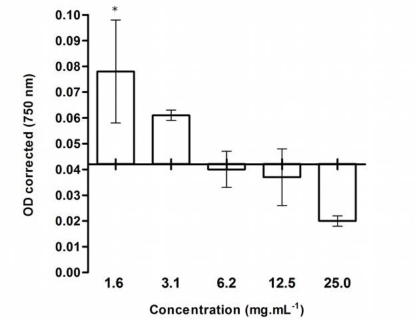
Understanding potential biochemical interactions and effects among cyanobacteria and other organisms is one of the main keys to a better knowledge of microbial population structuring and dynamics. In this study, the effects of cyanobacteria from benthos and plankton of estuaries on other cyanobacteria and green algae growth were evaluated. To understand how the estuarine cyanobacteria might influence the dynamics of phytoplankton, experiments were carried out with the freshwater species Microcystis aeruginosa and Chlorella sp., and the marine Synechocystis salina and Nannochloropsis sp. exposed to aqueous and organic (70% methanol) crude extracts of cyanobacteria for 96 h. The most pronounced effect observed was the growth stimulation. Growth inhibition was also observed for S. salina and M. aeruginosa target-species at the highest and lowest concentrations of cyanobacterial extracts. The methanolic crude extract of Phormidium cf. chalybeum LEGE06078 was effective against S. salina growth in a concentration-dependent manner after 96 h-exposure. All of the cyanobacterial isolates showed some bioactivity on the target-species growth, i.e., inhibitory or stimulating effects. These results indicate that the analyzed cyanobacterial isolates can potentially contribute to blooms' proliferation of other cyanobacteria and to the abnormal growth of green algae disturbing the dynamic of estuarine phytoplankton communities. Since estuaries are transitional ecosystems, the benthic and picoplanktonic estuarine cyanobacteria can change both freshwater and marine phytoplankton succession, competition and bloom formation. Furthermore, a potential biotechnological application of these isolates as a tool to control cyanobacteria and microalgae proliferation can be feasible. This work is the first on the subject of growth responses of photoautotrophs to cyanobacteria from Atlantic estuarine environments.
了解蓝藻和其他生物之间潜在的生化相互作用和影响是更好地了解微生物种群结构和动态的主要关键之一。在这项研究中,评估了河口底栖和浮游生物中的蓝藻对其他蓝藻和绿藻生长的影响。为了了解河口蓝藻如何影响浮游植物的动态,进行了实验,使用了淡水物种铜绿微囊藻和小球藻,以及海洋聚球藻和拟球藻,暴露于蓝藻的水相和有机相(70%甲醇)粗提物中 96 小时。观察到的最显著影响是生长刺激。在蓝藻提取物的最高和最低浓度下,海洋聚球藻和铜绿微囊藻的目标物种也观察到生长抑制。经过 96 小时暴露后,Phormidium cf. chalybeum LEGE06078 的甲醇粗提取物以浓度依赖的方式有效地抑制了 S. salina 的生长。所有的蓝藻分离株对目标物种的生长表现出一定的生物活性,即抑制或刺激作用。这些结果表明,分析的蓝藻分离株可能有助于其他蓝藻的繁殖和绿藻的异常生长,从而干扰河口浮游植物群落的动态。由于河口是过渡性生态系统,底栖和微微型浮游蓝藻可以改变淡水和海洋浮游植物的演替、竞争和繁殖。此外,这些分离株作为控制蓝藻和微藻繁殖的工具的潜在生物技术应用是可行的。这项工作是关于大西洋河口环境中蓝藻对光自养生物生长反应的首次研究。