Jackson D A, Dickinson P, Cook P R
Sir William Dunn School of Pathology, Oxford, UK.
Nucleic Acids Res. 1990 Aug 11;18(15):4385-93. doi: 10.1093/nar/18.15.4385.
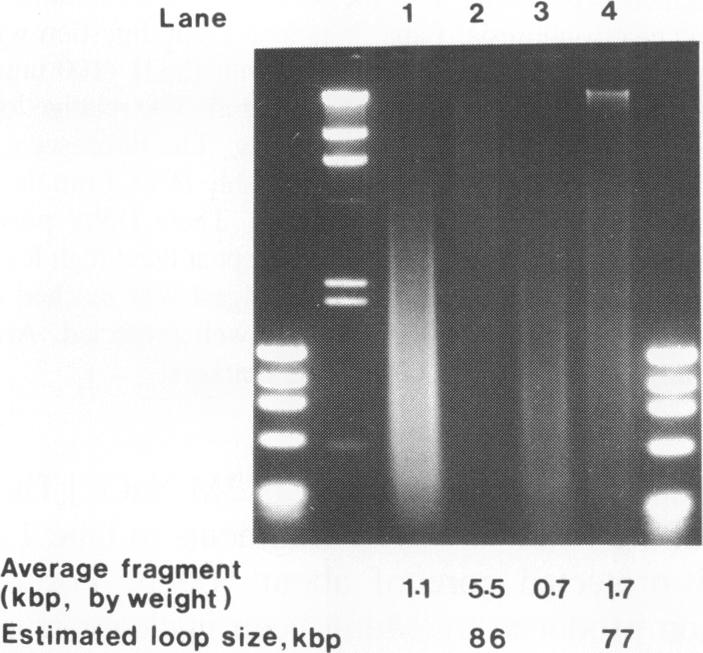
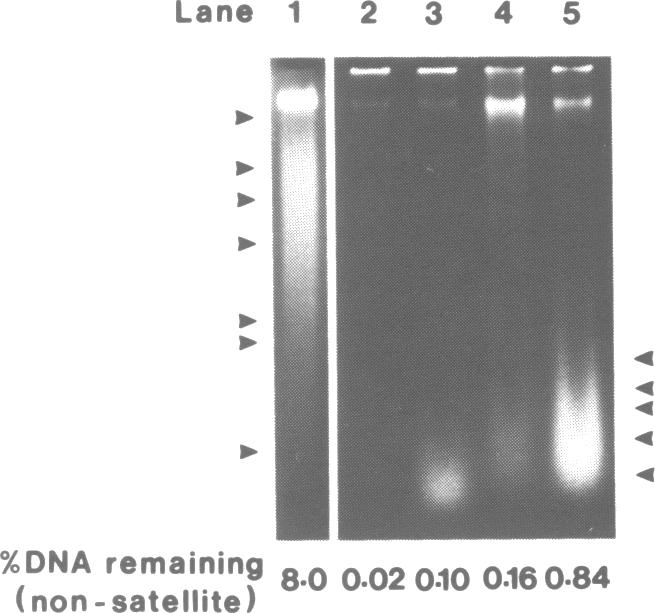
Although it is widely believed that eukaryotic DNA is looped by attachment to a nucleoskeleton, there is controversy about its composition and which sequences are attached to it. As most nuclear derivatives are isolated using unphysiological conditions, the criticism that attachments seen in vitro are generated artifactually has been difficult to rebut. Therefore we have re-investigated attachments of chromatin to the skeleton using physiological conditions. HeLa cells are encapsulated in agarose microbeads and lysed using Triton in a 'physiological' buffer. Then, most chromatin can be electroeluted after treatment with a restriction enzyme to leave some at the base of the loops still attached. Analysis of the size and amounts of these residual fragments indicates that the loops are 80-90kbp long. The residual fragments are stably attached, with about 1kbp of each fragment protected from nuclease attack. This is very much longer than a typical protein-binding site of 10-20bp.
尽管人们普遍认为真核生物的DNA通过附着在核骨架上形成环状结构,但关于核骨架的组成以及哪些序列与之相连仍存在争议。由于大多数核衍生物是在非生理条件下分离得到的,因此很难反驳关于体外观察到的附着是人为产生的批评。因此,我们使用生理条件重新研究了染色质与骨架的附着情况。将HeLa细胞封装在琼脂糖微珠中,并在“生理”缓冲液中用Triton裂解。然后,在用限制性内切酶处理后,大多数染色质可以通过电洗脱分离出来,而仍有一些留在环状结构的基部附着。对这些残留片段的大小和数量进行分析表明,环状结构的长度为80 - 90kbp。残留片段稳定附着,每个片段约有1kbp受到核酸酶攻击的保护。这比典型的10 - 20bp蛋白质结合位点长得多。