Department of Chemistry, University of Michigan, 930 North University Avenue, Ann Arbor, Michigan 48109, USA.
J Am Chem Soc. 2011 Jul 27;133(29):11358-67. doi: 10.1021/ja203527a. Epub 2011 Jun 30.
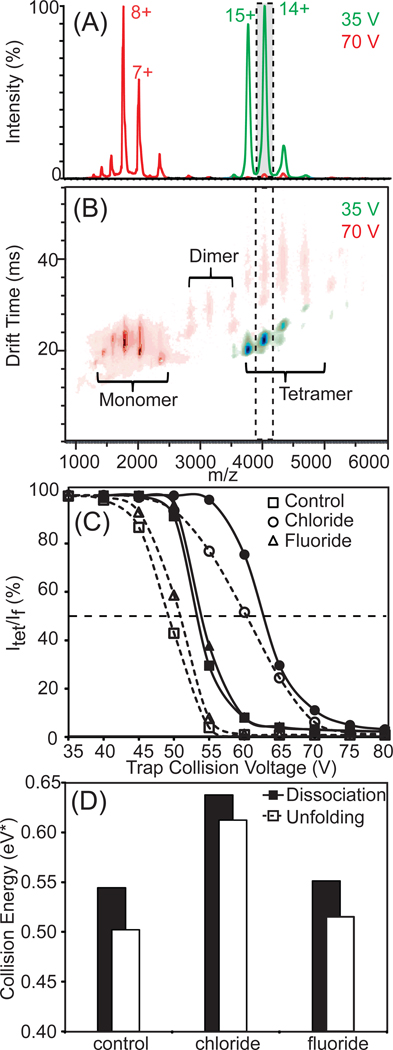
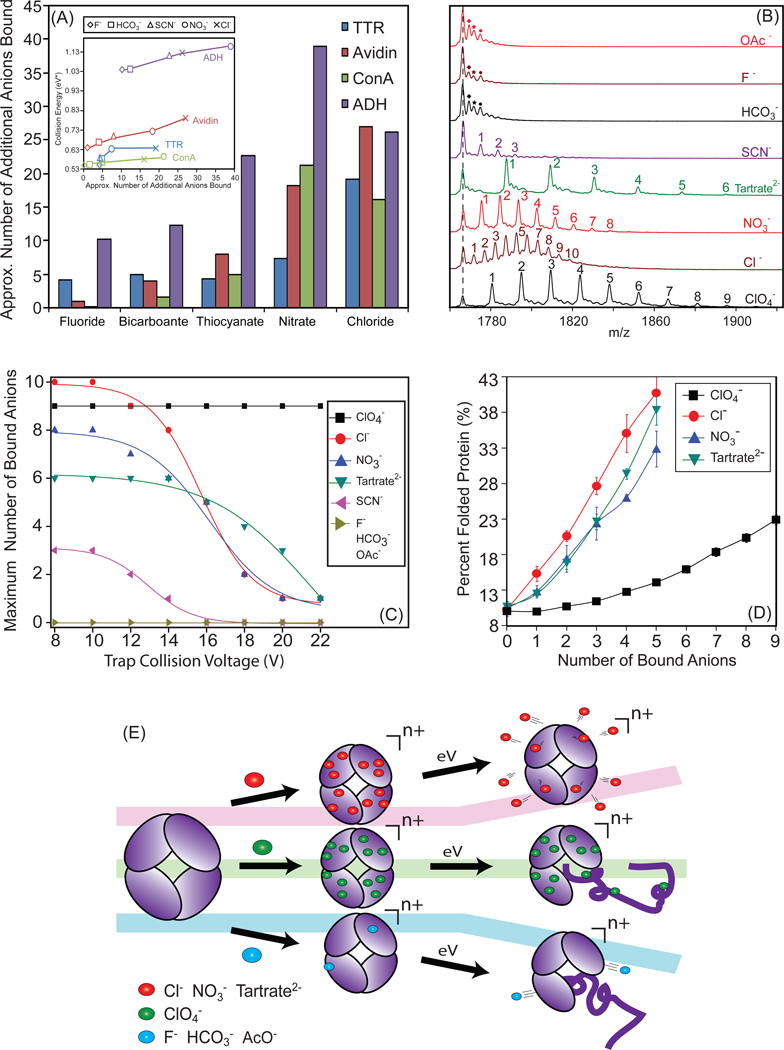
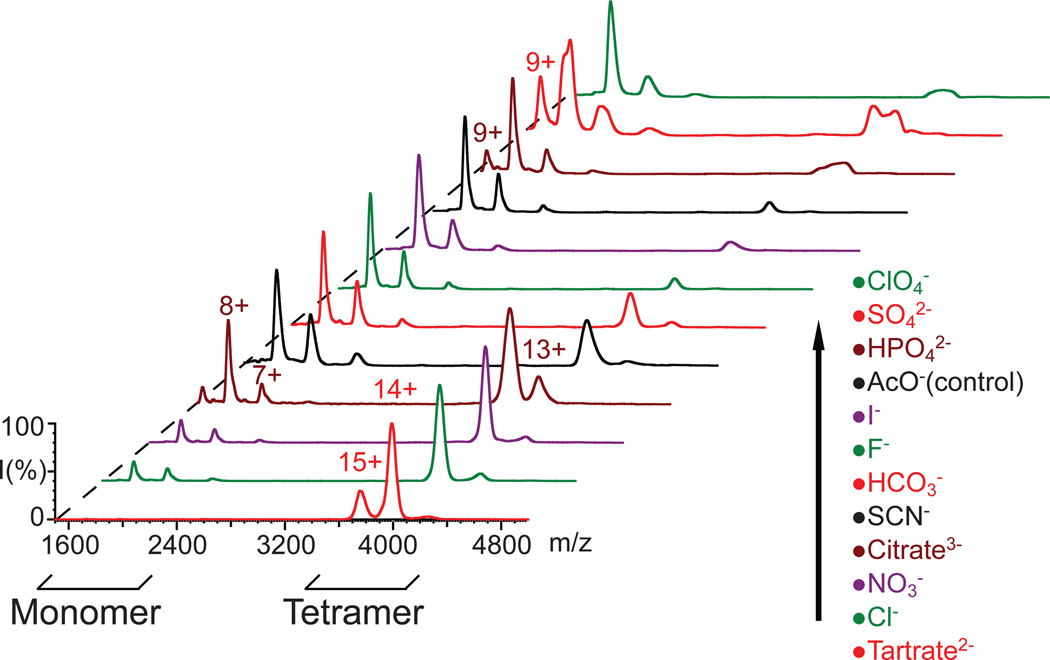
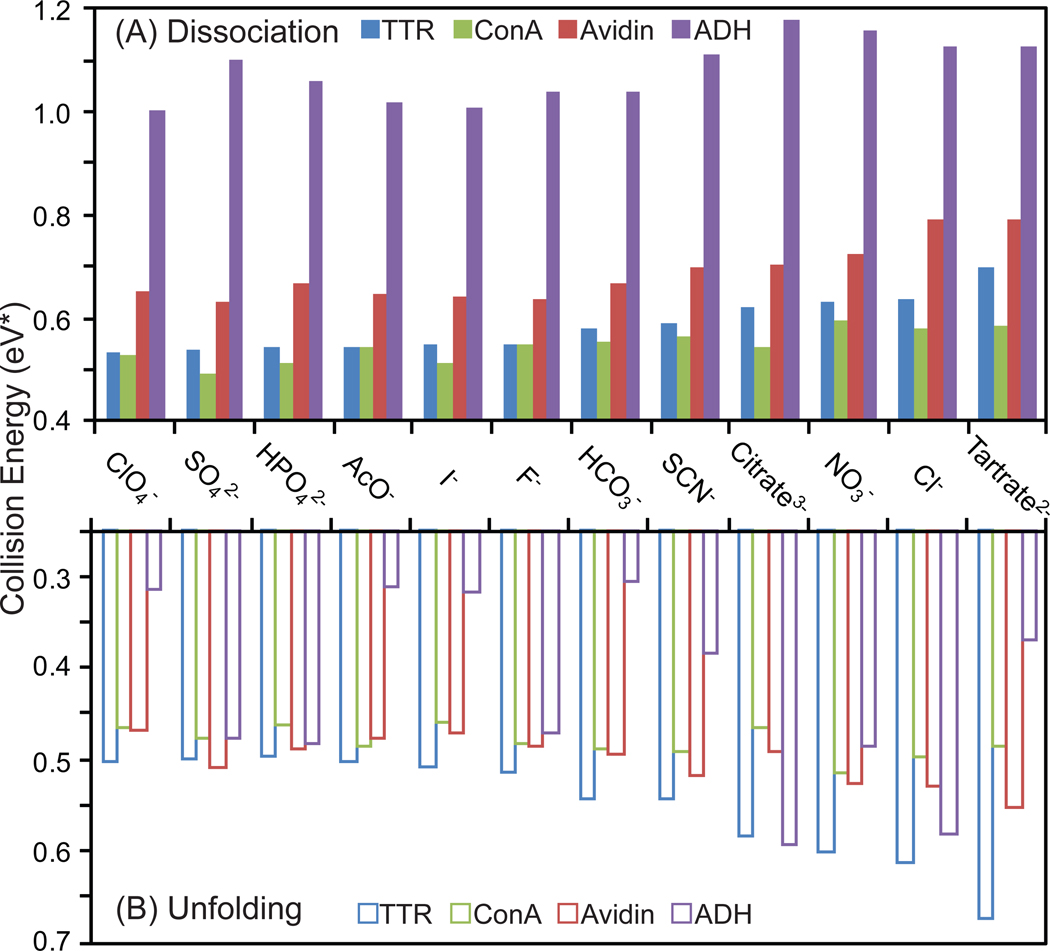
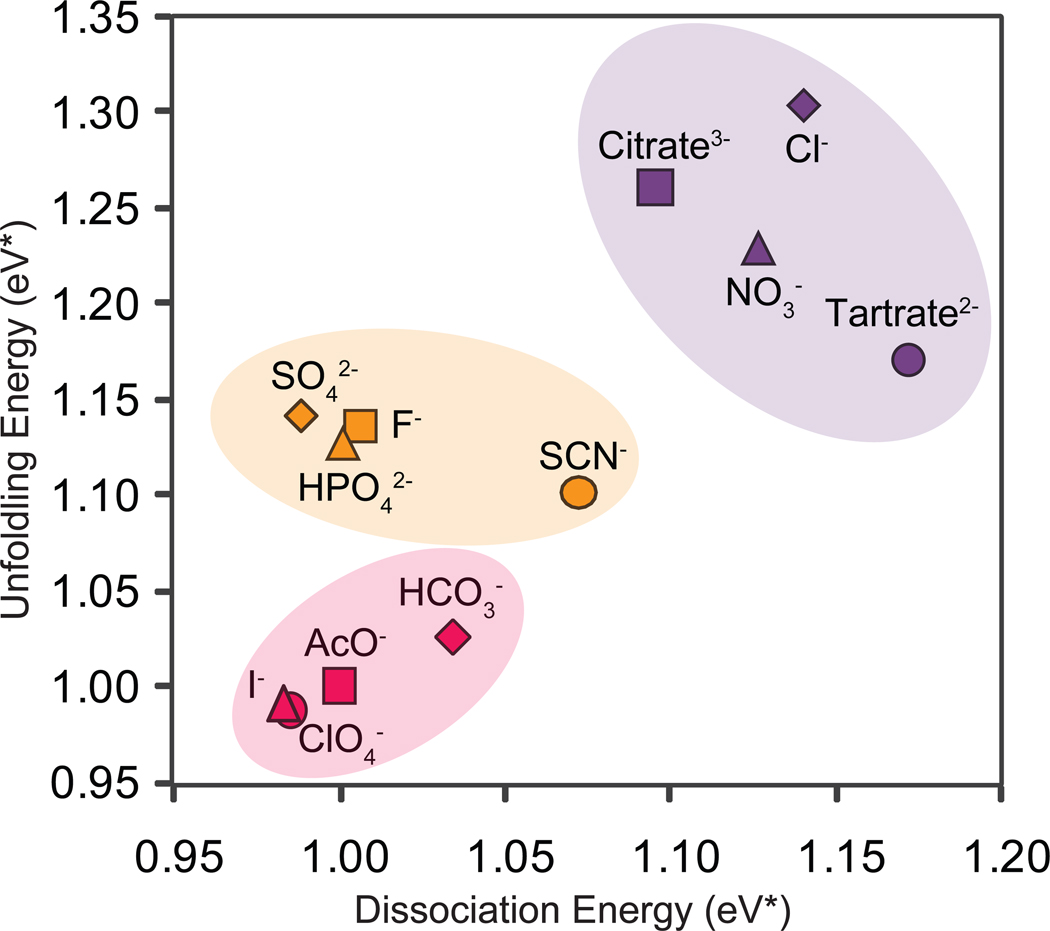
The combination of ion mobility separation with mass spectrometry is an emergent and powerful structural biology tool, capable of simultaneously assessing the structure, topology, dynamics, and composition of large protein assemblies within complex mixtures. An integral part of the ion mobility-mass spectrometry measurement is the ionization of intact multiprotein complexes and their removal from bulk solvent. This process, during which a substantial portion of protein structure and organization is likely to be preserved, imposes a foreign environment on proteins that may cause structural rearrangements to occur. Thus, a general means must be identified to stabilize protein structures in the absence of bulk solvent. Our approach to this problem involves the protection of protein complex structure through the addition of salts in solution prior to desorption/ionization. Anionic components of the added salts bind to the complex either in solution or during the electrospray process, and those that remain bound in the gas phase tend to have high gas phase acidities. The resulting 'shell' of counterions is able to carry away excess energy from the protein complex ion upon activation and can result in significant structural stabilization of the gas-phase protein assembly overall. By using ion mobility-mass spectrometry, we observe both the dissociation and unfolding transitions for four tetrameric protein complexes bound to populations of 12 different anions using collisional activation. The data presented here quantifies, for the first time, the influence of a large range of counterions on gas-phase protein structure and allows us to rank and classify counterions as structure stabilizers in the absence of bulk solvent. Our measurements indicate that tartrate, citrate, chloride, and nitrate anions are among the strongest stabilizers of gas-phase protein structure identified in this screen. The rank order determined by our data is substantially different when compared to the known Hofmeister salt series in solution. While this is an expected outcome of our work, due to the diminished influence of anion and protein solvation by water, our data correlates well to expected anion binding in solution and highlights the fact that both hydration layer and anion-protein binding effects are critical for Hofmeister-type stabilization in solution. Finally, we present a detailed mechanism of action for counterion stabilization of proteins and their complexes in the gas-phase, which indicates that anions must bind with high affinity, but must dissociate readily from the protein in order to be an effective stabilizer. Anion-resolved data acquired for smaller protein systems allows us to classify anions into three categories based on their ability to stabilize protein and protein complex structure in the absence of bulk solvent.
离子淌度分离与质谱联用是一种新兴的强大的结构生物学工具,能够同时评估复杂混合物中大型蛋白质组装体的结构、拓扑结构、动力学和组成。离子淌度-质谱测量的一个组成部分是完整的多蛋白复合物的电离及其从本体溶剂中去除。在这个过程中,大量的蛋白质结构和组织可能被保留下来,这会对蛋白质施加一个可能导致结构重排的外来环境。因此,必须确定一种通用的方法来稳定无本体溶剂时的蛋白质结构。我们解决这个问题的方法是在解吸/电离前通过在溶液中添加盐来保护蛋白质复合物的结构。添加盐的阴离子成分要么在溶液中,要么在电喷雾过程中与复合物结合,而那些在气相中仍然结合的成分往往具有较高的气相酸度。由此产生的抗衡离子“壳”能够在激活时从蛋白质复合物离子中带走多余的能量,并且能够导致气相蛋白质组装体的整体显著结构稳定。通过使用离子淌度-质谱,我们观察到与 12 种不同阴离子结合的四个四聚体蛋白质复合物的解离和展开转变。这里呈现的数据首次量化了大量抗衡离子对气相蛋白质结构的影响,并使我们能够对无本体溶剂的情况下的抗衡离子进行分类和分类,将其作为结构稳定剂。我们的测量结果表明,酒石酸盐、柠檬酸盐、氯化物和硝酸盐阴离子是在这种筛选中确定的对气相蛋白质结构最强的稳定剂之一。与溶液中的已知荷电盐系列相比,我们的数据确定的等级顺序有很大的不同。虽然这是我们工作的预期结果,由于阴离子和蛋白质的水合作用对水的影响减弱,但我们的数据与溶液中预期的阴离子结合很好地相关,并强调了水合层和阴离子-蛋白质结合效应对溶液中荷电盐型稳定化都至关重要的事实。最后,我们提出了一种在气相中蛋白质及其复合物的抗衡离子稳定化的详细作用机制,该机制表明阴离子必须具有高亲和力,但必须易于从蛋白质中解离,才能成为有效的稳定剂。对于较小的蛋白质系统获得的阴离子分辨数据使我们能够根据它们在无本体溶剂时稳定蛋白质和蛋白质复合物结构的能力将阴离子分为三类。