Division of Plastic and Reconstructive Surgery, Department of Surgery, Kaohsiung Medical University Hospital, Kaohsiung, Taiwan.
BMC Neurol. 2011 Jun 16;11:71. doi: 10.1186/1471-2377-11-71.
Intrathecal lidocaine reverses tactile allodynia after nerve injury, but whether neuropathic pain is attenuated by intrathecal lidocaine pretreatment is uncertain.
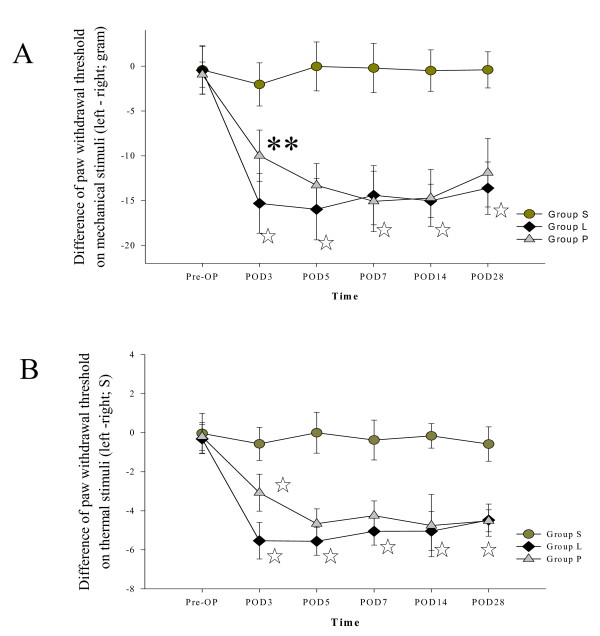
Sixty six adult male Sprague-Dawley rats were divided into three treatment groups: (1) sham (Group S), which underwent removal of the L6 transverse process; (2) ligated (Group L), which underwent left L5 spinal nerve ligation (SNL); and (3) pretreated (Group P), which underwent L5 SNL and was pretreated with intrathecal 2% lidocaine (50 μl). Neuropathic pain was assessed based on behavioral responses to thermal and mechanical stimuli. Expression of sodium channels (Nav1.3 and Nav1.8) in injured dorsal root ganglia and microglial proliferation/activation in the spinal cord were measured on post-operative days 3 (POD3) and 7 (POD7).
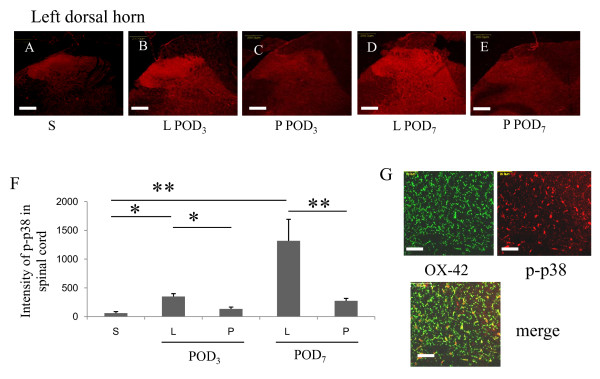
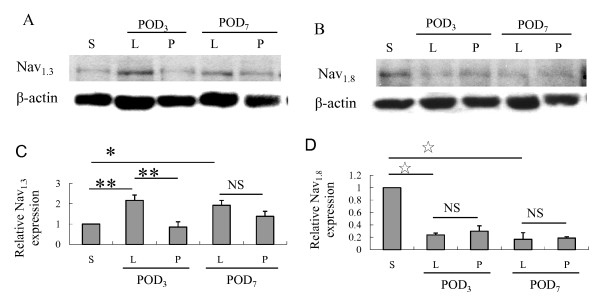
Group L presented abnormal behavioral responses indicative of mechanical allodynia and thermal hyperalgesia, exhibited up-regulation of Nav1.3 and down-regulation of Nav1.8, and showed increased microglial activation. Compared with ligation only, pretreatment with intrathecal lidocaine before nerve injury (Group P), as measured on POD3, palliated both mechanical allodynia (p < 0.01) and thermal hyperalgesia (p < 0.001), attenuated Nav1.3 up-regulation (p = 0.003), and mitigated spinal microglial activation (p = 0.026) by inhibiting phosphorylation (activation) of p38 MAP kinase (p = 0.034). p38 activation was also suppressed on POD7 (p = 0.002).
Intrathecal lidocaine prior to SNL blunts the response to noxious stimuli by attenuating Nav1.3 up-regulation and suppressing activation of spinal microglia. Although its effects are limited to 3 days, intrathecal lidocaine pretreatment can alleviate acute SNL-induced neuropathic pain.
鞘内利多卡因可逆转神经损伤后的触觉异常性疼痛,但鞘内利多卡因预处理是否能减轻神经性疼痛尚不确定。
66 只成年雄性 Sprague-Dawley 大鼠分为三组:(1)假手术组(S 组),仅切除 L6 横突;(2)结扎组(L 组),结扎左侧 L5 脊神经;(3)预处理组(P 组),结扎左侧 L5 脊神经并鞘内预先注射 2%利多卡因(50 μl)。术后第 3 天(POD3)和第 7 天(POD7),通过热刺激和机械刺激评估神经性疼痛。测量损伤背根神经节钠离子通道(Nav1.3 和 Nav1.8)的表达和脊髓小胶质细胞的增殖/激活。
L 组表现出机械性痛觉过敏和热痛觉过敏的异常行为反应,Nav1.3 上调,Nav1.8 下调,小胶质细胞激活增加。与单纯结扎相比,神经损伤前鞘内注射利多卡因(P 组)可缓解机械性痛觉过敏(p < 0.01)和热痛觉过敏(p < 0.001),减轻 Nav1.3 上调(p = 0.003),抑制脊髓小胶质细胞的激活(p = 0.026),抑制 p38 MAP 激酶的磷酸化(激活)(p = 0.034)。POD7 时 p38 也被抑制(p = 0.002)。
SNL 前鞘内注射利多卡因可通过减轻 Nav1.3 上调和抑制脊髓小胶质细胞激活来减轻伤害性刺激的反应。虽然其作用仅限于 3 天,但鞘内利多卡因预处理可减轻急性 SNL 诱导的神经性疼痛。