Gregory-Evans Cheryl Y, Moosajee Mariya, Shan Xianghong, Gregory-Evans Kevin
Department of Ophthalmology and Visual Sciences, University of British Columbia, Vancouver BC, Canada.
Mol Vis. 2011;17:1473-84. Epub 2011 Jun 4.
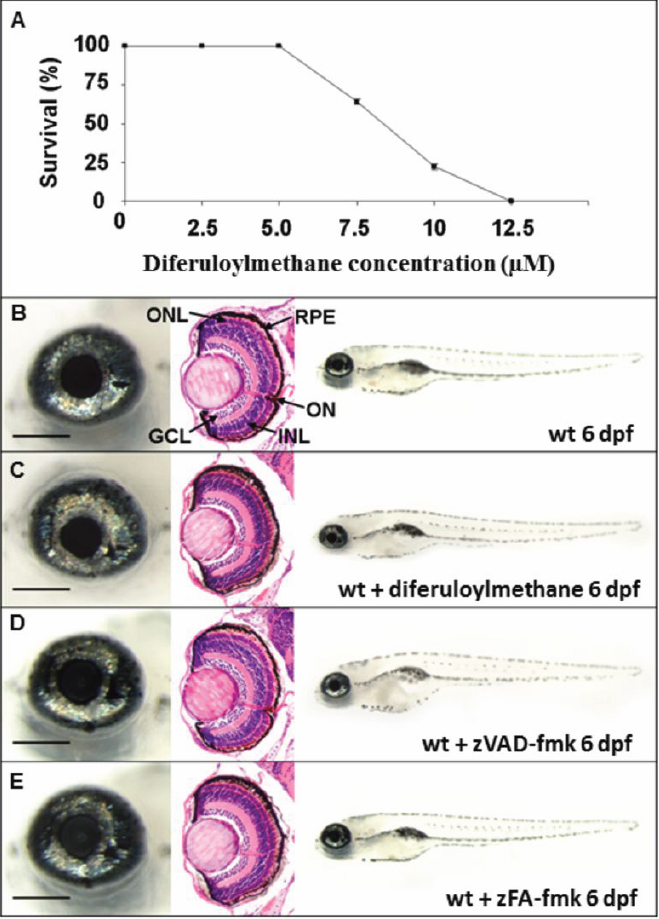
We recently demonstrated that molecular therapy using aminoglycosides can overcome the underlying genetic defect in two zebrafish models of ocular coloboma and showed abnormal cell death to be a key feature associated with the optic fissure closure defects. In further studies to identify molecular therapies for this common congenital malformation, we now examine the effects of anti-apoptotic compounds in zebrafish models of ocular coloboma in vivo.
Two ocular coloboma zebrafish lines (pax2.1/noi(tu29a) and lamb1/gup(m189)) were exposed to diferuloylmethane (curcumin) or benzyloxycarbonyl-Val-Ala-Asp(Ome)-fluoromethylketone (zVAD-fmk; a pan-caspase inhibitor) for up to 8 days post-fertilization. The effects of these compounds were assessed by morphology, histology, terminal deoxynucleotidyl transferase dUTP nick end labeling (TUNEL) staining and western blot analysis.
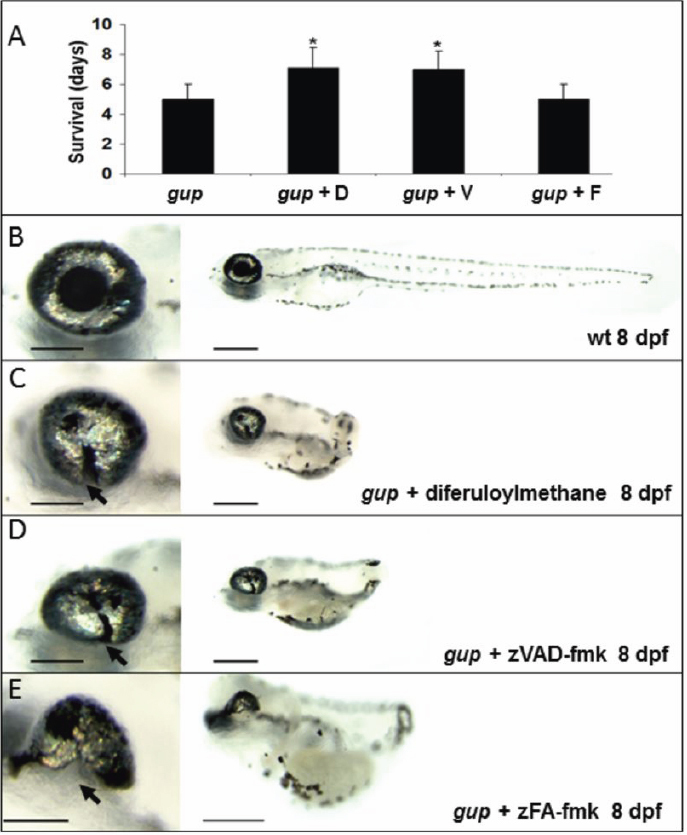
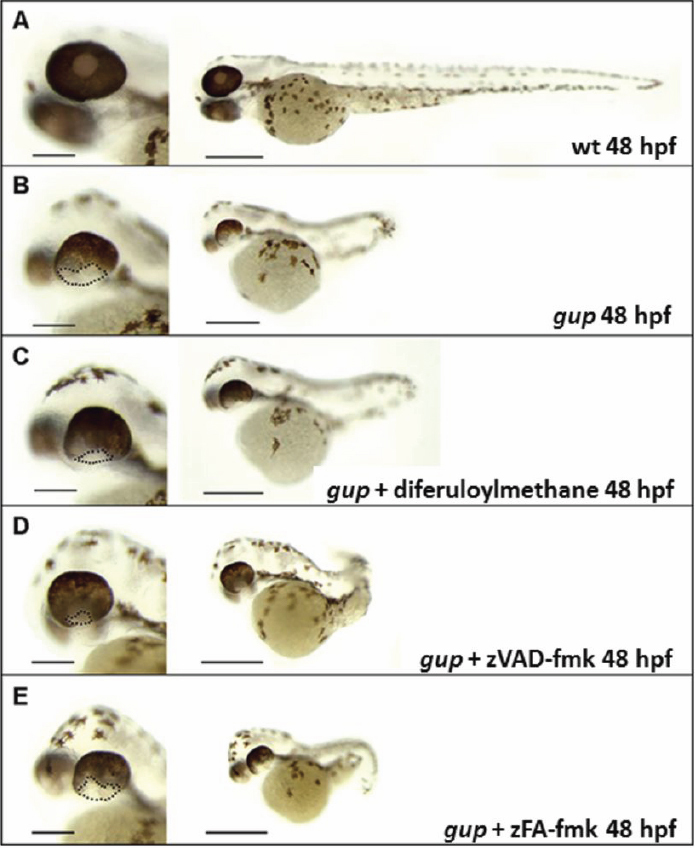
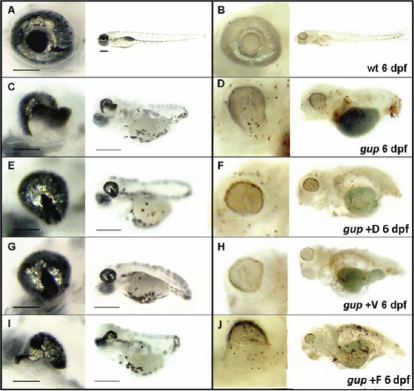
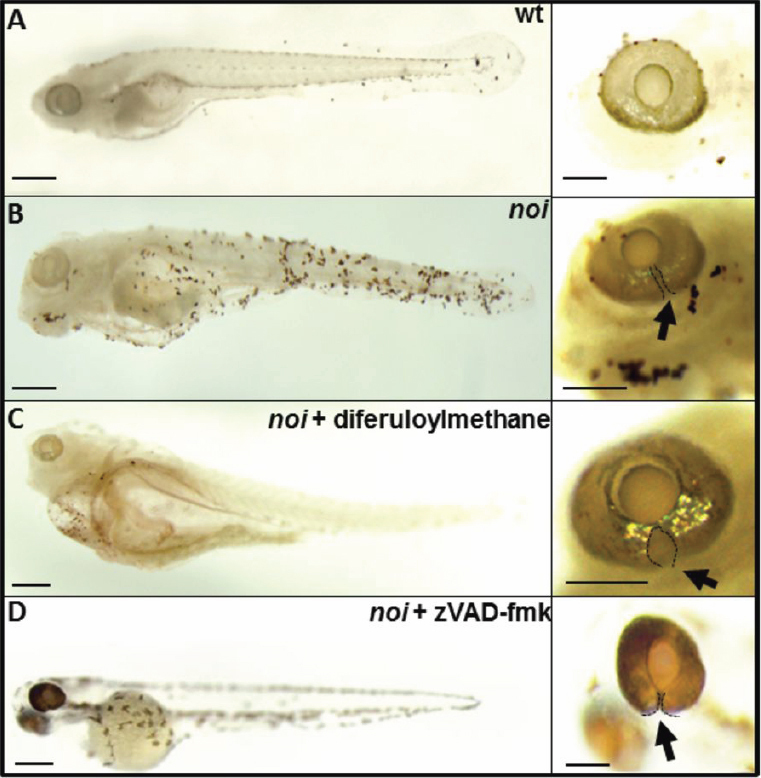
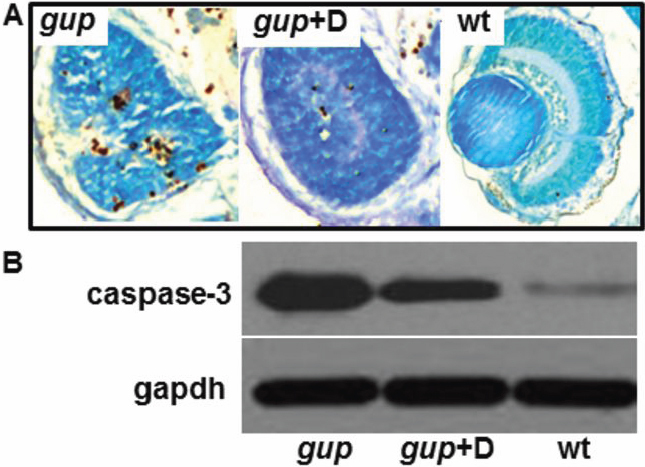
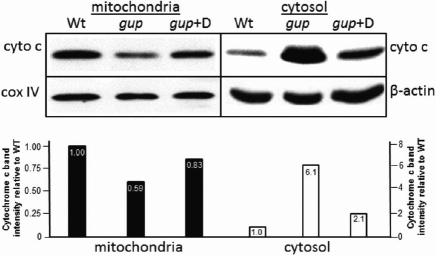
The size of the coloboma in gup zebrafish mutants treated with diferuloylmethane was greatly reduced. In treated mutants a reduction in TUNEL staining and a 67% decrease in activated caspase-3 protein were observed. The release of cytochrome c from the mitochondria into the cytosol was reduced fourfold by in vivo diferuloylmethane treatment, suggesting that the drug was acting to inhibit the intrinsic apoptotic pathway. Inhibition of caspases directly with zVAD-fmk also resulted in a similar reduction in coloboma phenotype. Treatment with either diferuloylmethane or zVAD-fmk resulted in a statistically significant 1.4 fold increase in length of survival of these mutant zebrafish (p<0.001), which normally succumb to the lethal genetic mutation. In contrast, the coloboma phenotype in noi zebrafish mutants did not respond to either diferuloylmethane or zVAD-fmk exposure, even though inhibition of apoptotic cell death was observed by a reduction in TUNEL staining.
The differential sensitivity to anti-apoptotic agents in lamb1-deficient and pax2.1-deficient zebrafish models, suggests that apoptotic cell death is not a final common pathway in all ocular coloboma genotypes. When considering anti-cell death therapies for ocular colobomatous defects attention should be paid to the genotype under investigation.
我们最近证明,使用氨基糖苷类进行分子治疗可以克服两种眼裂缺损斑马鱼模型中的潜在基因缺陷,并表明异常细胞死亡是与视裂闭合缺陷相关的关键特征。在进一步研究以确定针对这种常见先天性畸形的分子疗法时,我们现在在体内研究抗凋亡化合物对眼裂缺损斑马鱼模型的影响。
将两种眼裂缺损斑马鱼品系(pax2.1/noi(tu29a) 和 lamb1/gup(m189))在受精后长达8天的时间内暴露于二阿魏酰甲烷(姜黄素)或苄氧羰基-Val-Ala-Asp(Ome)-氟甲基酮(zVAD-fmk;一种泛半胱天冬酶抑制剂)。通过形态学、组织学、末端脱氧核苷酸转移酶dUTP缺口末端标记(TUNEL)染色和蛋白质印迹分析评估这些化合物的作用。
用二阿魏酰甲烷处理的gup斑马鱼突变体中的眼裂缺损大小大大减小。在处理过的突变体中,观察到TUNEL染色减少,活化的半胱天冬酶-3蛋白减少67%。体内用二阿魏酰甲烷处理使细胞色素c从线粒体释放到细胞质中的量减少了四倍,这表明该药物的作用是抑制内源性凋亡途径。用zVAD-fmk直接抑制半胱天冬酶也导致眼裂缺损表型有类似程度的减轻。用二阿魏酰甲烷或zVAD-fmk处理导致这些突变斑马鱼的存活长度在统计学上显著增加1.4倍(p<0.001),这些斑马鱼通常会死于致死性基因突变。相比之下,noi斑马鱼突变体中的眼裂缺损表型对二阿魏酰甲烷或zVAD-fmk暴露均无反应,尽管通过TUNEL染色减少观察到凋亡细胞死亡受到抑制。
在lamb1缺陷和pax2.1缺陷的斑马鱼模型中对抗凋亡剂的不同敏感性表明,凋亡细胞死亡并非所有眼裂缺损基因型的最终共同途径。在考虑针对眼裂缺损性缺陷的抗细胞死亡疗法时,应关注所研究的基因型。