Department of Surgery, Monash University, Melbourne, Victoria, Australia.
BMC Med Res Methodol. 2011 Jun 17;11:92. doi: 10.1186/1471-2288-11-92.
Evidence mapping describes the quantity, design and characteristics of research in broad topic areas, in contrast to systematic reviews, which usually address narrowly-focused research questions. The breadth of evidence mapping helps to identify evidence gaps, and may guide future research efforts. The Global Evidence Mapping (GEM) Initiative was established in 2007 to create evidence maps providing an overview of existing research in Traumatic Brain Injury (TBI) and Spinal Cord Injury (SCI).
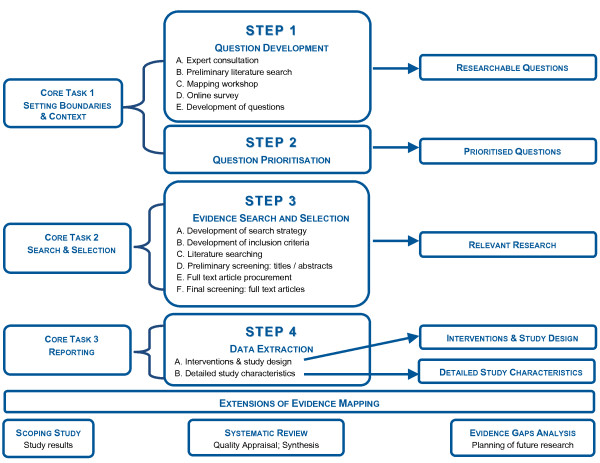
The GEM evidence mapping method involved three core tasks:1. Setting the boundaries and context of the map: Definitions for the fields of TBI and SCI were clarified, the prehospital, acute inhospital and rehabilitation phases of care were delineated and relevant stakeholders (patients, carers, clinicians, researchers and policymakers) who could contribute to the mapping were identified. Researchable clinical questions were developed through consultation with key stakeholders and a broad literature search. 2. Searching for and selection of relevant studies: Evidence search and selection involved development of specific search strategies, development of inclusion and exclusion criteria, searching of relevant databases and independent screening and selection by two researchers. 3. Reporting on yield and study characteristics: Data extraction was performed at two levels - 'interventions and study design' and 'detailed study characteristics'. The evidence map and commentary reflected the depth of data extraction.
One hundred and twenty-nine researchable clinical questions in TBI and SCI were identified. These questions were then prioritised into high (n = 60) and low (n = 69) importance by the stakeholders involved in question development. Since 2007, 58 263 abstracts have been screened, 3 731 full text articles have been reviewed and 1 644 relevant neurotrauma publications have been mapped, covering fifty-three high priority questions.
GEM Initiative evidence maps have a broad range of potential end-users including funding agencies, researchers and clinicians. Evidence mapping is at least as resource-intensive as systematic reviewing. The GEM Initiative has made advancements in evidence mapping, most notably in the area of question development and prioritisation. Evidence mapping complements other review methods for describing existing research, informing future research efforts, and addressing evidence gaps.
证据图谱描述了广泛主题领域的研究数量、设计和特征,与通常针对重点研究问题的系统评价形成对比。证据图谱的广度有助于发现证据差距,并可能指导未来的研究工作。全球证据图谱倡议(GEM)成立于 2007 年,旨在创建创伤性脑损伤(TBI)和脊髓损伤(SCI)现有研究的证据图谱概述。
GEM 证据图谱方法涉及三个核心任务:1. 确定图谱的边界和背景:明确 TBI 和 SCI 的领域定义,划定院前、急性住院和康复阶段的护理范围,并确定可能为图谱做出贡献的相关利益相关者(患者、照顾者、临床医生、研究人员和政策制定者)。通过与主要利益相关者协商和广泛的文献检索,制定了可研究的临床问题。2. 搜索和选择相关研究:证据搜索和选择涉及制定特定的搜索策略、制定纳入和排除标准、搜索相关数据库以及由两名研究人员进行独立筛选和选择。3. 报告结果和研究特征:在两个层面上进行数据提取——“干预和研究设计”和“详细研究特征”。证据图谱和评论反映了数据提取的深度。
确定了 129 个可研究的 TBI 和 SCI 临床问题。然后,通过参与问题制定的利益相关者将这些问题分为高(n=60)和低(n=69)重要性。自 2007 年以来,已经筛选了 58263 个摘要,审查了 3731 篇全文文章,并绘制了 1644 篇相关神经创伤出版物,涵盖了 53 个高优先级问题。
GEM 倡议证据图谱有广泛的潜在最终用户,包括资助机构、研究人员和临床医生。证据图谱的资源密集程度至少与系统评价相同。GEM 倡议在证据图谱方面取得了进展,尤其是在问题制定和优先级确定方面。证据图谱补充了其他描述现有研究、为未来研究工作提供信息和解决证据差距的审查方法。