School of Health Sciences, The University of Melbourne, Parkville, Victoria 3052, Australia.
BMC Neurol. 2011 Jun 18;11:73. doi: 10.1186/1471-2377-11-73.
There is much discourse in healthcare about the importance of client-centred rehabilitation, however in the realm of community-based therapy post-stroke there has been little investigation into the efficacy of goal-directed practice that reflects patients' valued activities. In addition, the effect of active involvement of carers in such a rehabilitation process and their subsequent contribution to functional and emotional recovery post-stroke is unclear. In community based rehabilitation, interventions based on patients' perceived needs may be more likely to alter such outcomes. In this paper, we describe the methodology of a randomised controlled trial of an integrated approach to facilitating patient goal achievement in the first year post-stroke. The effectiveness of this intervention in reducing the severity of post-stroke depression, improving participation status and health-related quality of life is examined. The impact on carers is also examined.
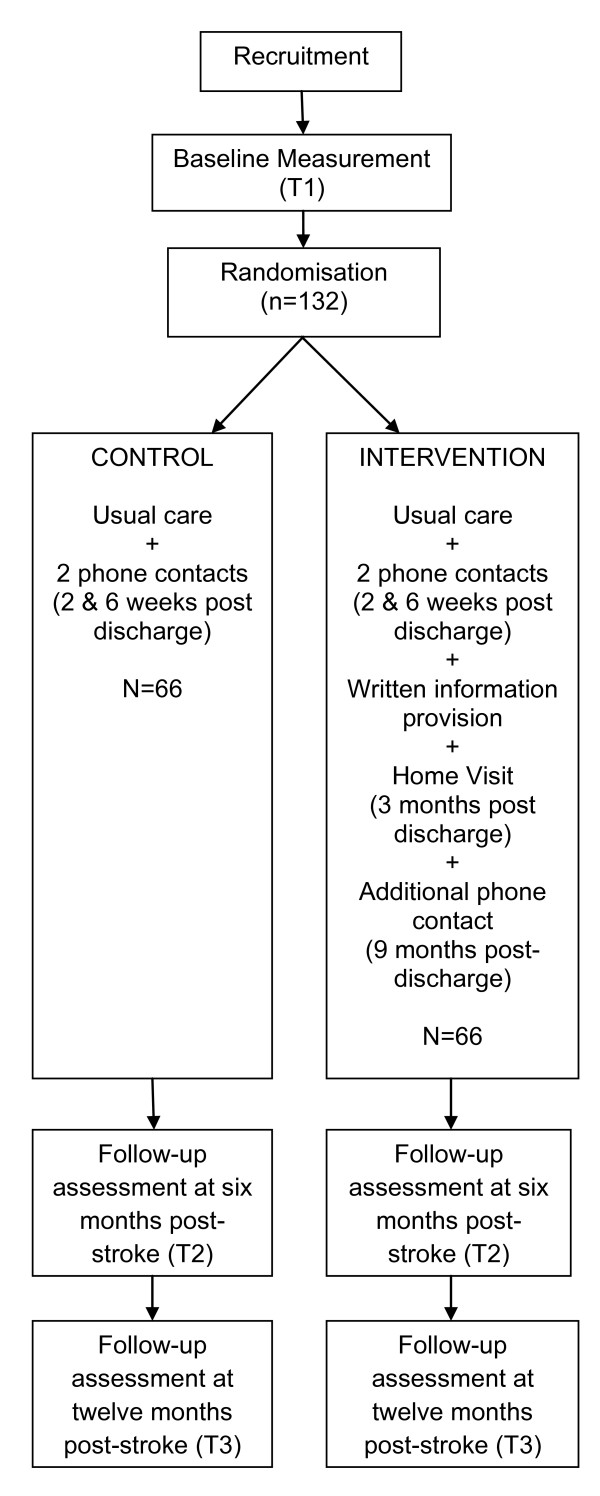
METHODS/DESIGN: Patients (and their primary carers, if available) are randomly allocated to an intervention or control arm of the study. The intervention is multimodal and aims to screen for adverse stroke sequelae and address ways to enhance participation in patient-valued activities. Intervention methods include: telephone contacts, written information provision, home visitation, and contact with treating health professionals, with further relevant health service referrals as required. The control involves treatment as usual, as determined by inpatient and community rehabilitation treating teams. Formal blinded assessments are conducted at discharge from inpatient rehabilitation, and at six and twelve months post-stroke. The primary outcome is depression. Secondary outcome measures include participation and activity status, health-related quality of life, and self-efficacy.
The results of this trial will assist with the development of a model for community-based rehabilitation management for stroke patients and their carers, with emphasis on goal-directed practice to enhance home and community participation status. Facilitation of participation in valued activities may be effective in reducing the incidence or severity of post-stroke depression, as well as enhancing the individual's perception of their health-related quality of life. The engagement of carers in the rehabilitation process will enable review of the influence of the broader social context on recovery.
Australia and New Zealand Clinical Trials Register (ANZCTR): ACTRN12608000042347.
在医疗保健领域,人们经常讨论以患者为中心的康复的重要性,然而,在社区为基础的脑卒中治疗领域,对于反映患者重视的活动的目标导向实践的疗效,研究甚少。此外,在这种康复过程中,让照顾者积极参与及其对脑卒中后功能和情感恢复的后续贡献,目前尚不清楚。在社区为基础的康复中,基于患者感知需求的干预措施可能更有可能改变这些结果。在本文中,我们描述了一项随机对照试验的方法学,该试验旨在促进脑卒中后第一年患者目标的实现。研究考察了这种干预措施在减轻脑卒中后抑郁的严重程度、改善参与状况和健康相关生活质量方面的有效性。还考察了对照顾者的影响。
方法/设计:将患者(和他们的主要照顾者,如果有的话)随机分配到研究的干预组或对照组。该干预措施是多模式的,旨在筛查不良的脑卒中后遗症,并寻找方法来增强患者重视的活动的参与度。干预方法包括:电话联系、书面信息提供、家访,以及与治疗健康专业人员的联系,并根据需要进一步提供相关的卫生服务转介。对照组涉及常规治疗,由住院和社区康复治疗团队决定。在住院康复出院时以及脑卒中后 6 个月和 12 个月进行正式的盲法评估。主要结局是抑郁。次要结局指标包括参与和活动状况、健康相关生活质量和自我效能感。
该试验的结果将有助于为脑卒中患者及其照顾者制定基于社区的康复管理模式,重点是目标导向的实践,以增强家庭和社区的参与状况。促进重视活动的参与可能有助于降低脑卒中后抑郁的发生率或严重程度,以及提高个人对其健康相关生活质量的感知。让照顾者参与康复过程将能够审查更广泛的社会背景对康复的影响。
澳大利亚和新西兰临床试验注册(ANZCTR):ACTRN12608000042347。