AIDS Research Center, Institute of Pathogen Biology, Chinese Academy of Medical Sciences and Peking Union Medical College, Beijing, China.
PLoS One. 2011;6(6):e21081. doi: 10.1371/journal.pone.0021081. Epub 2011 Jun 8.
Despite prolonged treatment with highly active antiretroviral therapy (HAART), the infectious HIV-1 continues to replicate and resides latently in the resting memory CD4+ T lymphocytes, which blocks the eradication of HIV-1. The viral persistence of HIV-1 is mainly caused by its proviral DNA being either linear nonintegrated, circular nonintegrated, or integrated. Previous reports have largely focused on the dynamics of HIV-1 DNA from the samples collected with relatively long time intervals during the process of disease and HAART treatment, which may have missed the intricate changes during the intervals in early treatment.
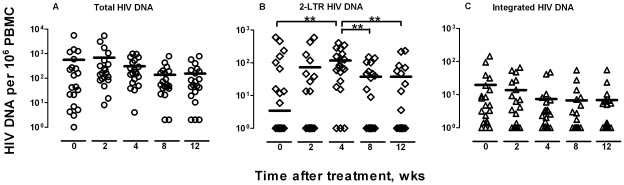
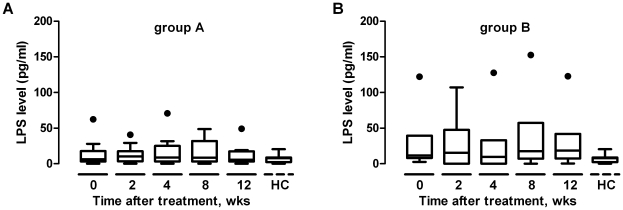
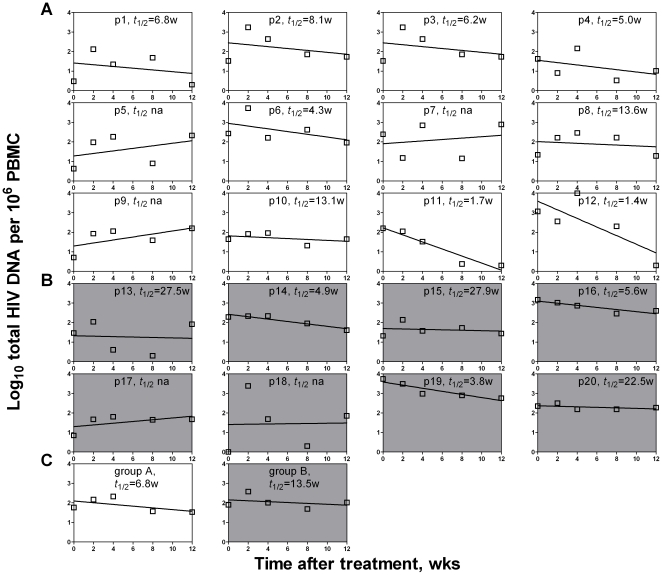
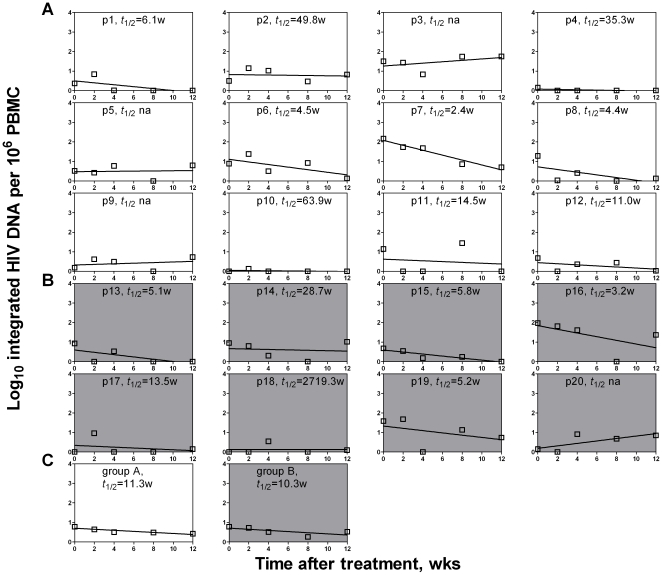
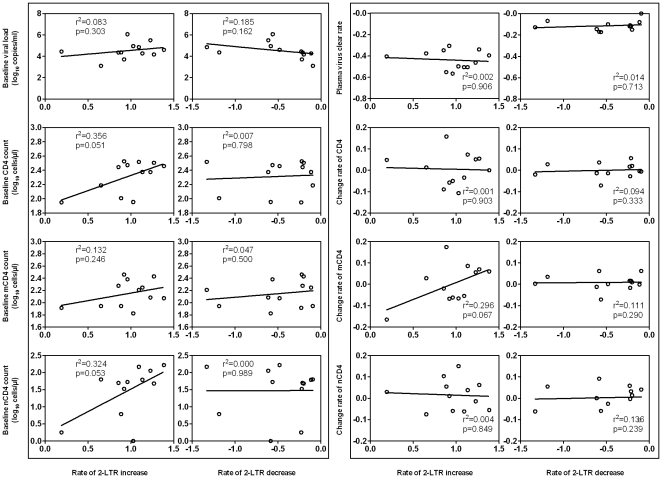
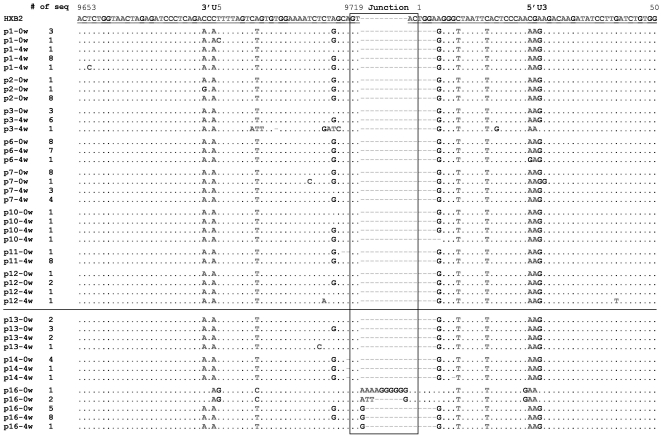
METHODOLOGY/PRINCIPAL FINDINGS: In this study, we investigated the dynamics of HIV-1 DNA in patients during the early phase of HARRT treatment. Using optimized real time PCR, we observed significant changes in 2-LTR during the first 12-week of treatment, while total and integrated HIV-1 DNA remained stable. The doubling time and half-life of 2-LTR were not correlated with the baseline and the rate of changes in plasma viral load and various CD4+ T-cell populations. Longitudinal analyses on 2-LTR sequences and plasma lipopolysaccharide (LPS) levels did not reveal any significant changes in the same treatment period.
CONCLUSIONS/SIGNIFICANCE: Our study revealed the rapid changes in 2-LTR concentration in a relatively large number of patients during the early HAART treatment. The rapid changes indicate the rapid infusion and clearance of cells bearing 2-LTR in the peripheral blood. Those changes are not expected to be caused by the blocking of viral integration, as our study did not include the integrase inhibitor raltegravir. Our study helps better understand the dynamics of HIV-DNA and its potential role as a biomarker for the diseases and for the treatment efficacy of HAART.
尽管经过长时间的高效抗逆转录病毒治疗(HAART),传染性 HIV-1 仍持续复制并潜伏在静止的记忆 CD4+T 淋巴细胞中,从而阻止了 HIV-1 的清除。HIV-1 的病毒持续存在主要是由于其前病毒 DNA 呈线性非整合、环形非整合或整合状态。先前的报告主要集中在疾病和 HAART 治疗过程中相对较长时间间隔采集的样本中 HIV-1 DNA 的动态变化,这可能错过了早期治疗期间的复杂变化。
方法/主要发现:在这项研究中,我们研究了 HAART 治疗早期患者 HIV-1 DNA 的动态变化。使用优化的实时 PCR,我们观察到在治疗的前 12 周内,2-LTR 发生了显著变化,而总 HIV-1 DNA 和整合 HIV-1 DNA 保持稳定。2-LTR 的倍增时间和半衰期与基线以及血浆病毒载量和各种 CD4+T 细胞群的变化率无关。在相同的治疗期间,对 2-LTR 序列和血浆脂多糖(LPS)水平进行纵向分析未发现任何显著变化。
结论/意义:我们的研究揭示了在 HAART 治疗早期,相对大量患者的 2-LTR 浓度的快速变化。快速变化表明携带 2-LTR 的细胞在外周血中的快速输注和清除。这些变化预计不会是由病毒整合的阻断引起的,因为我们的研究不包括整合酶抑制剂拉替拉韦。我们的研究有助于更好地理解 HIV-DNA 的动态及其作为疾病和 HAART 治疗效果的生物标志物的潜在作用。