Smyk Daniel, Cholongitas Evangelos, Kriese Stephen, Rigopoulou Eirini I, Bogdanos Dimitrios P
Institute of Liver Studies, King's College London School of Medicine at King's College Hospital, Denmark Hill Campus, London SE5 9RS, UK.
Autoimmune Dis. 2011;2011:189585. doi: 10.4061/2011/189585. Epub 2011 May 5.
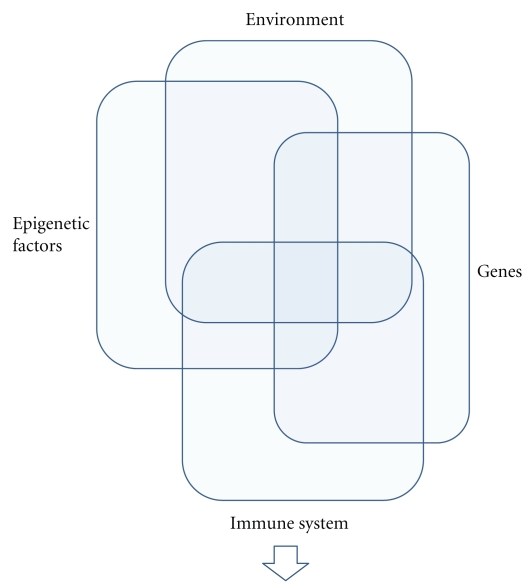
Primary biliary cirrhosis (PBC) is a chronic immune-mediated cholestatic liver disease of unknown aetiology which affects mostly women in middle age. Familial PBC is when PBC affects more than one member of the same family, and data suggest that first-degree relatives of PBC patients have an increased risk of developing the disease. Most often, these familial clusters involve mother-daughter pairs, which is consistent with the female preponderance of the disease. These clusters provide evidence towards a genetic basis underlying PBC. However, clusters of nonrelated individuals have also been reported, giving strength to an environmental component. Twin studies have demonstrated a high concordance for PBC in monozygotic twins and a low concordance among dizygotic twins. In conclusion, studies of PBC in families clearly demonstrate that genetic, epigenetic, and environmental factors play a role in the development of the disease.
原发性胆汁性肝硬化(PBC)是一种病因不明的慢性免疫介导性胆汁淤积性肝病,主要影响中年女性。家族性PBC是指PBC影响同一个家族中的多名成员,数据表明,PBC患者的一级亲属患该病的风险增加。最常见的情况是,这些家族聚集性病例涉及母女对,这与该病女性发病率高相符。这些聚集性病例为PBC存在遗传基础提供了证据。然而,也有报道称存在非亲属个体的聚集性病例,这表明环境因素也起作用。双胞胎研究表明,单卵双胞胎中PBC的一致性较高,而异卵双胞胎中的一致性较低。总之,对家族性PBC的研究清楚地表明,遗传、表观遗传和环境因素在该病的发生发展中起作用。