Departamento de Genética, Instituto de Biociências, Universidade Federal do Rio Grande do Sul, Porto Alegre, Rio Grande do Sul, Brazil.
PLoS One. 2011;6(6):e20328. doi: 10.1371/journal.pone.0020328. Epub 2011 Jun 8.
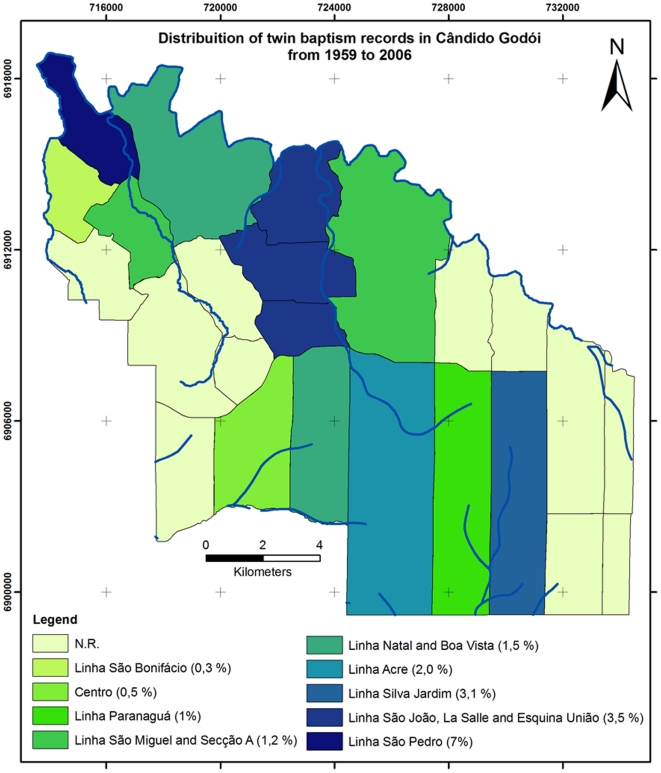
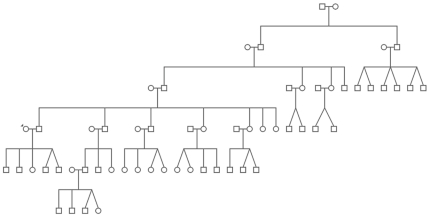
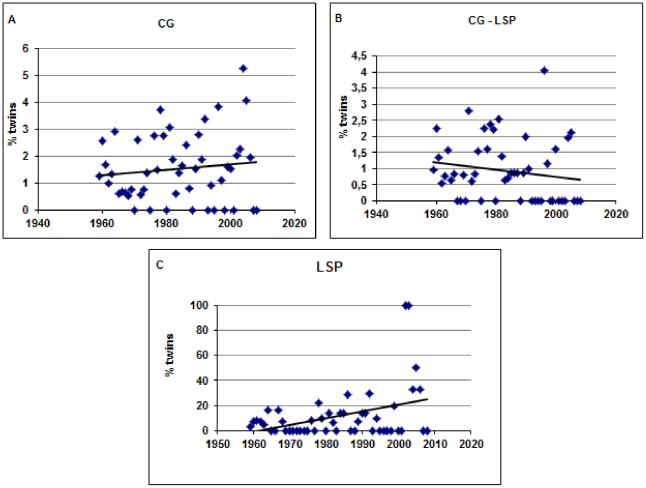
Cândido Godói (CG) is a small municipality in South Brazil with approximately 6,000 inhabitants. It is known as the "Twins' Town" due to its high rate of twin births. Recently it was claimed that such high frequency of twinning would be connected to experiments performed by the German Nazi doctor Joseph Mengele. It is known, however, that this town was founded by a small number of families and therefore a genetic founder effect may represent an alternatively explanation for the high twinning prevalence in CG. In this study, we tested specific predictions of the "Nazi's experiment" and of the "founder effect" hypotheses. We surveyed a total of 6,262 baptism records from 1959-2008 in CG catholic churches, and identified 91 twin pairs and one triplet. Contrary to the "Nazi's experiment hypothesis", there is no spurt in twinning between the years (1964-1968) when Mengele allegedly was in CG (P = 0.482). Moreover, there is no temporal trend for a declining rate of twinning since the 1960s (P = 0.351), and no difference in twinning among CG districts considering two different periods: 1927-1958 and 1959-2008 (P = 0.638). On the other hand, the "founder effect hypothesis" is supported by an isonymy analysis that shows that women who gave birth to twins have a higher inbreeding coefficient when compared to women who never had twins (0.0148, 0.0081, respectively, P = 0.019). In summary, our results show no evidence for the "Nazi's experiment hypothesis" and strongly suggest that the "founder effect hypothesis" is a much more likely alternative for explaining the high prevalence of twinning in CG. If this hypothesis is correct, then this community represents a valuable population where genetic factors linked to twinning may be identified.
坎迪多·戈多伊(CG)是巴西南部的一个小镇,大约有 6000 名居民。由于双胞胎出生率高,它被称为“双胞胎镇”。最近有报道称,这种高双胞胎出生率与德国纳粹医生约瑟夫·门格勒(Joseph Mengele)进行的实验有关。然而,众所周知,这个城镇是由少数几个家庭建立的,因此遗传奠基者效应可能是 CG 高双胞胎出生率的另一种解释。在这项研究中,我们检验了“纳粹实验”和“奠基者效应”假说的具体预测。我们调查了 CG 天主教堂 1959 年至 2008 年期间的 6262 份洗礼记录,并确定了 91 对双胞胎和 1 对三胞胎。与“纳粹实验假说”相反,在据称门格勒在 CG 期间(1964-1968 年),双胞胎出生没有激增(P=0.482)。此外,自 20 世纪 60 年代以来,双胞胎出生率没有下降趋势(P=0.351),并且考虑到两个不同时期,CG 地区的双胞胎出生情况没有差异:1927-1958 年和 1959-2008 年(P=0.638)。另一方面,同宗分析支持“奠基者效应假说”,该分析表明,与从未生育过双胞胎的女性相比,生育双胞胎的女性的近交系数更高(分别为 0.0148 和 0.0081,P=0.019)。综上所述,我们的研究结果没有为“纳粹实验假说”提供证据,强烈表明“奠基者效应假说”是解释 CG 高双胞胎出生率的更可能的替代假说。如果这个假说成立,那么这个社区代表了一个有价值的人群,其中可能会发现与双胞胎相关的遗传因素。