Department of Epidemiology, Institute of Social Medicine, Rio de Janeiro State University, Brazil.
BMC Med Res Methodol. 2011 Jun 20;11:93. doi: 10.1186/1471-2288-11-93.
The Edinburgh Postnatal Depression Scale (EPDS) has been proposed as a one-dimensional instrument and used as a single 10-item scale. This might be considered questionable since repeated psychometric studies have shown multi-dimensionality, which would entail using separate component subscales. This study reappraised the dimensional structure of the EPDS, with a focus on the extent of factor correlations and related factor-based discriminant validity as a foundation for deciding how to effectively scale the component items.
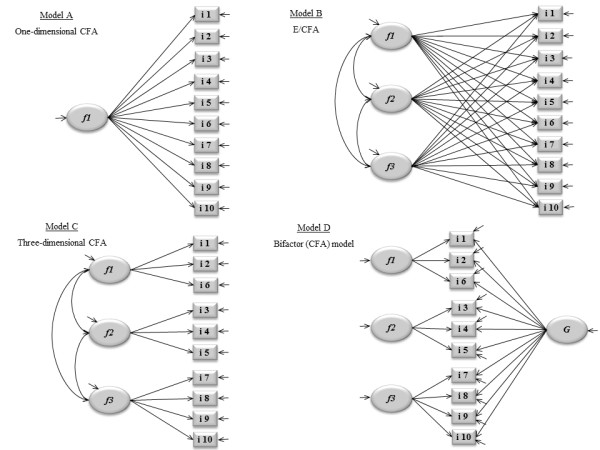
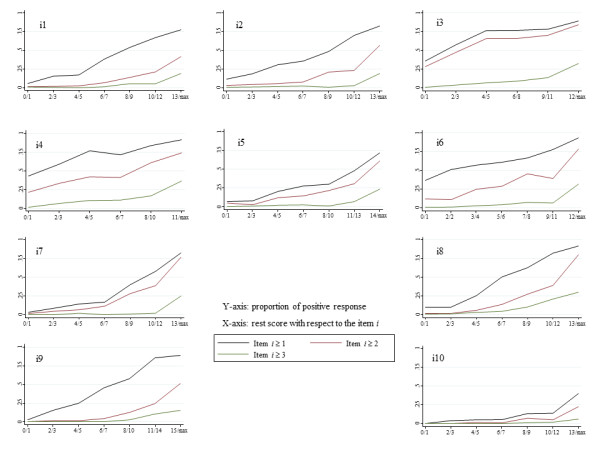
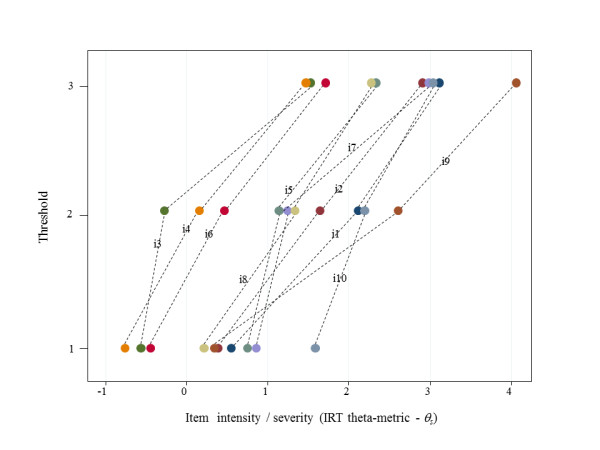
The sample comprised 811 randomly selected mothers of children up to 5 months attending primary health services of Rio de Janeiro, Brazil. Strict Confirmatory Factor Analysis (CFA) and Exploratory Factor Analysis modeled within a CFA framework (E/CFA) were sequentially used to identify best fitting and parsimonious model(s), including a bifactor analysis to evaluate the existence of a general factor. Properties concerning the related 10-item raw-score scale were also investigated using non-parametric items response theory methods (scalability and monotonicity).
An initial CFA rejected the one-dimensional structure, while an E/CFA subscribed a three-dimensional solution. Yet, factors were highly correlated (0.66, 0.75 and 0.82). The ensuing CFA showed poor discriminant validity (some square-roots of average variance extracted below the factor correlations). A general bifactor CFA was then fit. Results suggested that, although still weakly encompassing three specific factors, the EPDS might be better described by a model encompassing a general factor (loadings ranging from 0.51 to 0.81). The related 10-item raw score showed adequate scalability (Loevinger's H coefficient = 0.4208), monotonicity e partial double monotonicity (nonintersections of Item Step Response Functions).
Although the EPDS indicated the presence of specific factors, they do not qualify as independent dimensions if used separately and should therefore not be used empirically as sub-scales (raw scores). An all-encompassing scale seems better suited and continuing its use in clinical practice and applied research should be encouraged.
爱丁堡产后抑郁量表(EPDS)已被提议作为一个一维工具,并作为一个单一的 10 项量表使用。这可能值得怀疑,因为反复的心理测量研究表明它具有多维性,这将需要使用单独的组成分量表。本研究重新评估了 EPDS 的维度结构,重点是因素相关性的程度和相关的基于因素的判别有效性,作为决定如何有效地对组成项目进行缩放的基础。
该样本由 811 名随机选择的 5 个月以下儿童的母亲组成,他们在巴西里约热内卢的初级保健服务机构就诊。严格的验证性因素分析(CFA)和在 CFA 框架内建模的探索性因素分析(E/CFA)依次用于确定最佳拟合和简约模型(包括双因素分析以评估一般因素的存在)。还使用非参数项目反应理论方法(可扩展性和单调性)研究了与 10 项原始分数量表相关的特性。
初始的 CFA 拒绝了一维结构,而 E/CFA 则采用了三维解决方案。然而,因素之间高度相关(0.66、0.75 和 0.82)。随后的 CFA 显示出较差的判别有效性(一些平均方差提取的平方根低于因素相关性)。然后拟合了一个通用双因素 CFA。结果表明,尽管仍能较弱地包含三个特定因素,但 EPDS 可能通过一个包含一般因素的模型来更好地描述(负荷从 0.51 到 0.81)。相关的 10 项原始分数显示出足够的可扩展性(Loevinger 的 H 系数=0.4208)、单调性和部分双重单调性(项目步长响应函数的非交点)。
尽管 EPDS 表明存在特定因素,但如果单独使用,它们不具备独立维度的资格,因此不应作为子量表(原始分数)在实证中使用。一个包罗万象的量表似乎更合适,应鼓励在临床实践和应用研究中继续使用。