Instituto de Ingeniería Biomédica (IIBM), Facultad de Ingeniería (FI), Universidad de Buenos Aires (UBA), Ciudad de Buenos Aires, Argentina.
Biomed Eng Online. 2011 Jun 21;10:54. doi: 10.1186/1475-925X-10-54.
The notion of the nucleus tractus solitarius (NTS) as a comparator evaluating the error signal between its rostral neural structures (RNS) and the cardiovascular receptor afferents into it has been recently presented. From this perspective, stress can cause hypertension via set point changes, so offering an answer to an old question. Even though the local blood flow to tissues is influenced by circulating vasoactive hormones and also by local factors, there is yet significant sympathetic control. It is well established that the state of maturation of sympathetic innervation of blood vessels at birth varies across animal species and it takes place mostly during the postnatal period. During ontogeny, chemoreceptors are functional; they discharge when the partial pressures of oxygen and carbon dioxide in the arterial blood are not normal.
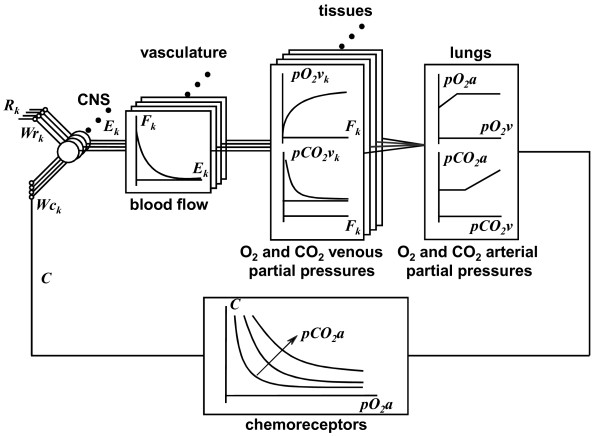
The model is a simple biological plausible adaptative neural network to simulate the development of the sympathetic nervous control. It is hypothesized that during ontogeny, from the RNS afferents to the NTS, the optimal level of each sympathetic efferent discharge is learned through the chemoreceptors' feedback. Its mean discharge leads to normal oxygen and carbon dioxide levels in each tissue. Thus, the sympathetic efferent discharge sets at the optimal level if, despite maximal drift, the local blood flow is compensated for by autoregulation. Such optimal level produces minimum chemoreceptor output, which must be maintained by the nervous system. Since blood flow is controlled by arterial blood pressure, the long-term mean level is stabilized to regulate oxygen and carbon dioxide levels. After development, the cardiopulmonary reflexes play an important role in controlling efferent sympathetic nerve activity to the kidneys and modulating sodium and water excretion.
Starting from fixed RNS afferents to the NTS and random synaptic weight values, the sympathetic efferents converged to the optimal values. When learning was completed, the output from the chemoreceptors became zero because the sympathetic efferents led to normal partial pressures of oxygen and carbon dioxide.
We introduce here a simple simulating computational theory to study, from a neurophysiologic point of view, the sympathetic development of cardiovascular regulation due to feedback signals sent off by cardiovascular receptors. The model simulates, too, how the NTS, as emergent property, acts as a comparator and how its rostral afferents behave as set point.
最近提出了核索(NTS)作为评估其头端神经结构(RNS)与心血管受体传入信号之间误差信号的比较器的概念。从这个角度来看,压力可以通过设定点变化引起高血压,从而为一个老问题提供答案。尽管局部血流受到循环血管活性激素和局部因素的影响,但仍然存在显著的交感神经控制。已经证实,出生时血管交感神经支配的成熟状态因动物物种而异,并且主要发生在出生后期间。在个体发生过程中,化学感受器是功能性的;当动脉血液中的氧和二氧化碳分压不正常时,它们就会放电。
该模型是一个简单的生物合理的自适应神经网络,用于模拟交感神经控制的发育。假设在个体发生过程中,从 RNS 传入到 NTS,每个交感传出放电的最佳水平是通过化学感受器的反馈来学习的。其平均放电导致每个组织中的氧气和二氧化碳水平正常。因此,如果尽管存在最大漂移,但局部血流通过自动调节得到补偿,则交感传出放电设置在最佳水平。这种最佳水平产生最小的化学感受器输出,必须由神经系统维持。由于血流受动脉血压控制,因此长期平均水平得到稳定以调节氧气和二氧化碳水平。发育后,心肺反射在控制肾脏传出交感神经活动和调节钠和水排泄方面起着重要作用。
从固定的 NTS 传入到 NTS 的 RNS 和随机突触权重值开始,交感传出神经收敛到最佳值。学习完成后,化学感受器的输出变为零,因为交感传出神经导致氧气和二氧化碳分压正常。
我们在这里引入了一个简单的模拟计算理论,从神经生理学的角度研究心血管调节的交感神经发育,因为心血管受体发出反馈信号。该模型还模拟了 NTS 如何作为比较器发挥作用,以及其头端传入信号如何作为设定点发挥作用。