Eshleman Emily, Shahzad Aamir, Cohrs Randall J
Cedar Crest College, Allentown, PA, USA.
Future Virol. 2011 Mar;6(3):341-355. doi: 10.2217/fvl.10.90.
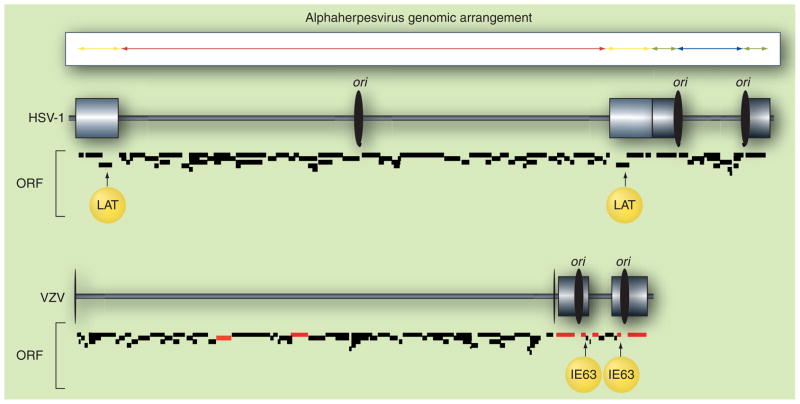
Primary infection by varicella zoster virus (VZV) typically results in childhood chickenpox, at which time latency is established in the neurons of the cranial nerve, dorsal root and autonomic ganglia along the entire neuraxis. During latency, the histone-associated virus genome assumes a circular episomal configuration from which transcription is epigenetically regulated. The lack of an animal model in which VZV latency and reactivation can be studied, along with the difficulty in obtaining high-titer cell-free virus, has limited much of our understanding of VZV latency to descriptive studies of ganglia removed at autopsy and analogy to HSV-1, the prototype alphaherpesvirus. However, the lack of miRNA, detectable latency-associated transcript and T-cell surveillance during VZV latency highlight basic differences between the two neurotropic herpesviruses. This article focuses on VZV latency: establishment, maintenance and reactivation. Comparisons are made with HSV-1, with specific attention to differences that make these viruses unique human pathogens.
水痘带状疱疹病毒(VZV)的初次感染通常会导致儿童水痘,此时病毒会在沿整个神经轴的颅神经、背根和自主神经节的神经元中建立潜伏状态。在潜伏期间,与组蛋白相关的病毒基因组呈现环状游离型构型,转录通过表观遗传进行调控。由于缺乏可用于研究VZV潜伏和再激活的动物模型,以及难以获得高滴度的无细胞病毒,我们对VZV潜伏的了解大多局限于对尸检时切除的神经节的描述性研究,以及与原型α疱疹病毒单纯疱疹病毒1型(HSV-1)的类比。然而,VZV潜伏期间缺乏微小RNA、可检测到的潜伏相关转录本和T细胞监测,凸显了这两种嗜神经性疱疹病毒之间的基本差异。本文重点关注VZV的潜伏:建立、维持和再激活。同时与HSV-1进行比较,特别关注使这些病毒成为独特人类病原体的差异。