Vaccine and Infectious Disease Division, Fred Hutchinson Cancer Research Center, 1100 Fairview Ave N, Seattle, WA, USA.
Department of Laboratory Medicine, University of Washington, Seattle, WA, USA.
Virol J. 2021 Apr 23;18(1):85. doi: 10.1186/s12985-021-01555-7.
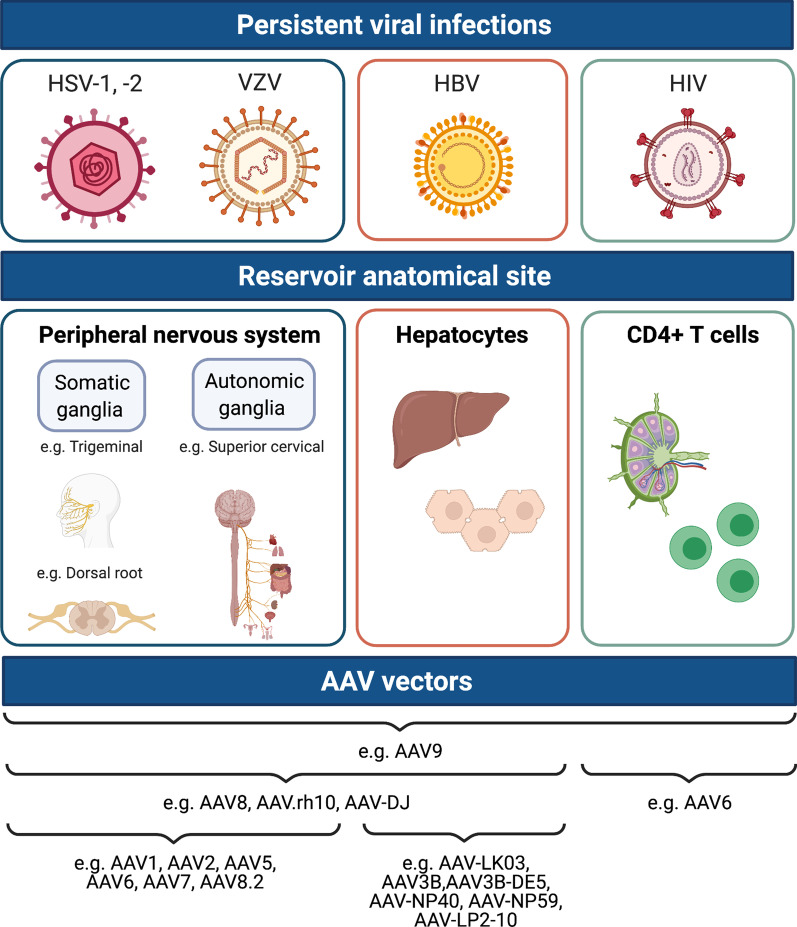
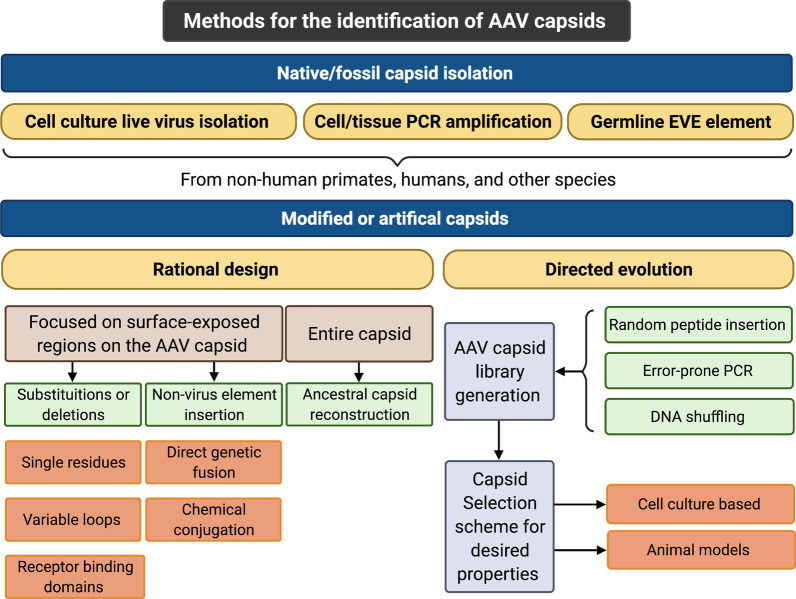
Gene delivery of antiviral therapeutics to anatomical sites where viruses accumulate and persist is a promising approach for the next generation of antiviral therapies. Recombinant adeno-associated viruses (AAV) are one of the leading vectors for gene therapy applications that deliver gene-editing enzymes, antibodies, and RNA interference molecules to eliminate viral reservoirs that fuel persistent infections. As long-lived viral DNA within specific cellular reservoirs is responsible for persistent hepatitis B virus, Herpes simplex virus, and human immunodeficiency virus infections, the discovery of AAV vectors with strong tropism for hepatocytes, sensory neurons and T cells, respectively, is of particular interest. Identification of natural isolates from various tissues in humans and non-human primates has generated an extensive catalog of AAV vectors with diverse tropisms and transduction efficiencies, which has been further expanded through molecular genetic approaches. The AAV capsid protein, which forms the virions' outer shell, is the primary determinant of tissue tropism, transduction efficiency, and immunogenicity. Thus, over the past few decades, extensive efforts to optimize AAV vectors for gene therapy applications have focused on capsid engineering with approaches such as directed evolution and rational design. These approaches are being used to identify variants with improved transduction efficiencies, alternate tropisms, reduced sequestration in non-target organs, and reduced immunogenicity, and have produced AAV capsids that are currently under evaluation in pre-clinical and clinical trials. This review will summarize the most recent strategies to identify AAV vectors with enhanced tropism and transduction in cell types that harbor viral reservoirs.
将抗病毒治疗药物递送到病毒积累和持续存在的解剖部位是下一代抗病毒治疗的一种有前途的方法。重组腺相关病毒 (AAV) 是基因治疗应用的主要载体之一,可将基因编辑酶、抗体和 RNA 干扰分子递送到消除导致持续性感染的病毒库。由于特定细胞库中长寿命的病毒 DNA 是导致持续性乙型肝炎病毒、单纯疱疹病毒和人类免疫缺陷病毒感染的原因,因此,发现对肝细胞、感觉神经元和 T 细胞分别具有强嗜性的 AAV 载体特别有趣。从人类和非人类灵长类动物的各种组织中鉴定出的天然分离株产生了具有不同嗜性和转导效率的广泛 AAV 载体目录,通过分子遗传方法进一步扩展了该目录。AAV 衣壳蛋白形成病毒粒子的外壳,是组织嗜性、转导效率和免疫原性的主要决定因素。因此,在过去几十年中,为了优化 AAV 载体在基因治疗应用中的应用,人们进行了广泛的努力,重点是通过定向进化和合理设计等方法进行衣壳工程。这些方法正在用于鉴定具有改进的转导效率、替代嗜性、减少在非靶器官中的隔离以及降低免疫原性的变体,并已产生了目前正在临床前和临床试验中评估的 AAV 衣壳。这篇综述将总结最近用于鉴定具有增强的嗜性和在携带病毒库的细胞类型中转导的 AAV 载体的策略。