Ottawa Hospital Research Institute, Ottawa, Ontario, Canada.
PLoS One. 2011;6(6):e21093. doi: 10.1371/journal.pone.0021093. Epub 2011 Jun 15.
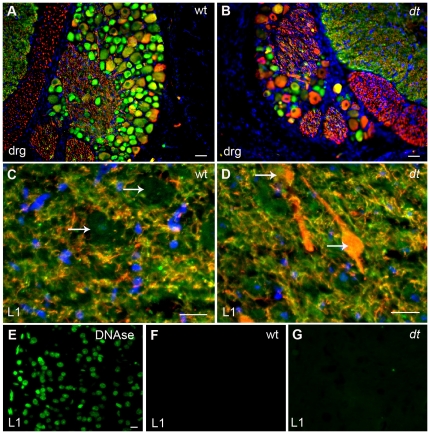
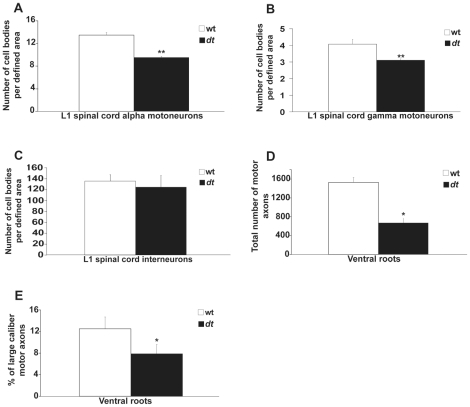
Dystonia musculorum (dt) is a mouse inherited sensory neuropathy caused by mutations in the dystonin gene. While the primary pathology lies in the sensory neurons of dt mice, the overt movement disorder suggests motor neurons may also be affected. Here, we report on the contribution of motor neurons to the pathology in dt(27J) mice. Phenotypic dt(27J) mice display reduced alpha motor neuron cell number and eccentric alpha motor nuclei in the ventral horn of the lumbar L1 spinal cord region. A dramatic reduction in the total number of motor axons in the ventral root of postnatal day 15 dt(27J) mice was also evident. Moreover, analysis of the trigeminal nerve of the brainstem showed a 2.4 fold increase in number of degenerating neurons coupled with a decrease in motor neuron number relative to wild type. Aberrant phosphorylation of neurofilaments in the perikaryon region and axonal swellings within the pre-synaptic terminal region of motor neurons were observed. Furthermore, neuromuscular junction staining of dt(27J) mouse extensor digitorum longus and tibialis anterior muscle fibers showed immature endplates and a significant decrease in axon branching compared to wild type littermates. Muscle atrophy was also observed in dt(27J) muscle. Ultrastructure analysis revealed amyelinated motor axons in the ventral root of the spinal nerve, suggesting a possible defect in Schwann cells. Finally, behavioral analysis identified defective motor function in dt(27J) mice. This study reveals neuromuscular defects that likely contribute to the dt(27J) pathology and identifies a critical role for dystonin outside of sensory neurons.
肌肉张力障碍(dt)是一种由 dystonin 基因突变引起的遗传性感觉神经病变。虽然主要的病理学位于 dt 小鼠的感觉神经元中,但明显的运动障碍表明运动神经元也可能受到影响。在这里,我们报告了运动神经元对 dt(27J)小鼠病理学的贡献。表型 dt(27J)小鼠显示出 alpha 运动神经元细胞数量减少和腰骶部 L1 脊髓区域腹角的 alpha 运动神经元核偏心。出生后 15 天 dt(27J)小鼠的腹根中运动轴突总数明显减少。此外,对脑干三叉神经的分析显示,退化神经元的数量增加了 2.4 倍,而相对于野生型,运动神经元的数量减少了。观察到运动神经元的胞体区神经丝异常磷酸化和轴突膨大区的前突触终端区。此外,dt(27J)小鼠伸趾长肌和胫骨前肌纤维的运动神经元神经肌肉接头染色显示未成熟的终板,与野生型同窝仔相比,轴突分支明显减少。dt(27J)肌肉也观察到肌肉萎缩。超微结构分析显示脊髓神经腹根中无髓运动轴突,提示施万细胞可能存在缺陷。最后,行为分析确定了 dt(27J)小鼠的运动功能缺陷。这项研究揭示了可能导致 dt(27J)病理学的神经肌肉缺陷,并确定了 dystonin 在感觉神经元之外的关键作用。