Department of Animal Science and Ethology, Canine Behavior Research Center, Czech University of Life Sciences, Praha, Czech Republic.
PLoS One. 2011;6(6):e20704. doi: 10.1371/journal.pone.0020704. Epub 2011 Jun 15.
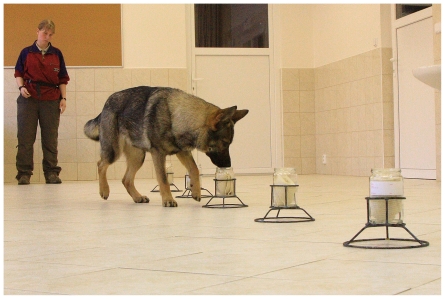
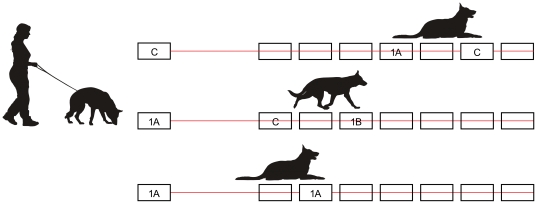
Earlier studies have shown variation among experimental attempts to establish whether human monozygotic twins that are genetically identical also have identical individual scents. In none of the cases were the dogs able to distinguish all the individual scents of monozygotic twins living in the same environment if the scents were presented to them separately. Ten specially trained police German Shepherd dogs of three Czech Republic Police Regional Headquarters were used for scent identification in our study. The dogs were supposed to match scents of two monozygotic pairs (5 and 7 years old) and two dizygotic twin pairs (8 and 13 years old). Scents were collected on cotton squares stored in glass jars. Dog handlers were blind to the experiment details. In each trial (line-up), one scent was used as a starting scent and the dog was then sent to determine if any of the 7 presented glass jars contained a matching scent. Scents of children of similar ages were used as distractors. In the matching procedure, the dogs matched correctly the scent of one twin with the other, as well as two scents collected from every single identical and non-identical twin to prove their efficacy and likewise, the presence of the matching twin scent in any given glass jar. All dogs in all trials distinguished correctly the scents of identical as well as non-identical twins. All dogs similarly matched positively two scents collected from the same individuals. Our findings indicated that specially trained German Shepherd dogs are able to distinguish individual scents of identical twins despite the fact that they live in the same environment, eat the same food and even if the scents are not presented to them simultaneously.
早期的研究表明,在实验中试图确定遗传上完全相同的人类同卵双胞胎是否具有相同的个体气味存在着差异。在所有情况下,如果将气味分别呈现给狗,它们都无法区分生活在相同环境中的同卵双胞胎的所有个体气味。在我们的研究中,使用了来自捷克共和国三个地区警察局的 10 只经过特殊训练的警犬德国牧羊犬进行气味识别。这些狗应该匹配两对同卵双胞胎(5 岁和 7 岁)和两对异卵双胞胎(8 岁和 13 岁)的气味。气味收集在储存在玻璃罐中的棉方块上。狗的 handler 对实验细节一无所知。在每次试验(列队)中,使用一种气味作为起始气味,然后让狗去确定 7 个呈现的玻璃罐中是否有匹配的气味。使用年龄相似的儿童的气味作为干扰物。在匹配过程中,狗正确地将一个双胞胎的气味与另一个双胞胎的气味相匹配,以及从每个相同和不同的双胞胎收集的两个气味,以证明它们的效力,同样,在任何给定的玻璃罐中都存在匹配的双胞胎气味。所有的狗在所有的试验中都正确地区分了同卵和异卵双胞胎的气味。所有的狗都同样积极地匹配了来自相同个体的两个气味。我们的研究结果表明,经过特殊训练的德国牧羊犬能够区分同卵双胞胎的个体气味,尽管他们生活在相同的环境中,吃相同的食物,甚至如果气味不是同时呈现给他们。