Department of Medical Oncology, University Medical Centre Groningen, P.O. Box 30.001, 9700 RB, Groningen, The Netherlands.
Eur J Nucl Med Mol Imaging. 2011 Oct;38(10):1854-61. doi: 10.1007/s00259-011-1862-5. Epub 2011 Jun 23.
Positron emission tomography (PET) using 6-[18F]fluoro-L-dihydroxyphenylalanine (18F-dopa) has an excellent sensitivity to detect carcinoid tumour lesions. 18F-dopa tumour uptake and the levels of biochemical tumour markers are mediated by tumour endocrine metabolic activity. We evaluated whether total 18F-dopa tumour uptake on PET, defined as whole-body metabolic tumour burden (WBMTB), reflects tumour load per patient, as measured with tumour markers.
Seventy-seven consecutive carcinoid patients who underwent an 18F-dopa PET scan in two previously published studies were analysed. For all tumour lesions mean standardised uptake values (SUVs) at 40% of the maximal SUV and tumour volume on 18F-dopa PET were determined and multiplied to calculate a metabolic burden per lesion. WBMTB was the sum of the metabolic burden of all individual lesions per patient. The 24-h urinary serotonin, urine and plasma 5-hydroxindoleacetic acid (5-HIAA), catecholamines (nor)epinephrine, dopamine and their metabolites, measured in urine and plasma, and serum chromogranin A served as tumour markers.
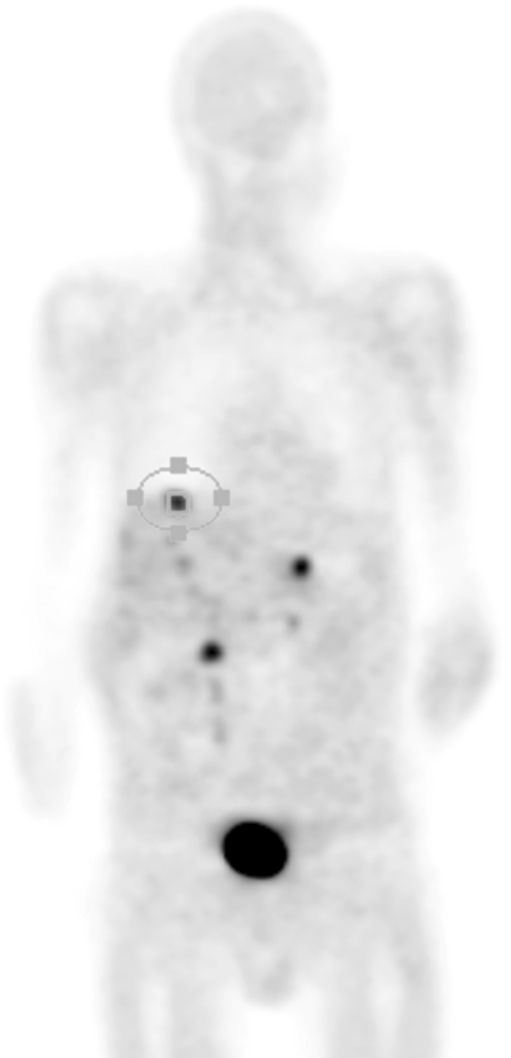
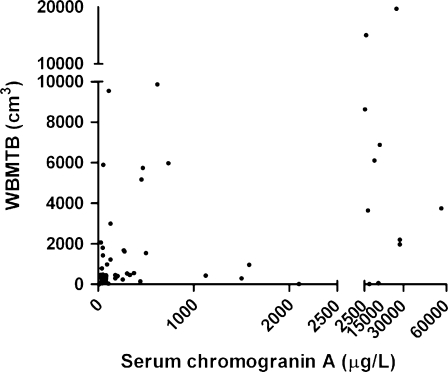
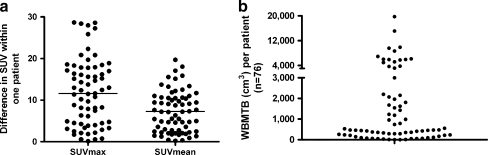
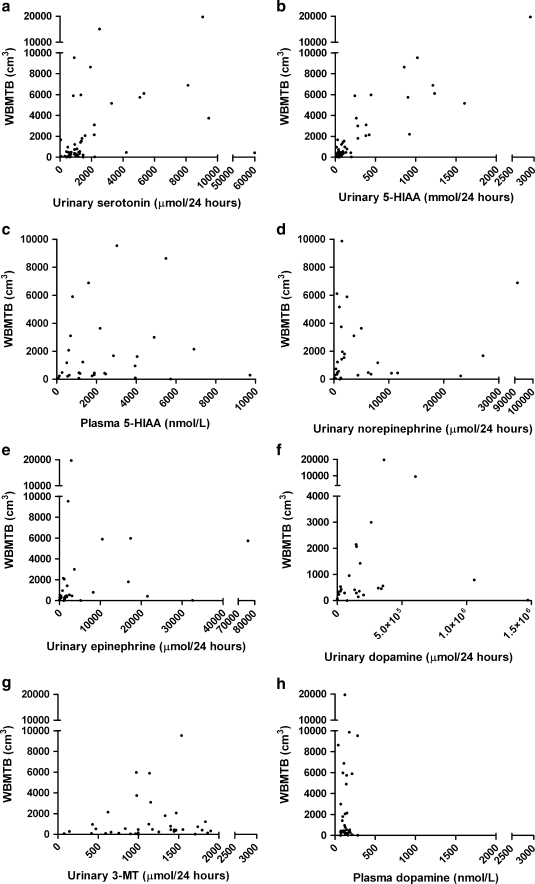
All but 1 were evaluable for WBMTB; 74 patients had metastatic disease. 18F-dopa PET detected 979 lesions. SUVmax on 18F-dopa PET varied up to 29-fold between individual lesions within the same patients. WBMTB correlated with urinary serotonin (r=0.51) and urinary and plasma 5-HIAA (r=0.78 and 0.66). WBMTB also correlated with urinary norepinephrine, epinephrine, dopamine and plasma dopamine, but not with serum chromogranin A.
Tumour load per patient measured with 18F-dopa PET correlates with tumour markers of the serotonin and catecholamine pathway in urine and plasma in carcinoid patients, reflecting metabolic tumour activity.
正电子发射断层扫描(PET)使用 6-[18F]氟-L-二羟苯丙氨酸(18F-dopa)对类癌肿瘤病变具有出色的灵敏度。18F-dopa 肿瘤摄取和生化肿瘤标志物水平受肿瘤内分泌代谢活性的调节。我们评估了 PET 上的总 18F-dopa 肿瘤摄取,即全身代谢肿瘤负担(WBMTB),是否反映了每位患者的肿瘤负荷,这可以通过肿瘤标志物来衡量。
对两项先前发表的研究中接受 18F-dopa PET 扫描的 77 例连续类癌患者进行了分析。确定了 18F-dopa PET 上所有肿瘤病变的平均标准化摄取值(SUV)在最大 SUV 的 40%和肿瘤体积,并将其相乘以计算每个病变的代谢负担。WBMTB 是每位患者所有单个病变代谢负担的总和。24 小时尿液 5-羟色胺、尿液和血浆 5-羟吲哚乙酸(5-HIAA)、儿茶酚胺(去甲)肾上腺素、多巴胺及其代谢物,以及尿液和血浆中的血清嗜铬粒蛋白 A 作为肿瘤标志物进行了测量。
除 1 例外,所有患者均可以评估 WBMTB;74 例患者患有转移性疾病。18F-dopa PET 检测到 979 个病变。同一患者内的不同病变之间,18F-dopa PET 的 SUVmax 差异高达 29 倍。WBMTB 与尿液 5-羟色胺(r=0.51)和尿液和血浆 5-HIAA(r=0.78 和 0.66)相关。WBMTB 还与尿液去甲肾上腺素、肾上腺素、多巴胺和血浆多巴胺相关,但与血清嗜铬粒蛋白 A 无关。
用 18F-dopa PET 测量的每位患者的肿瘤负荷与类癌患者尿液和血浆中 5-羟色胺和儿茶酚胺途径的肿瘤标志物相关,反映了肿瘤的代谢活性。