Department of Psychiatry and Human Behavior, University of California, Irvine, California 92697-4260, USA.
Psychosom Med. 2011 Jul-Aug;73(6):469-74. doi: 10.1097/PSY.0b013e31821fbf9a. Epub 2011 Jun 23.
Biobehavioral models of prenatal stress highlight the importance of the stress-related hormone cortisol. However, the association between maternal cortisol levels and the length of human gestation requires further investigation because most previous studies have relied on one-time cortisol measures assessed at varying gestational ages. This study assessed whether ecological momentary assessment (EMA) of cortisol sampling improves the ability to predict the length of human gestation. In addition, associations between EMA-based measures of psychological state (negative affect) with cortisol levels during pregnancy were assessed.
For a 4-day period, 25 healthy pregnant women (mean gestational age at assessment = 23.4 [standard deviation = 9.1] weeks) collected seven salivary samples per day for the assessment of cortisol and provided a rating of negative affect every waking hour using an electronic diary.
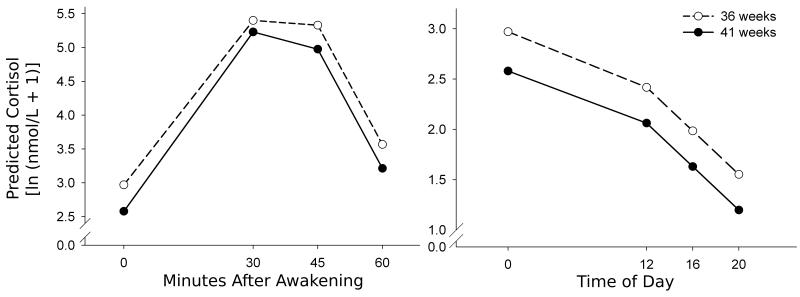
Higher salivary cortisol concentrations at awakening and throughout the day (p = .001), as well as a flatter cortisol response to awakening (p = .005), were associated with shorter length of gestation. Women who delivered an infant at 36 weeks of gestations had 13% higher salivary cortisol levels at awakening than women who delivered an infant at 41 weeks of gestation. The EMA-based measure of negative affect was associated with higher cortisol throughout the day (p = .006) but not to gestational length (p = .641). The one-time measure of cortisol was not associated with length of gestation, and traditional retrospective recall measures of negative affect were not associated with cortisol.
Our findings support the ecological validity of repeated ambulatory assessments of cortisol in pregnancy and their ability to improve the prediction of adverse birth outcomes.
产前应激的生物行为模型强调了应激相关激素皮质醇的重要性。然而,母体皮质醇水平与人类妊娠时间的关系仍需要进一步研究,因为大多数先前的研究依赖于在不同妊娠年龄评估的单次皮质醇测量。本研究评估了皮质醇的生态瞬时评估(EMA)采样是否能提高预测人类妊娠时间的能力。此外,还评估了 EMA 基础的心理状态(负性情绪)与妊娠期间皮质醇水平之间的关联。
在 4 天的时间内,25 名健康孕妇(评估时的平均妊娠年龄为 23.4[标准差=9.1]周)每天采集 7 份唾液样本,以评估皮质醇,并使用电子日记每小时评估一次负性情绪。
觉醒时和全天较高的唾液皮质醇浓度(p=0.001),以及觉醒时皮质醇反应较平坦(p=0.005)与妊娠时间较短有关。在 36 周分娩的女性的唾液皮质醇水平比在 41 周分娩的女性高 13%。基于 EMA 的负性情绪测量与全天皮质醇水平升高相关(p=0.006),但与妊娠时间无关(p=0.641)。单次皮质醇测量与妊娠时间无关,传统的回顾性负性情绪测量也与皮质醇无关。
我们的发现支持妊娠期间重复进行皮质醇的移动评估的生态有效性,以及它们提高预测不良分娩结局的能力。