Chao H H, Waheed A, Pohlmann R, Hille A, von Figura K
Georg-August-Universität Göttingen, Biochemie II, FRG.
EMBO J. 1990 Nov;9(11):3507-13. doi: 10.1002/j.1460-2075.1990.tb07559.x.
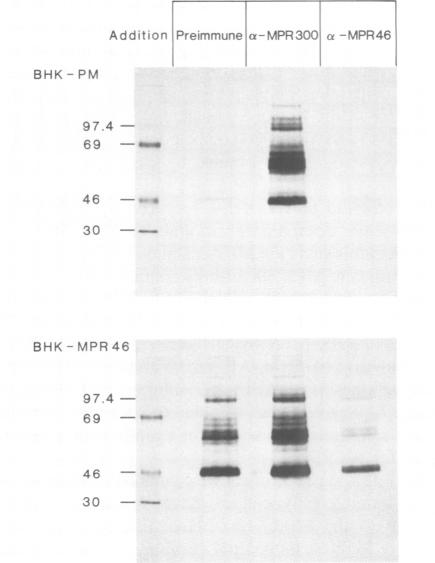
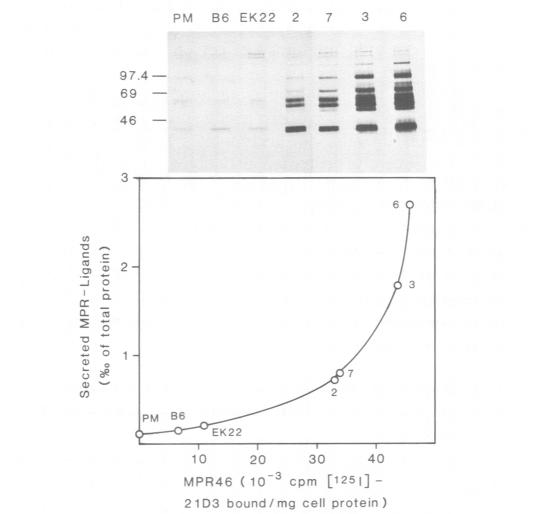
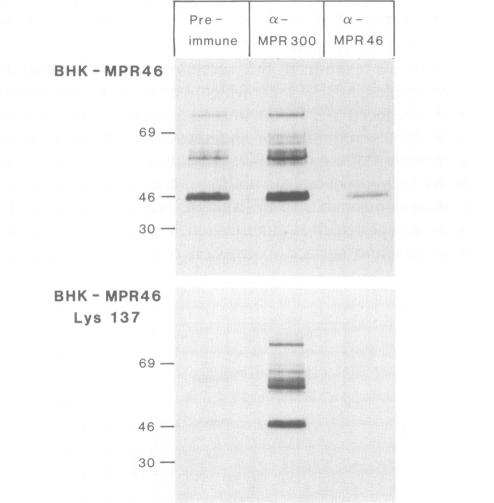
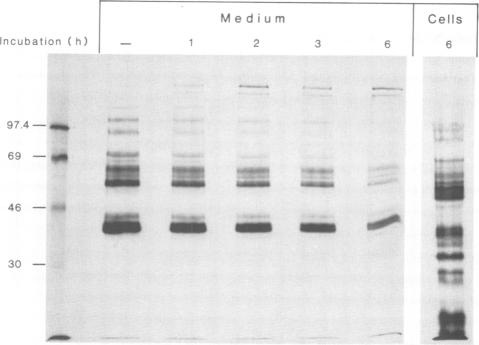
BHK and mouse L cells transfected with the cDNA for the human 46 kd mannose 6-phosphate receptor (MPR 46) secrete excessive amounts of newly synthesized mannose 6-phosphate containing polypeptides. The secretion is dependent on the amount, the recycling and the affinity for ligands of MPR 46. Incubation of transfected cells with antibodies blocking the binding site of MPR 46 reduces the secretion, and cotransfection with the cDNA for the human 300 kd mannose 6-phosphate (MPR 300) restores it to normal values. These results indicate that the two mannose 6-phosphate receptors compete for binding of newly synthesized ligands. In contrast to ligands bound to MPR 300, those bound to the MPR 46 are transported to and released at a site, e.g. early endosomes or plasma membrane, from where they can exit into the medium. Since antibodies blocking the binding site of MPR 46 reduce secretion also in non-transfected BHK and mouse L cells, at least part of the basal secretion of M6P-containing polypeptides is mediated by the endogenous MPR 46.
用人类46kd甘露糖6-磷酸受体(MPR 46)的cDNA转染的BHK细胞和小鼠L细胞分泌过量新合成的含甘露糖6-磷酸的多肽。这种分泌取决于MPR 46的量、循环利用情况及其对配体的亲和力。用阻断MPR 46结合位点的抗体孵育转染细胞会减少分泌,而与人300kd甘露糖6-磷酸(MPR 300)的cDNA共转染可使其恢复到正常水平。这些结果表明,两种甘露糖6-磷酸受体竞争新合成配体的结合。与结合到MPR 300的配体不同,结合到MPR 46的配体被转运到一个位点(如早期内体或质膜)并在该处释放,从那里它们可以分泌到培养基中。由于阻断MPR 46结合位点的抗体在未转染的BHK细胞和小鼠L细胞中也会减少分泌,因此含M6P多肽的基础分泌至少部分是由内源性MPR 46介导的。