Department of Epidemiology and Public Health, Swiss Tropical and Public Health Institute, Basel, Switzerland.
Parasit Vectors. 2011 Jun 24;4:116. doi: 10.1186/1756-3305-4-116.
Disability weights (DWs) are important for estimating burden of disease in terms of disability-adjusted life years. The previous practice of eliciting DWs by expert opinion has been challenged. More recent approaches employed quality of life (QoL) questionnaires to establish patient-based DWs, but results are ambiguous.
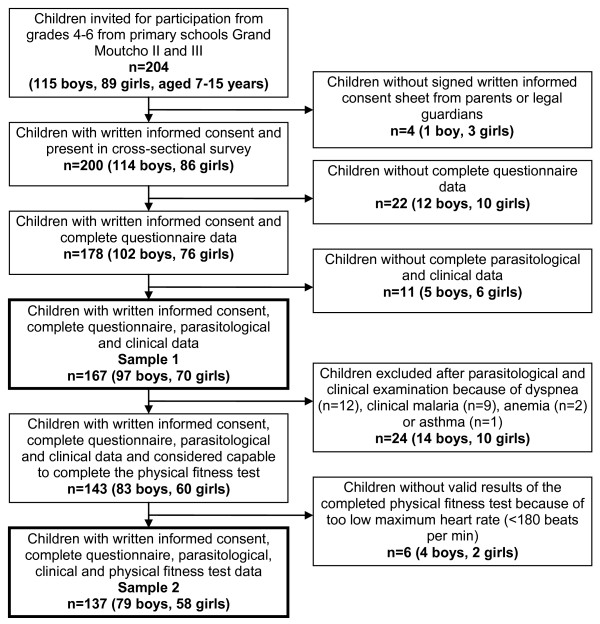
In early 2010, we administered a questionnaire pertaining to physical fitness to 200 schoolchildren in Côte d'Ivoire. Helminth and Plasmodium spp. infections were determined and schoolchildren's physical fitness objectively measured in a maximal multistage 20 m shuttle run test. Associations between objectively measured and self-reported physical fitness and between self-reported physical fitness and infection status were determined. Spearman rank correlation coefficient, uni- and multivariable linear regression models adjusting for children's age and sex, ambient air temperature and humidity, Fisher's test, χ(2) and t-test statistics were used for statistical analysis.
The prevalence of Schistosoma haematobium, Plasmodium spp., Schistosoma mansoni, hookworm and Ascaris lumbricoides in 167 children with complete parasitological results was 84.4%, 74.9%, 54.5%, 14.4% and 1.2%, respectively. High infection intensities and multiple species parasite infections were common. In the 137 children with complete data also from the shuttle run test, we found statistically significant correlations between objectively measured and self-reported physical fitness. However, no statistically significant correlation between the children's parasitic infection status and self-reported physical fitness was identified. An attrition analysis revealed considerably lower self-reported physical fitness scores of parasitized children who were excluded from shuttle run testing due to medical concerns in comparison to parasitized children who were able to successfully complete the shuttle run test.
Our QoL questionnaire proofed valid to assess children's physical fitness in the current study area. Reasons why no differences in self-reported physical fitness in children with different parasitic infections were found are manifold, but do not preclude the use of QoL questionnaires in the elicitation of DWs. Indeed, the questionnaire was particularly useful in assessing physical fitness of those children, who were - supposedly due to parasitic infections - unable to complete the shuttle run test. Hence, we encourage others to use QoL questionnaires to determine not only physical fitness, but also more subtle morbidities.
失能权重(DWs)对于用残疾调整生命年来衡量疾病负担非常重要。之前通过专家意见来获取 DWs 的做法受到了挑战。最近的方法采用生活质量(QoL)问卷来建立基于患者的 DWs,但结果存在歧义。
2010 年初,我们向科特迪瓦的 200 名学童发放了一份与身体健康有关的问卷。确定了他们是否感染了蠕虫和疟原虫,并使用最大多阶段 20 米穿梭跑测试对他们的身体机能进行了客观测量。我们还确定了客观测量的身体机能和自我报告的身体机能之间的关联,以及自我报告的身体机能和感染状况之间的关联。我们使用 Spearman 秩相关系数、单变量和多变量线性回归模型(调整了儿童的年龄和性别、环境空气温度和湿度、Fisher 检验、χ²和 t 检验统计数据)进行统计分析。
在 167 名完成寄生虫学检查的儿童中,有 84.4%、74.9%、54.5%、14.4%和 1.2%的人患有埃及血吸虫病、疟原虫病、曼氏血吸虫病、钩虫病和蛔虫病。高感染强度和多种寄生虫感染很常见。在 137 名完成了所有数据,包括穿梭跑测试的儿童中,我们发现客观测量的身体机能和自我报告的身体机能之间存在统计学上显著的相关性。然而,我们没有发现儿童寄生虫感染状况和自我报告的身体机能之间存在统计学显著的相关性。一项流失分析显示,由于医疗原因而无法进行穿梭跑测试的寄生虫感染儿童的自我报告身体机能评分明显低于能够成功完成穿梭跑测试的寄生虫感染儿童。
我们的 QoL 问卷在当前研究地区证明了评估儿童身体机能的有效性。在不同寄生虫感染的儿童中,自我报告的身体机能没有差异的原因有很多,但这并不能排除在 DWs 中使用 QoL 问卷。实际上,该问卷在评估那些由于寄生虫感染而无法完成穿梭跑测试的儿童的身体机能方面特别有用。因此,我们鼓励其他人使用 QoL 问卷来确定不仅是身体机能,还有更微妙的病态。