Department of Nutrition, 1215 West Cumberland Avenue, 229 Jessie Harris Building, University of Tennessee, Knoxville, TN 37996-1920, USA.
Nutr Metab (Lond). 2011 Jun 24;8(1):43. doi: 10.1186/1743-7075-8-43.
It is hypothesized that dietary linoleic acid (LA) promotes chronic and acute diseases in humans by enriching tissues with arachidonic acid (AA), its downstream metabolite, and dietary studies with rodents have been useful for validation. However, levels of LA in research diets of rodents, as published in the literature, are notoriously erratic making interspecies comparisons unreliable. Therefore, the ability to extrapolate the biological effects of dietary LA from experimental rodents to humans necessitates an allometric scaling model that is rooted within a human equivalent context.
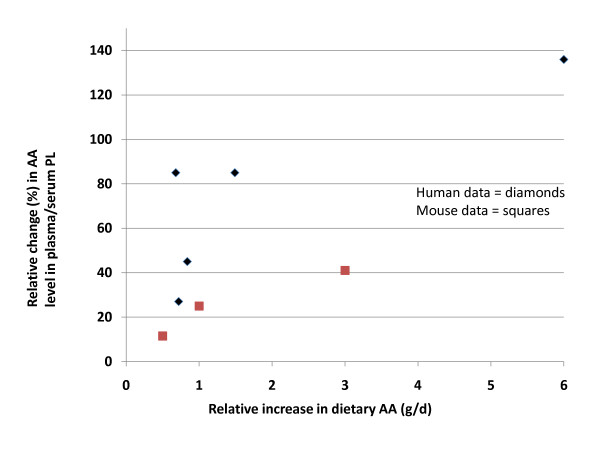
To determine the physiological response of dietary LA on tissue AA, a mathematical model for extrapolating nutrients based on energy was used, as opposed to differences in body weight. C57BL/6J mice were divided into 9 groups fed a background diet equivalent to that of the US diet (% energy) with supplemental doses of LA or AA. Changes in the phospholipid fatty acid compositions were monitored in plasma and erythrocytes and compared to data from humans supplemented with equivalent doses of LA or AA.
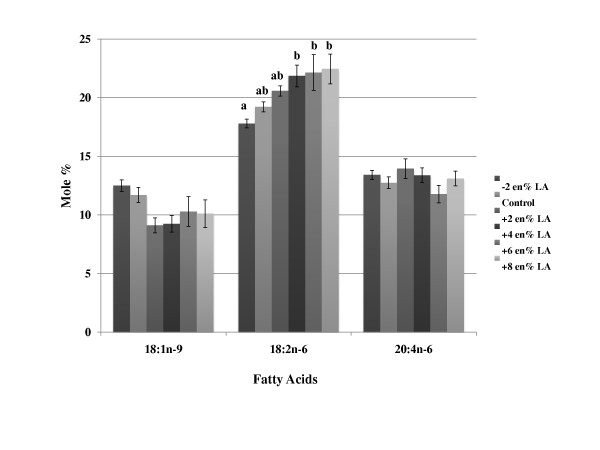
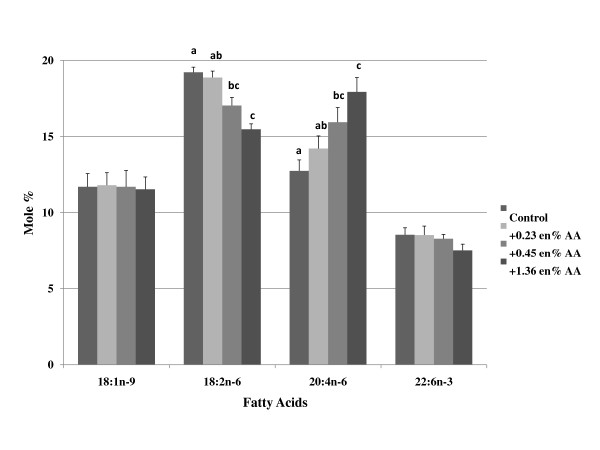
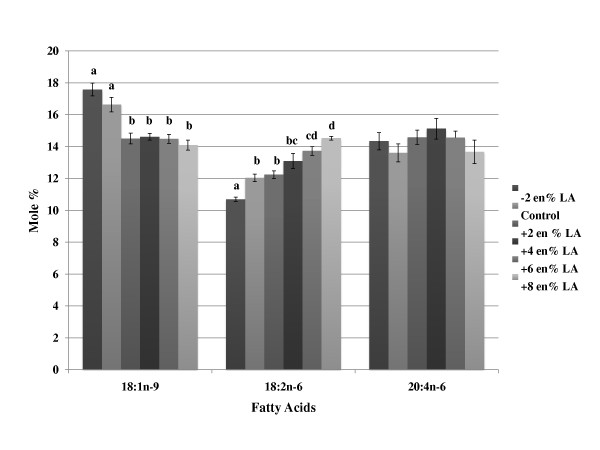
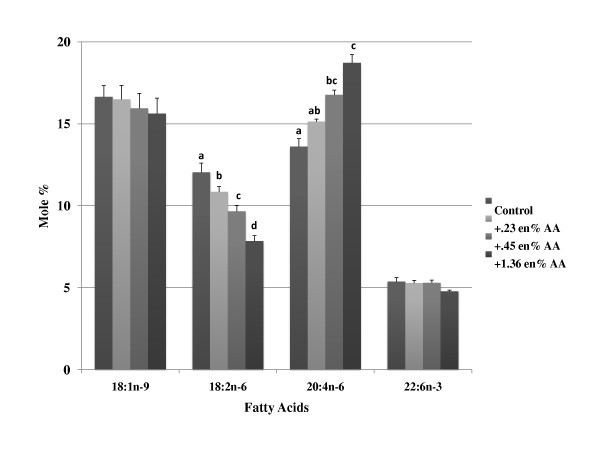
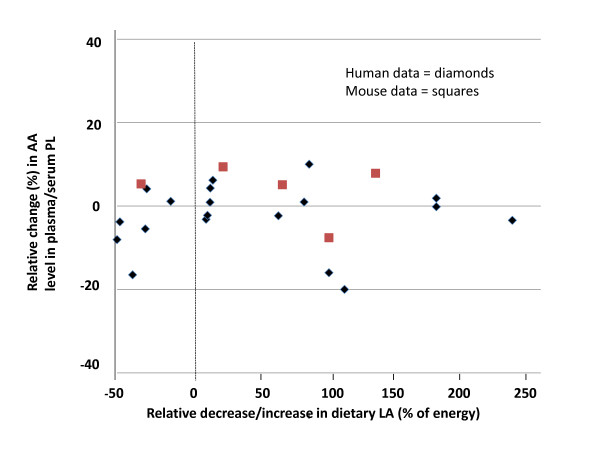
Increasing dietary LA had little effect on tissue AA, while supplementing diets with AA significantly increased tissue AA levels, importantly recapitulating results from human trials.
Thus, interspecies comparisons for dietary LA between rodents and humans can be achieved when rodents are provided human equivalent doses based on differences in metabolic activity as defined by energy consumption.
据推测,饮食中的亚油酸(LA)通过丰富组织中的花生四烯酸(AA)及其下游代谢物来促进人类的慢性和急性疾病,并且啮齿动物的饮食研究已被证明是有用的。然而,文献中报道的啮齿动物研究饮食中的 LA 水平非常不稳定,使得种间比较不可靠。因此,从实验啮齿动物推断饮食 LA 的生物学效应到人类,需要一种基于能量的营养物质的比例缩放模型,该模型根植于人类等效的背景中。
为了确定饮食 LA 对组织 AA 的生理反应,使用了一种基于能量的数学模型来推断营养素,而不是基于体重的差异。将 C57BL/6J 小鼠分为 9 组,分别用相当于美国饮食(%能量)的基础饮食和补充剂量的 LA 或 AA 喂养。监测了血浆和红细胞中磷脂脂肪酸组成的变化,并与用等量 LA 或 AA 补充的人类数据进行了比较。
增加饮食中的 LA 对组织 AA 的影响很小,而用 AA 补充饮食则显著增加了组织 AA 水平,重要的是重现了人类试验的结果。
因此,当根据能量消耗定义的代谢活性差异,为啮齿动物提供人类等效剂量时,可在啮齿动物和人类之间进行饮食 LA 的种间比较。