Epigenetics Programme, The Babraham Institute, Cambridge, UK.
Nat Genet. 2011 Jun 26;43(8):811-4. doi: 10.1038/ng.864.
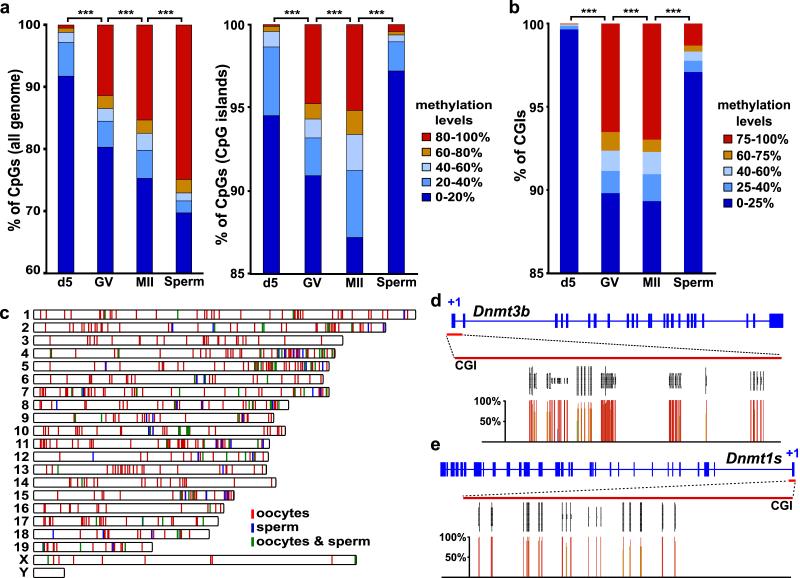
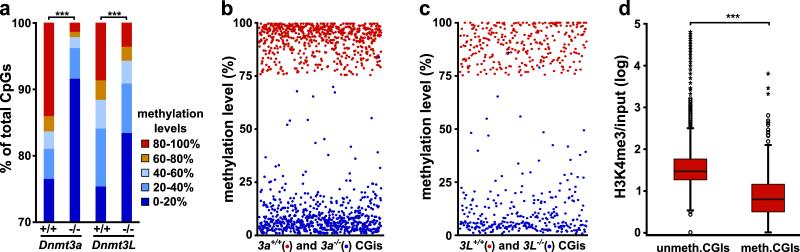
Elucidating how and to what extent CpG islands (CGIs) are methylated in germ cells is essential to understand genomic imprinting and epigenetic reprogramming. Here we present, to our knowledge, the first integrated epigenomic analysis of mammalian oocytes, identifying over a thousand CGIs methylated in mature oocytes. We show that these CGIs depend on DNMT3A and DNMT3L but are not distinct at the sequence level, including in CpG periodicity. They are preferentially located within active transcription units and are relatively depleted in H3K4me3, supporting a general transcription-dependent mechanism of methylation. Very few methylated CGIs are fully protected from post-fertilization reprogramming but, notably, the majority show incomplete demethylation in embryonic day (E) 3.5 blastocysts. Our study shows that CGI methylation in gametes is not entirely related to genomic imprinting but is a strong factor in determining methylation status in preimplantation embryos, suggesting a need to reassess mechanisms of post-fertilization demethylation.
阐明生殖细胞中 CpG 岛(CGIs)的甲基化方式和程度对于理解基因组印迹和表观遗传重编程至关重要。在这里,我们展示了迄今为止对哺乳动物卵母细胞的第一个综合表观基因组分析,鉴定出成熟卵母细胞中甲基化的一千多个 CGI。我们表明,这些 CGI 依赖于 DNMT3A 和 DNMT3L,但在序列水平上没有明显区别,包括 CpG 周期性。它们优先位于活跃的转录单元内,并且相对缺乏 H3K4me3,支持一般转录依赖性的甲基化机制。很少有甲基化的 CGI 能完全免受受精后重编程的影响,但值得注意的是,大多数在胚胎发育第 3.5 天的囊胚中表现出不完全去甲基化。我们的研究表明,配子中的 CGI 甲基化并不完全与基因组印迹有关,但却是决定植入前胚胎甲基化状态的一个重要因素,这表明需要重新评估受精后去甲基化的机制。