Laboratory of Developmental Genetics and Imprinting, The Babraham Institute, Cambridge, UK.
Nature. 2010 Feb 25;463(7284):1101-5. doi: 10.1038/nature08829.
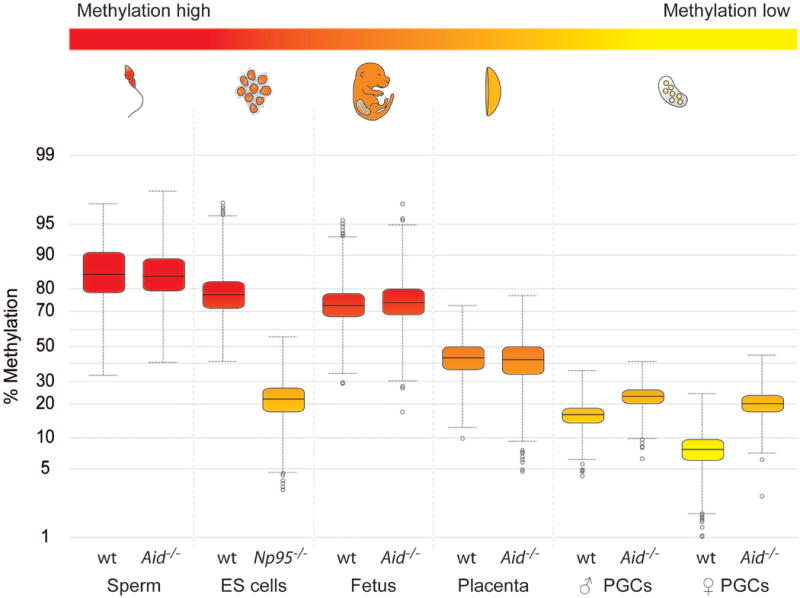
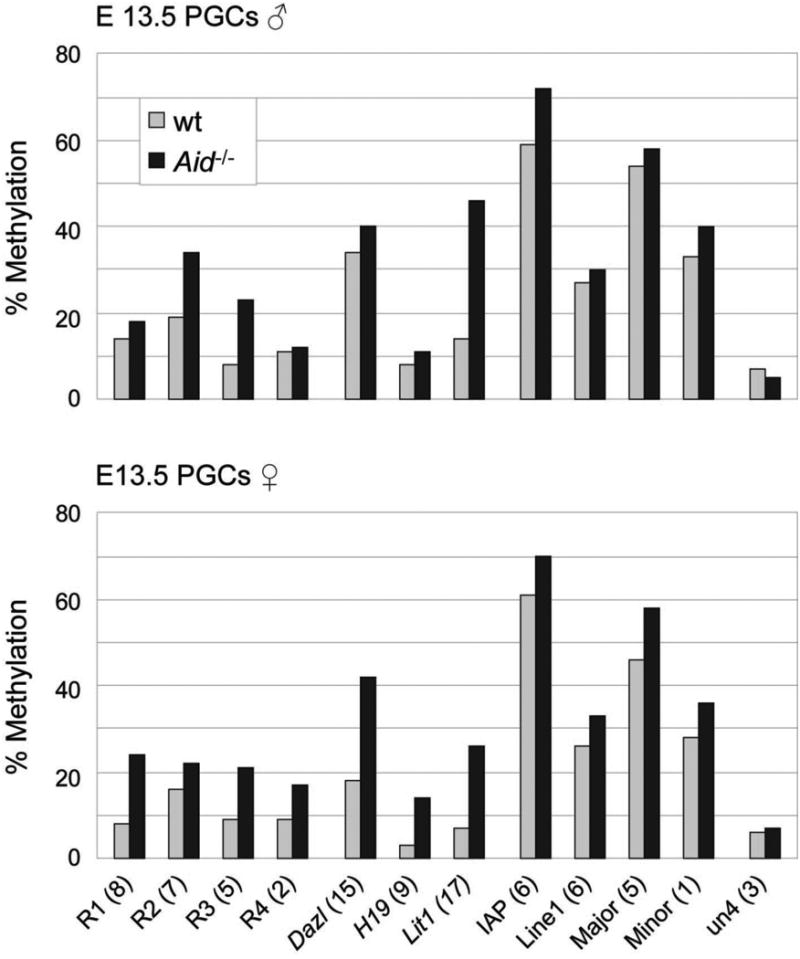
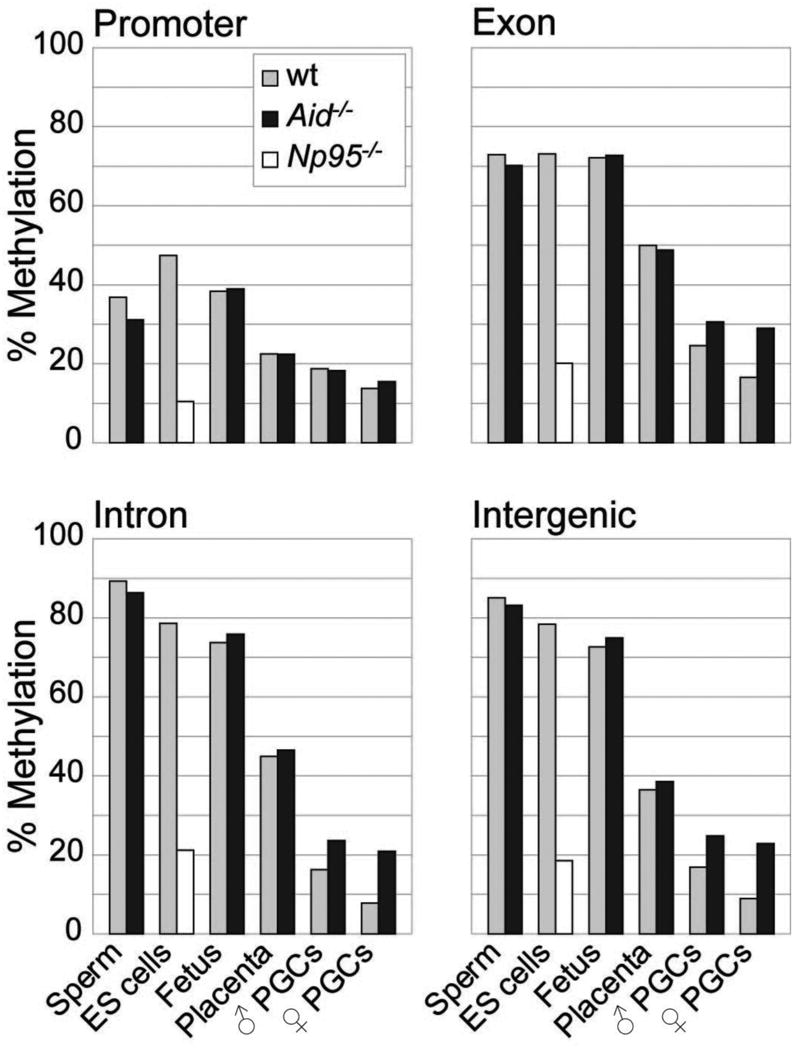
Epigenetic reprogramming including demethylation of DNA occurs in mammalian primordial germ cells (PGCs) and in early embryos, and is important for the erasure of imprints and epimutations, and the return to pluripotency. The extent of this reprogramming and its molecular mechanisms are poorly understood. We previously showed that the cytidine deaminases AID and APOBEC1 can deaminate 5-methylcytosine in vitro and in Escherichia coli, and in the mouse are expressed in tissues in which demethylation occurs. Here we profiled DNA methylation throughout the genome by unbiased bisulphite next generation sequencing in wild-type and AID-deficient mouse PGCs at embryonic day (E)13.5. Wild-type PGCs revealed marked genome-wide erasure of methylation to a level below that of methylation deficient (Np95(-/-), also called Uhrf1(-/-)) embryonic stem cells, with female PGCs being less methylated than male ones. By contrast, AID-deficient PGCs were up to three times more methylated than wild-type ones; this substantial difference occurred throughout the genome, with introns, intergenic regions and transposons being relatively more methylated than exons. Relative hypermethylation in AID-deficient PGCs was confirmed by analysis of individual loci in the genome. Our results reveal that erasure of DNA methylation in the germ line is a global process, hence limiting the potential for transgenerational epigenetic inheritance. AID deficiency interferes with genome-wide erasure of DNA methylation patterns, indicating that AID has a critical function in epigenetic reprogramming and potentially in restricting the inheritance of epimutations in mammals.
哺乳动物原始生殖细胞(PGCs)和早期胚胎中发生表观遗传重编程,包括 DNA 的去甲基化,这对于印迹和表观突变的消除以及回到多能性至关重要。这种重编程的程度及其分子机制知之甚少。我们之前表明,胞嘧啶脱氨酶 AID 和 APOBEC1 可以在体外和大肠杆菌中使 5-甲基胞嘧啶脱氨,并且在发生去甲基化的组织中在小鼠中表达。在这里,我们通过无偏 bisulphite 下一代测序在野生型和 AID 缺陷型小鼠 PGCs 中对整个基因组的 DNA 甲基化进行了分析。在胚胎日(E)13.5。野生型 PGCs 显示出明显的全基因组去甲基化,甲基化程度低于甲基化缺陷(Np95(-/-),也称为 Uhrf1(-/-))胚胎干细胞,雌性 PGCs 的甲基化程度低于雄性。相比之下,AID 缺陷型 PGCs 的甲基化程度比野生型高 3 倍;这种显著差异发生在整个基因组中,内含子、基因间区和转座子比外显子相对更甲基化。通过分析基因组中的个别基因座,证实了 AID 缺陷型 PGCs 中的相对超甲基化。我们的研究结果表明,生殖系中 DNA 甲基化的消除是一个全局过程,因此限制了跨代表观遗传遗传的潜力。AID 缺陷干扰了 DNA 甲基化模式的全基因组消除,表明 AID 在表观遗传重编程中具有关键功能,并且可能在限制哺乳动物中表观突变的遗传方面具有重要作用。