Yerkes National Primate Research Center, Emory Vaccine Center and Department of Pathology, Emory University, Atlanta, Georgia, USA.
Nat Med. 2011 Jun 26;17(7):830-6. doi: 10.1038/nm.2395.
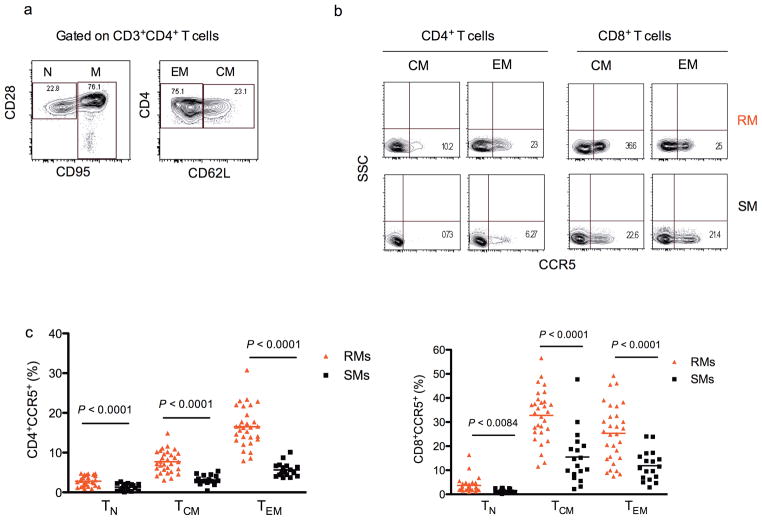
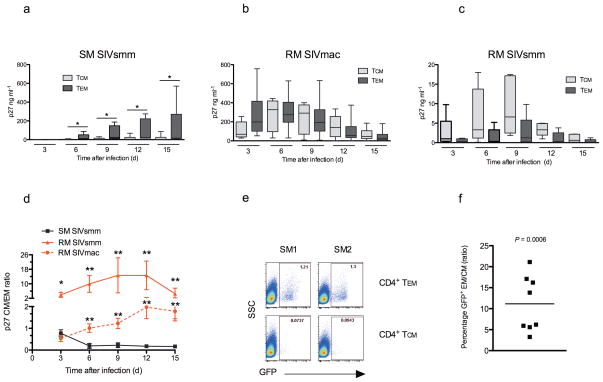
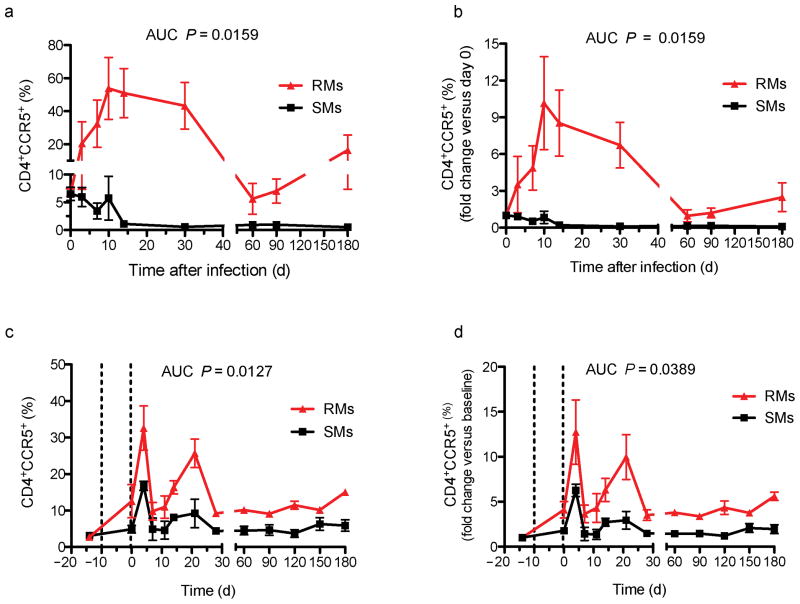
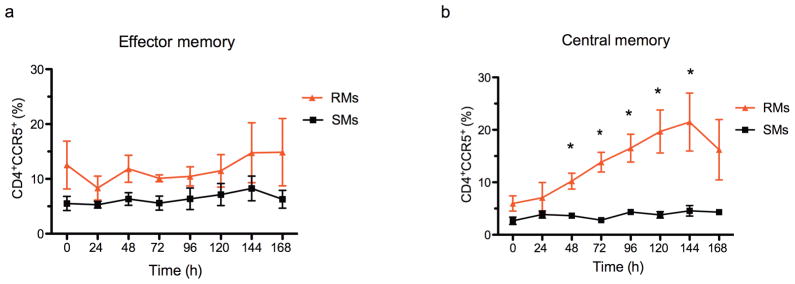
Naturally simian immunodeficiency virus (SIV)-infected sooty mangabeys do not progress to AIDS despite high-level virus replication. We previously showed that the fraction of CD4(+)CCR5(+) T cells is lower in sooty mangabeys compared to humans and macaques. Here we found that, after in vitro stimulation, sooty mangabey CD4(+) T cells fail to upregulate CCR5 and that this phenomenon is more pronounced in CD4(+) central memory T cells (T(CM) cells). CD4(+) T cell activation was similarly uncoupled from CCR5 expression in sooty mangabeys in vivo during acute SIV infection and the homeostatic proliferation that follows antibody-mediated CD4(+) T cell depletion. Sooty mangabey CD4(+) T(CM) cells that express low amounts of CCR5 showed reduced susceptibility to SIV infection both in vivo and in vitro when compared to CD4(+) T(CM) cells of rhesus macaques. These data suggest that low CCR5 expression on sooty mangabey CD4(+) T cells favors the preservation of CD4(+) T cell homeostasis and promotes an AIDS-free status by protecting CD4(+) T(CM) cells from direct virus infection.
自然感染猴免疫缺陷病毒(SIV)的食蟹猴尽管存在高水平的病毒复制,但不会进展为艾滋病。我们之前曾表明,与人类和猕猴相比,食蟹猴中 CD4(+)CCR5(+)T 细胞的比例较低。在这里,我们发现,在体外刺激后,食蟹猴 CD4(+)T 细胞不能上调 CCR5,而这种现象在 CD4(+)中央记忆 T 细胞(T(CM)细胞)中更为明显。在急性 SIV 感染和随后的抗体介导的 CD4(+)T 细胞耗竭后的稳态增殖期间,食蟹猴体内 CD4(+)T 细胞的激活同样与 CCR5 表达脱偶联。与恒河猴 CD4(+)T(CM)细胞相比,表达低水平 CCR5 的食蟹猴 CD4(+)T(CM)细胞在体内和体外对 SIV 感染的敏感性降低。这些数据表明,食蟹猴 CD4(+)T 细胞上低水平的 CCR5 有利于 CD4(+)T 细胞的稳态维持,并通过保护 CD4(+)T(CM)细胞免受直接病毒感染,促进了无艾滋病状态。