Department of Botany and Zoology, Faculty of Science, Masaryk University, Kotlářská 2, 611 37 Brno, Czech Republic.
Parasit Vectors. 2011 Jun 27;4:120. doi: 10.1186/1756-3305-4-120.
The basic function of the immune system is to protect an organism against infection in order to minimize the fitness costs of being infected. According to life-history theory, energy resources are in a trade-off between the costly demands of immunity and other physiological demands. Concerning fish, both physiology and immunity are influenced by seasonal changes (i.e. temporal variation) associated to the changes of abiotic factors (such as primarily water temperature) and interactions with pathogens and parasites. In this study, we investigated the potential associations between the physiology and immunocompetence of common carp (Cyprinus carpio) collected during five different periods of a given year. Our sampling included the periods with temporal variability and thus, it presented a different level in exposure to parasites. We analyzed which of two factors, seasonality or parasitism, had the strongest impact on changes in fish physiology and immunity.
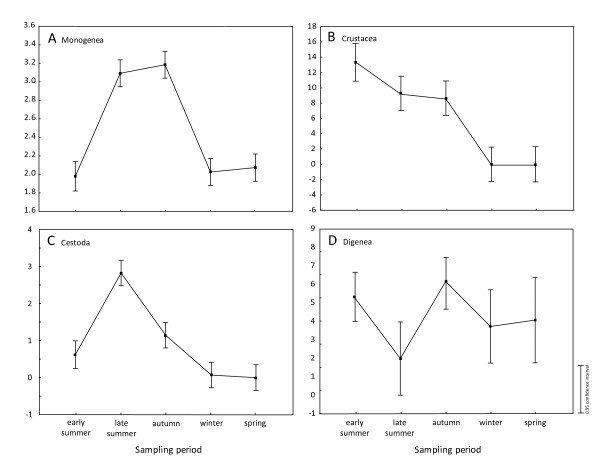
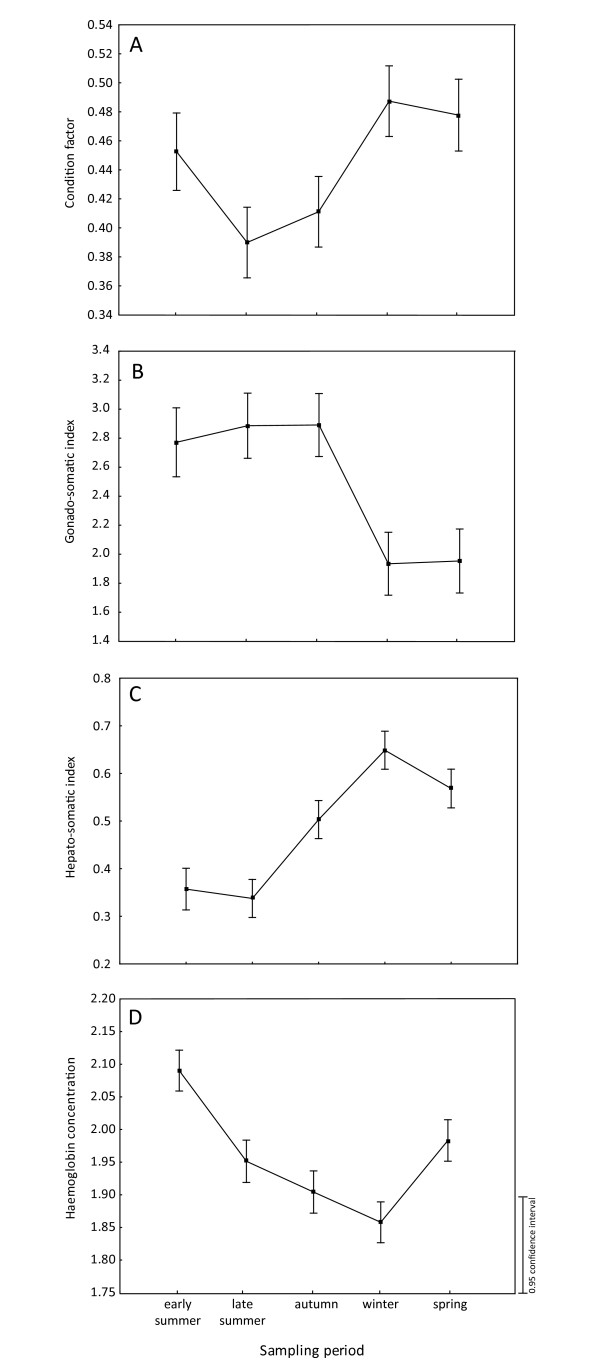
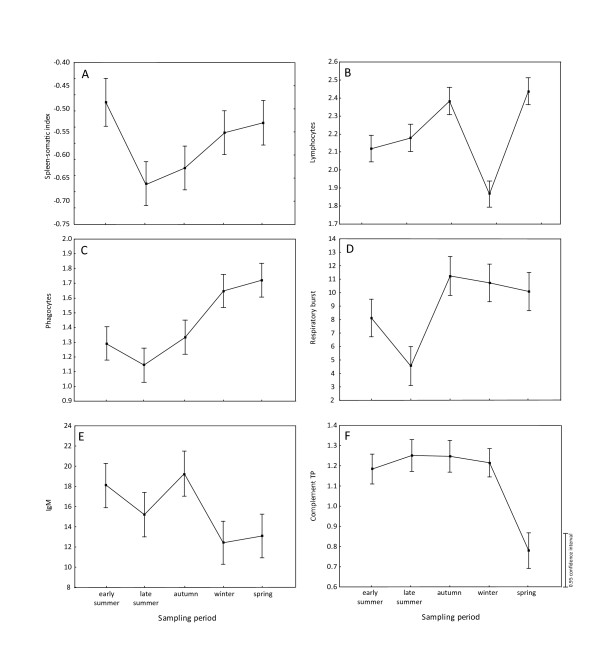
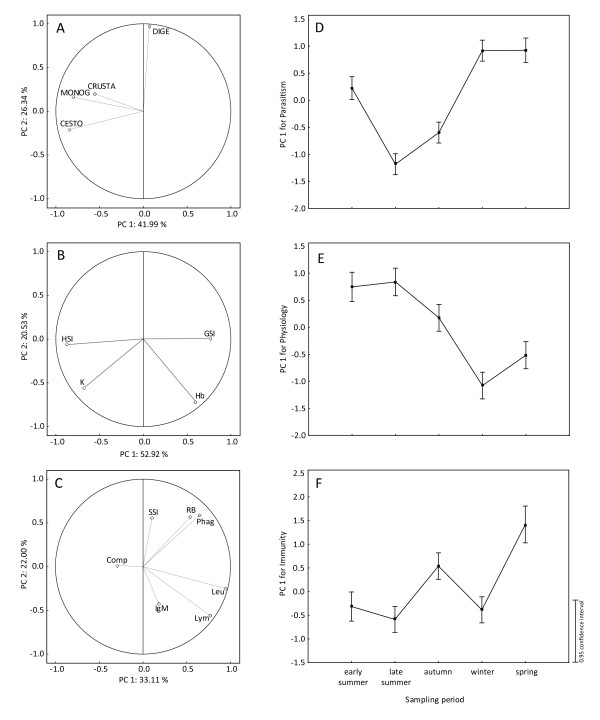
We found that seasonal changes play a key role in affecting the analyzed measurements of physiology, immunity and parasitism. The correlation analysis revealed the relationships between the measures of overall host physiology, immunity and parasite load when temporal variability effect was removed. When analyzing separately parasite groups with different life-strategies, we found that fish with a worse condition status were infected more by monogeneans, representing the most abundant parasite group. The high infection by cestodes seems to activate the phagocytes. A weak relationship was found between spleen size and abundance of trematodes when taking into account seasonal changes.
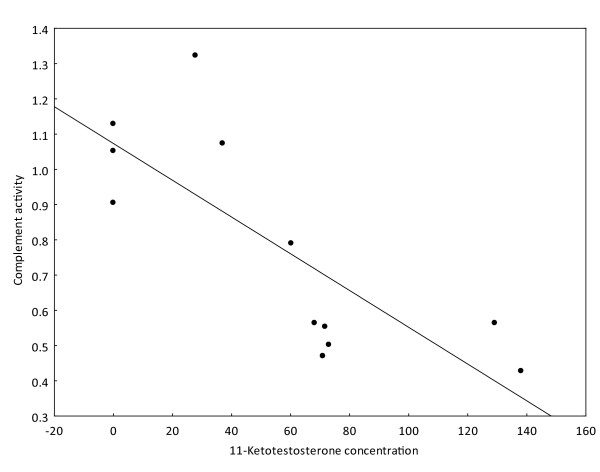
Even if no direct trade-off between the measures of host immunity and physiology was confirmed when taking into account the seasonality, it seems that seasonal variability affects host immunity and physiology through energy allocation in a trade-off between life important functions, especially reproduction and fish condition. Host immunity measures were not found to be in a trade-off with the investigated physiological traits or functions, but we confirmed the immunosuppressive role of 11-ketotestosterone on fish immunity measured by complement activity. We suggest that the different parasite life-strategies influence different aspects of host physiology and activate the different immunity pathways.
免疫系统的基本功能是保护生物体免受感染,以将被感染的适应成本降至最低。根据生活史理论,能量资源在免疫的高代价需求和其他生理需求之间存在权衡。就鱼类而言,生理和免疫都受到与非生物因素(如主要是水温)变化相关的季节性变化(即时间变化)以及与病原体和寄生虫相互作用的影响。在这项研究中,我们调查了在给定一年的五个不同时期采集的鲤鱼(Cyprinus carpio)的生理学和免疫能力之间的潜在关联。我们的采样包括具有时间可变性的时期,因此,它具有不同水平的寄生虫暴露。我们分析了季节性或寄生虫感染这两个因素中,哪个因素对鱼类生理学和免疫的变化影响更大。
我们发现季节性变化在影响分析中的生理学、免疫和寄生虫感染测量方面起着关键作用。相关性分析揭示了在去除时间可变性影响时,宿主整体生理学、免疫和寄生虫负荷测量之间的关系。当分别分析具有不同生活策略的寄生虫群时,我们发现状况较差的鱼类受到更多单殖吸虫的感染,单殖吸虫是最丰富的寄生虫群。绦虫的高感染似乎激活了吞噬细胞。当考虑季节性变化时,在考虑到季节性变化时,脾脏大小与吸虫丰度之间发现了微弱的关系。
即使在考虑季节性变化时,宿主免疫和生理学测量之间没有直接的权衡关系,但季节性变化似乎通过在重要生命功能(特别是繁殖和鱼类状况)之间的能量分配来影响宿主免疫和生理学。宿主免疫措施与所研究的生理特征或功能之间没有权衡关系,但我们证实了 11-酮睾酮对通过补体活性测量的鱼类免疫的免疫抑制作用。我们认为,不同寄生虫的生活策略会影响宿主生理学的不同方面,并激活不同的免疫途径。