University of Southern California, Los Angeles, California, USA.
Environ Health Perspect. 2011 Oct;119(10):1472-7. doi: 10.1289/ehp.1103516. Epub 2011 Jun 27.
The fractional concentration of nitric oxide in exhaled air (FeNO) potentially detects airway inflammation related to air pollution exposure. Existing studies have not yet provided conclusive evidence on the association of FeNO with traffic-related pollution (TRP).
We evaluated the association of FeNO with residential TRP exposure in a large cohort of children.
We related FeNO measured on 2,143 children (ages 7-11 years) who participated in the Southern California Children's Health Study (CHS) to five classes of metrics of residential TRP: distances to freeways and major roads; length of all and local roads within circular buffers around the home; traffic densities within buffers; annual average line source dispersion modeled nitrogen oxides (NOx) from freeways and nonfreeway roads; and predicted annual average nitrogen oxide, nitrogen dioxide, and NOx from a model based on intracommunity sampling in the CHS.
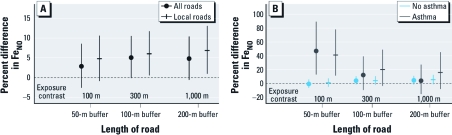
In children with asthma, length of roads was positively associated with FeNO, with stronger associations in smaller buffers [46.7%; 95% confidence interval (CI), 14.3-88.4], 12.4% (95% CI, -8.8 to 38.4), and 4.1% (95% CI, -14.6 to 26.8) higher FeNO for 100-, 300-, and 1,000-m increases in the length of all roads in 50-, 100-, and 200-m buffers, respectively. Other TRP metrics were not significantly associated with FeNO, even though the study design was powered to detect exposures explaining as little as 0.4% of the variation in natural log-transformed FeNO (R2 = 0.004).
Length of road was the only indicator of residential TRP exposure associated with airway inflammation in children with asthma, as measured by FeNO.
呼气中一氧化氮的分数浓度(FeNO)可能可以检测到与空气污染暴露相关的气道炎症。现有研究尚未提供确凿证据表明 FeNO 与交通相关污染(TRP)有关。
我们评估了大量儿童中 FeNO 与住宅 TRP 暴露的相关性。
我们将参加南加州儿童健康研究(CHS)的 2143 名(7-11 岁)儿童的 FeNO 测量值与住宅 TRP 的五类指标相关联:与高速公路和主要道路的距离;家周围圆形缓冲区内部的所有道路和当地道路的长度;缓冲区内部的交通密度;基于高速公路和非高速公路的线源扩散模型氮氧化物(NOx)的年度平均线源;以及基于 CHS 社区内采样的模型预测的年度平均氮氧化物、二氧化氮和 NOx。
在患有哮喘的儿童中,道路长度与 FeNO 呈正相关,在较小的缓冲区中相关性更强[46.7%;95%置信区间(CI),14.3-88.4],12.4%(95% CI,-8.8 至 38.4)和 4.1%(95% CI,-14.6 至 26.8),分别在 50m、100m 和 200m 缓冲区中,所有道路长度增加 100m、300m 和 1000m,FeNO 分别增加 100m、300m 和 1000m。其他 TRP 指标与 FeNO 没有显著相关性,尽管研究设计旨在检测仅解释自然对数变换 FeNO 变异的 0.4%(R2 = 0.004)的暴露。
在患有哮喘的儿童中,作为气道炎症的测量指标,道路长度是唯一与住宅 TRP 暴露相关的指标。