Scuola Superiore Sant'Anna, Piazza Martiri della Libertà, 33 - 56127 Pisa, Italy.
BMC Neurol. 2011 Jun 28;11:80. doi: 10.1186/1471-2377-11-80.
Rehabilitation for children with hemiplegic cerebral palsy (HCP) aimed to improve function of the impaired upper limb (UL) uses a wide range of intervention programs. A new rehabilitative approach, called Action-Observation Therapy, based on the recent discovery of mirror neurons, has been used in adult stroke but not in children. The purpose of the present study is to design a randomised controlled trial (RCT) for evaluating the efficacy of Action-Observation Therapy in improving UL activity in children with HCP.
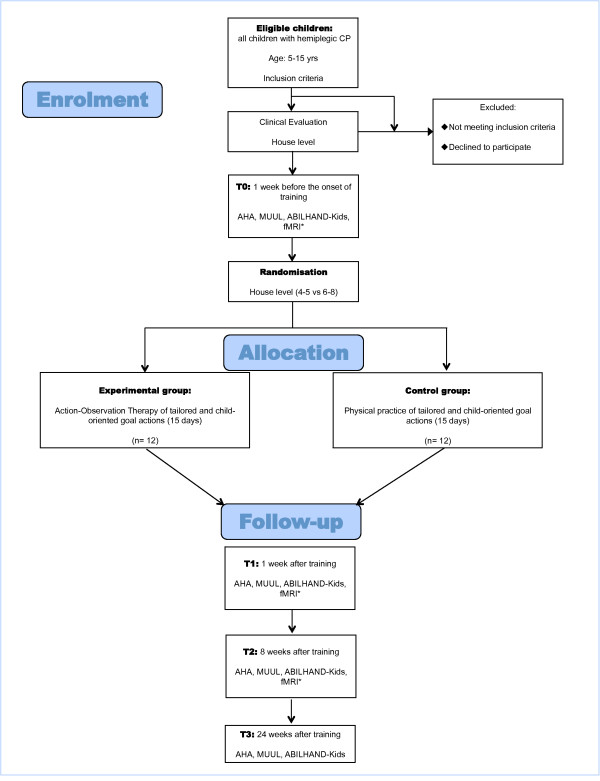
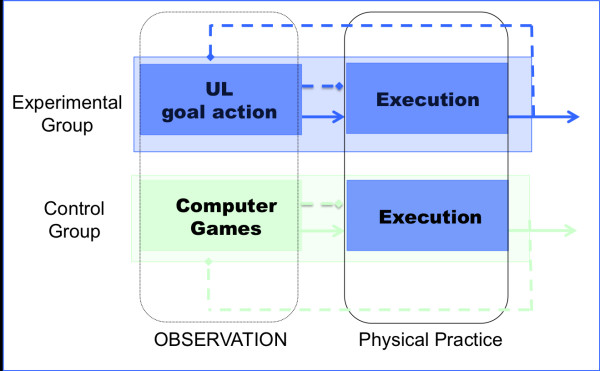
METHODS/DESIGN: The trial is designed according to CONSORT Statement. It is a randomised, evaluator-blinded, match-pair group trial. Children with HCP will be randomised within pairs to either experimental or control group. The experimental group will perform an Action-Observation Therapy, called UP-CAT (Upper Limb-Children Action-Observation Training) in which they will watch video sequences showing goal-directed actions, chosen according to children UL functional level, combined with motor training with their hemiplegic UL. The control group will perform the same tailored actions after watching computer games. A careful revision of psychometric properties of UL outcome measures for children with hemiplegia was performed. Assisting Hand Assessment was chosen as primary measure and, based on its calculation power, a sample size of 12 matched pairs was established. Moreover, Melbourne and ABILHAND-Kids were included as secondary measures. The time line of assessments will be T0 (in the week preceding the onset of the treatment), T1 and T2 (in the week after the end of the treatment and 8 weeks later, respectively). A further assessment will be performed at T3 (24 weeks after T1), to evaluate the retention of effects. In a subgroup of children enrolled in both groups functional Magnetic Resonance Imaging, exploring the mirror system and sensory-motor function, will be performed at T0, T1 and T2.
The paper aims to describe the methodology of a RCT for evaluating the efficacy of Action-Observation Therapy in improving UL activity in children with hemiplegia. This study will be the first to test this new type of treatment in childhood. The paper presents the theoretical background, study hypotheses, outcome measures and trial methodology.
NCT01016496.
旨在改善偏瘫脑瘫(HCP)患儿上肢(UL)功能的康复治疗采用了广泛的干预方案。一种新的康复方法,称为动作观察疗法,基于最近发现的镜像神经元,已在成人中风中使用,但未在儿童中使用。本研究的目的是设计一项随机对照试验(RCT),以评估动作观察疗法对改善 HCP 儿童 UL 活动的疗效。
方法/设计:试验根据 CONSORT 声明设计。这是一项随机、评估者盲法、配对组试验。HCP 患儿将在配对内随机分为实验组或对照组。实验组将进行动作观察疗法,称为 UP-CAT(上肢-儿童动作观察训练),他们将观看根据 UL 功能水平选择的目标导向动作的视频序列,同时结合偏瘫 UL 的运动训练。对照组将在观看电脑游戏后进行相同的定制动作。对偏瘫儿童 UL 结果测量的心理测量特性进行了仔细审查。辅助手评估被选为主要测量指标,并根据其计算能力,确定了 12 对匹配的样本量。此外,还包括墨尔本和 ABILHAND-Kids 作为次要措施。评估时间线将为 T0(在治疗开始前的一周)、T1 和 T2(分别在治疗结束后的一周和 8 周后)。T3(T1 后 24 周)将进行进一步评估,以评估效果的保留情况。在两组中招募的儿童亚组中,将在 T0、T1 和 T2 时进行功能磁共振成像,以探索镜像系统和感觉运动功能。
本文旨在描述一项 RCT 的方法,以评估动作观察疗法对改善偏瘫儿童 UL 活动的疗效。这项研究将是首次在儿童中测试这种新型治疗方法。本文介绍了理论背景、研究假设、结果测量和试验方法。
NCT01016496。