Simon-Martinez Cristina, Mailleux Lisa, Ortibus Els, Fehrenbach Anna, Sgandurra Giuseppina, Cioni Giovanni, Desloovere Kaat, Wenderoth Nicole, Demaerel Philippe, Sunaert Stefan, Molenaers Guy, Feys Hilde, Klingels Katrijn
Department of Rehabilitation Sciences, KU Leuven - University of Leuven, Leuven, Belgium.
Department of Development and Regeneration, KU Leuven - University of Leuven, Leuven, Belgium.
BMC Pediatr. 2018 Jul 31;18(1):250. doi: 10.1186/s12887-018-1228-2.
Upper limb (UL) deficits in children with unilateral cerebral palsy (uCP) have traditionally been targeted with motor execution treatment models, such as modified Constraint-Induced Movement Therapy (mCIMT). However, new approaches based on a neurophysiological model such as Action-Observation Training (AOT) may provide new opportunities for enhanced motor learning. The aim of this study is to describe a randomised controlled trial (RCT) protocol investigating the effects of an intensive treatment model, combining mCIMT and AOT compared to mCIMT alone on UL function in children with uCP. Additionally, the role of neurological factors as potential biomarkers of treatment response will be analysed.
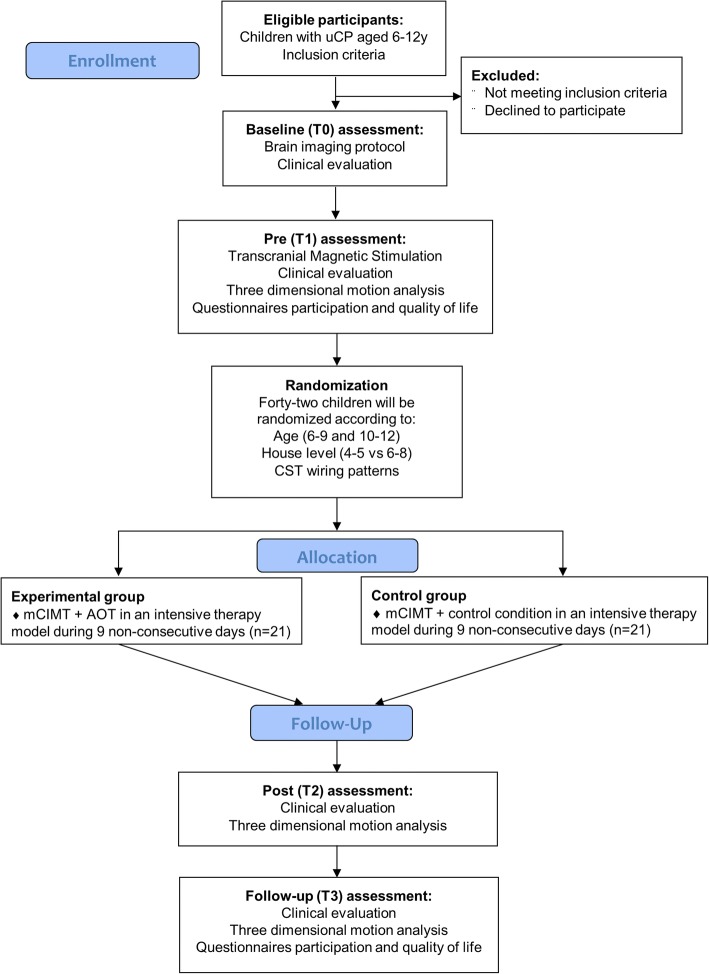
An evaluator-blinded RCT will be conducted in 42 children aged between 6 and 12 years. Before randomization, children will be stratified according to their House Functional Classification Scale, age and type of corticospinal tract wiring. A 2-week day-camp will be set up in which children receive intensive mCIMT therapy for 6 hours a day on 9 out of 11 consecutive days (54 h) including AOT or control condition (15 h). During AOT, these children watch video sequences showing goal-directed actions and subsequently execute the observed actions with the more impaired UL. The control group performs the same actions after watching computer games without human motion. The primary outcome measure will be the Assisting Hand Assessment. Secondary outcomes comprise clinical assessments across body function, activity and participation level of the International Classification of Function, Disability and Health. Furthermore, to quantitatively evaluate UL movement patterns, a three-dimensional motion analysis will be conducted. UL function will be assessed at baseline, immediately before and after intervention and at 6 months follow up. Brain imaging comprising structural and functional connectivity measures as well as Transcranial Magnetic Stimulation (TMS) to evaluate corticospinal tract wiring will be acquired before the intervention.
This paper describes the methodology of an RCT with two main objectives: (1) to evaluate the added value of AOT to mCIMT on UL outcome in children with uCP and (2) to investigate the role of neurological factors as potential biomarkers of treatment response.
NCT03256357 registered on 21st August 2017 (retrospectively registered).
传统上,针对单侧脑瘫(uCP)儿童的上肢(UL)功能缺陷采用运动执行治疗模式,如改良的强制性使用运动疗法(mCIMT)。然而,基于神经生理学模型的新方法,如动作观察训练(AOT),可能为增强运动学习提供新机会。本研究的目的是描述一项随机对照试验(RCT)方案,该方案旨在研究一种强化治疗模式(将mCIMT与AOT相结合)与单独使用mCIMT相比,对uCP儿童UL功能的影响。此外,还将分析神经学因素作为治疗反应潜在生物标志物的作用。
将对42名年龄在6至12岁之间的儿童进行评估者盲法RCT。在随机分组前,将根据儿童的豪斯功能分类量表、年龄和皮质脊髓束布线类型进行分层。将设立一个为期2周的日间营地,在此期间,儿童连续11天中的9天每天接受6小时的强化mCIMT治疗(共54小时),包括AOT或对照条件(15小时)。在AOT期间,这些儿童观看展示目标导向动作的视频序列,随后用受损更严重的UL执行观察到的动作。对照组在观看无人运动的电脑游戏后执行相同动作。主要结局指标将是辅助手评估。次要结局包括国际功能、残疾和健康分类中身体功能、活动和参与水平的临床评估。此外,为了定量评估UL运动模式,将进行三维运动分析。将在基线、干预前、干预后及6个月随访时评估UL功能。将在干预前获取包括结构和功能连接测量以及经颅磁刺激(TMS)以评估皮质脊髓束布线的脑成像。
本文描述了一项RCT的方法,该RCT有两个主要目标:(1)评估AOT对mCIMT在uCP儿童UL结局方面的附加价值;(2)研究神经学因素作为治疗反应潜在生物标志物的作用。
于2017年8月21日注册(追溯注册),注册号为NCT03256357