African Institute for Development Policy, Nairobi, Kenya.
J Urban Health. 2011 Jun;88 Suppl 2(Suppl 2):S185-99. doi: 10.1007/s11524-011-9595-0.
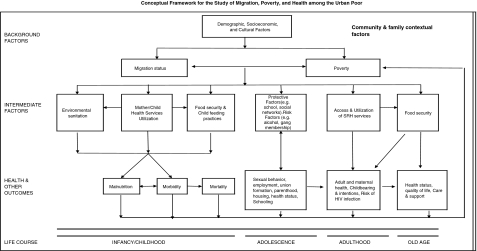
The Urbanization, Poverty, and Health Dynamics research program was designed to generate and provide the evidence base that would help governments, development partners, and other stakeholders understand how the urban slum context affects health outcomes in order to stimulate policy and action for uplifting the wellbeing of slum residents. The program was nested into the Nairobi Urban Health and Demographic Surveillance System, a uniquely rich longitudinal research platform, set up in Korogocho and Viwandani slum settlements in Nairobi city, Kenya. Findings provide rich insights on the context in which slum dwellers live and how poverty and migration status interacts with health issues over the life course. Contrary to popular opinions and beliefs that see slums as homogenous residential entities, the findings paint a picture of a highly dynamic and heterogeneous setting. While slum populations are highly mobile, about half of the population comprises relatively well doing long-term dwellers who have lived in slum settlements for over 10 years. The poor health outcomes that slum residents exhibit at all stages of the life course are rooted in three key characteristics of slum settlements: poor environmental conditions and infrastructure; limited access to services due to lack of income to pay for treatment and preventive services; and reliance on poor quality and mostly informal and unregulated health services that are not well suited to meeting the unique realities and health needs of slum dwellers. Consequently, policies and programs aimed at improving the wellbeing of slum dwellers should address comprehensively the underlying structural, economic, behavioral, and service-oriented barriers to good health and productive lives among slum residents.
城市化、贫困与健康动态研究方案旨在提供相关证据基础,帮助各国政府、发展伙伴和其他利益攸关方了解城市贫民窟环境如何影响健康结果,以便推动政策和行动,改善贫民窟居民的福祉。该方案被嵌套到内罗毕城市健康和人口监测系统中,该系统是一个独特的丰富纵向研究平台,建在肯尼亚内罗毕市的科罗戈乔和维万达尼贫民窟。研究结果提供了有关贫民窟居民生活环境的丰富见解,以及贫困和移民状况如何在整个生命过程中与健康问题相互作用。与将贫民窟视为同质居住实体的普遍观点和看法相反,研究结果描绘了一个高度动态和异质的环境。虽然贫民窟人口流动性很强,但约一半的人口是相对表现良好的长期居民,他们已经在贫民窟居住了 10 年以上。贫民窟居民在生命各个阶段表现出的不良健康结果,源于贫民窟的三个关键特征:恶劣的环境条件和基础设施;由于缺乏支付治疗和预防服务费用的收入,服务获取受到限制;以及依赖质量差、主要是非正规和不受监管的卫生服务,这些服务不太适合满足贫民窟居民的独特现实和健康需求。因此,旨在改善贫民窟居民福祉的政策和方案应全面解决导致贫民窟居民健康状况不佳和无法过上富有成效生活的结构性、经济、行为和面向服务的障碍。